

AI, data centers among topics addressed at W&J energy conference
 Courtesy of W&J College
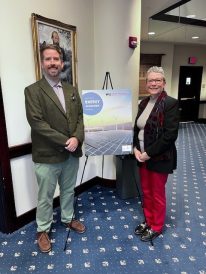
The atmosphere inside Washington & Jefferson College’s Burnett Center was electric on Tuesday during the Pennsylvania Energy Ecosystem Conference.
The ever-evolving energy industry was the focus of a five-hour event at Yost Auditorium, presented by the college’s Center for Energy Policy & Management. There were 10 live speakers, plus a state employee who spoke via video because of the state budget impasse.
This was the fourth year in a row that CEPM organized an in-person conference on emerging energy topics.
There were topics galore Tuesday, ranging from political shifts, to rapidly rising energy demands to accommodate expansion of data centers and artificial intelligence, and to the state striving to position itself to be a net exporter that can benefit economically.
Energy demands are a major concern, especially in this region and much of the nation’s northeast, where PJM Interconnection, the transmission grid for 13 states and the District of Columbia, is increasingly threatened with being stressed.
“There are concerns about power outages by 2030 if energy production lags,” said Gary Steinbauer, environmental attorney for Babst/Calland.
“We need backup sources to stay online and run 24/7 without interruption,” said Kevin Sunday, a consultant for energy, technology, infrastructure, and manufacturing policy with McNees Government Relations.
“Things have changed a lot,” Corey Young, director of CEPM, said while opening the program Tuesday morning. He was referring partly to shifts in federal policy and at the state level. Pennsylvania and the nation are in the midst of budget impasses.
Young introduced Adam Walters, senior energy adviser for the state Department of Community and Economic Development, as the opening speaker. Walters said on tape that DCED has listed five priority sectors based on its Economic Development Strategy for the state, and that energy is prominent among them. The others are agriculture, life sciences, manufacturing, and robotics and technology.
“Pennsylvania has abundant energy resources,” Walters said, as he posted a graphic declaring the state to be the second-largest energy exporter of natural gas in the nation, second in nuclear power-generation and having the third-largest power generation fleet.
Walters added, however, that a rollback in federal funding puts energy jobs and investments at risk.
He also discussed the development of AI campuses in the state and the repurposing of coal-fired power plants in Shippingport, Beaver County, and Homer City.
Steinbauer spoke about environmental regulations, which he said “can slow down projects. “De-emphasizing a climate change-based regulation is a shift from (former president Joe) Biden. Coal and gas-fired sources are favored by this administration.”
August Seibel, director of risk management for Liberty Power Innovations, profiled the Fort Cherry Powered Land Opportunity in the Fort Cherry Development District in western Washington County. He said Liberty and Range Resources are “supporting the development of a state-of-the-art power generation facility there.
Despite its tarnished reputation, coal remains a viable energy source, said Matt Mackowiak, director of government Affairs for Core Natural Resources, based at Southpointe. “Coal is in the mix and coal is in the future,” he said.
Core, formed in January via a merger of CONSOL Energy and Arch Resources, mines thermal and metallurgical coal, which he said is high quality. The company’s Pennsylvania Mining Complex – consisting of the Bailey, Enlow Fork and Harvey mines – exports 26 million tons of products, Mackowiak said.
Coal, he added, provides 35% of the global energy supply – the largest of any source.
Jacquie Fidler, another CORE official, discussed the company’s project to design a 21st century power plant up to 350 megawatts. “We wanted it to be in Western Pennsylvania, near our corporate offices.”
Fidler, vice president of environmental and sustainability, was speaking at her alma mater.
Two Washington County natives – Kristin Carter and Kimberly Price – also spoke from the podium.
“I graduated from high school in 2009, when we were in an economic crisis,” said Price, director of corporate adventures affairs for Pittsburgh-based EQT Corp., the nation’s leading natural gas producer. “Friends were getting jobs in the natural gas industry and opportunities abounded. It was a success.
“Now with AI and the need for data centers, the nation has another moment. Seeing AI and data centers, the need for power is changing. More natural gas has to be used here. This is Appalachia’s moment,” said Price, a W&J graduate.
Carter, a graduate of old Immaculate Conception High in Washington and a Canonsburg resident, is an assistant state geologist who has been with the Pennsylvania Geological Survey since 2001.
She has a boatload of experience in the Marcellus Shale, which is appropriate as her offices are along the Allegheny River in Pittsburgh.
Carter also is a subsurface specialist who addressed underground storage of natural gas. Sequestration is a process entailing capturing and storing carbon dioxide emissions underground that can be used later.
“The Appalachia Basin is like a large bathtub,” Carter said. “It’s 250 million to 540 million years old.
According to a handout available at the conference, “Class VI wells are used for the injection of CO2 into underground subsurface rock formations for long- term storage or geologic sequestration.”
Another geologist, Amanda Veazey, addressed the thorny issue of legacy and orphan oil and gas wells, some of which release emissions. A number of them were drilled when regulations were lax or nonexistent into the 1940s.
Plugging of wells has been haphazard, and identifying these wells is challenging. Some are holes in an open field.
Veazey said there are an estimated three million-plus legacy wells, ones that were often abandoned decades ago, in the United States.