

If the glove fits, cover your mouth
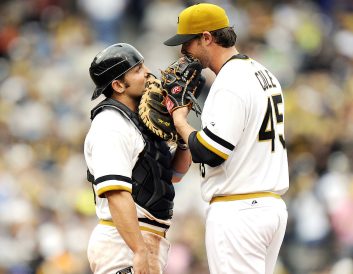
My wife thinks I’ve been watching too much baseball and softball.
Perhaps she’s right.
Last weekend, she wanted to go over some details of our upcoming vacation.
“Have you made the hotel reservations?” she asked.
I put my baseball glove on, covered my mouth with the Wilson A-2000 that I purchased decades ago when I was still in high school, and whispered something that, according to her, sounded like Charlie Brown’s teacher was talking.
“Put that smelly glove down,” she demanded. “Why are you walking around the house talking into that dirty old thing?”
I told her that I didn’t want the neighbors to hear our plans.
“They recently moved into the neighborhood and they might be lip reading,” I said. “You never know what they could be picking up by watching our conversations. I was thinking about purchasing a catcher’s mask for one of us to wear while we’re talking. You can never be too careful.”
It was then that I started spitting and scratching.
“That’s it,” she said. “No more baseball. You need to dial it back. Maybe go cold turkey.”
I tried to explain that lip reading has become so prevalent in baseball that opposing players and coaches can tell what is being whispered 150 feet away. Some of baseball’s greatest secrets are being stolen during conversations on the pitcher’s mound. That’s why the game’s new code of conduct is talk to the glove.
It’s not just the major leaguers who are doing this. It has trickled down the high school ranks. If you ask the players why they do this, they’ll probably say they have no idea but they’ve seen A.J. Burnett and Russell Martin do it on television. They’re just imitating what they see.
And even girls softball players are covering the mouth to make sure what is said in the pitcher’s circle remains in the circle. This spring, I saw many softball catchers and pitchers – each wears a mask these days – covering their masks with gloves while talking during the middle of an inning. I guess girls can lip read as well as boys.
You see this happen in every game. The catcher walks to the mound to talk to a struggling pitcher. Sometimes they are joined by a few infielders and either the manager or a coach. They begin talking with their gloves in front of their faces.
The first time you see this, you’ll think, “Which one of those guys had onions for lunch?” Then you say, “Can’t the team afford to provide breath mints for its players?”
I used to think conversations on the mound were rather predictable. The catcher usually would start by saying “Throw the damn ball over the plate for a change,” or “Don’t be afraid to mix things up and throw a strike.”
Sometimes these conversations do veer away from baseball, like the wedding present/candlesticks scene from “Bull Durham.” Jeff Isom, who was the Wild Things’ original manager and now holds the same job with the Frontier League’s Lake Erie Crushers, recently reminded me about one Washington game that was televised by what is now Root Sports. He remembered that Washington’s catcher, pitcher and pitching coach Kent Tekulve were on the mound having a conversation during a close game. The catcher, trying to get the struggling pitcher to relax, asked if he had spotted a particularly attractive female who was sitting in the boxseats. This was picked up by the microphone Tekulve was wearing and went out over the telecast.
These days, I’m assuming, everyone in the dugouts would know what the catcher said. That’s because modern baseball players must be master lip readers. Why else do they talk into their gloves?
The Pirates had two first-round draft picks last month for the first time in their history and used them to select an outfielder and a catcher. They might have been better served drafting a lip reader, one who knows English, Spanish and Japanese. It must be an important position if players are going to such lengths just to hold a 15-second conversation. You can build a winning team with good starting pitching, solid defense up the middle and an experienced lip reader.
This is, of course, all paranoia. Only in baseball does this kind of silliness make perfect sense. And it will continue to be a useless tactic until a team decides to plant an electronic audio bugging device in the pitching rubber.
That might happen next week.
Sports editor Chris Dugan can be reached at dugan@observer-reporter.com.