

The flying man: August 1896-May 1899
The story so far: Wilbur and Orville Wright run a bicycle shop in Dayton, Ohio. The work suits their mechanical skills, but Wilbur wonders about what else he might do in life. The answer will come from an unlikely direction.
Chapter Three
Wilbur and Orville first came across “the flying man” in 1890, years before they opened the bicycle shop. Orville spotted an article about him in a news-service report while working on The Evening Item, the neighborhood paper that the brothers published. Watching Orville read the report, Wilbur recognized a certain gleam in his brother’s eyes and a certain smile beneath his bushy red mustache. Orv could be painfully shy around strangers, but around the family, his playfulness showed. “We have to do something with this,” Orv told Wilbur.
“Let’s see what you’ve got.”
Orville handed Wilbur the report. It described a burly German with a ragged red beard, a man who was interested in flight. He was interested, and then some. This strange man, Otto Lilienthal, was building wings. It was hard to resist having a little fun with that. The brothers ran an article on him, making him into a small joke. They titled it “Needs More Wings.”
Most readers of The Evening Item laughed along with Orville and Wilbur. The common opinion then was that men interested in flight were fools, cranks in makeshift wings leaping off barns and breaking arms.
But Otto Lilienthal defied that idea. The more Orville and Wilbur learned about him, the more they realized that. Lilienthal was a trained engineer and a serious student of aeronautics. He had written a book on how birds fly. He built his wings after careful study and consideration. And the most impressive fact of all: his wings worked.
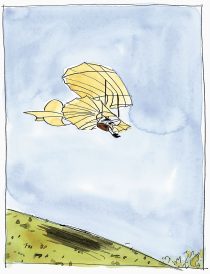
Lilienthal tested them in the Rhinow Hills, north of Berlin. They were made up of frames of split willow and bamboo, braces of heavy cord, and a covering of cotton twill. Lilienthal would put on the wings and begin to run. As the wings caught the wind, they would lighten, then tug at him, then pull him into the sky. Otto Lilienthal would glide off the hills and into the air.
By 1896 Lilienthal had swept through the sky on almost two thousand glides. He had tested machine after machine, and had made glides as long as eight hundred feet. Far from Berlin, Wilbur and Orville, by then full-time mechanics, read eagerly whenever Lilienthal’s name appeared in the papers or magazines.
Then, in August of that year, Wilbur came across an article that made him gasp. He wanted to share it with Orville immediately, but Orville was dangerously ill, bedridden and delirious with typhoid. Not until October did Orv’s fever break. Not until then could Wilbur share what he had read.
On August 9, Lilienthal had been soaring fifty feet above the earth when the air currents had shifted. Lilienthal lost control. He swung his weight from one direction to the other, trying to regain his balance, but his glider, normally a thing of strange and quiet grace, went twisting through the air. It rushed toward the earth and broke against the ground. The crowd that had come to watch him glide surged forward to pull away the torn canvas. Within the loose grip of the wreck Lilienthal managed to say, “Opfer müssen gebracht werden!” or, in English, “Sacrifices must be made!” His back had been broken. Lilienthal died in Berlin the next day.
Orville was as shocked as Wilbur had been. “It’s terrible,” he said.
The next day Wilbur pulled a book from his father’s library, a book with a chapter on how birds fly. Next he went to the Dayton Library and began reading about flight. For two years, on again then off again, he pursued his new interest. When Wilbur had read everything he could find in Dayton about flight, he wondered what to do next.
The answer came from a man named Samuel Langley. Langley was the secretary of the Smithsonian Institution, in Washington, D.C. He was testing flying models, powered by small engines.
Wilbur sat down with a piece of stationery from the bike shop and addressed it to the Smithsonian. He wrote, “I have been interested in the problem of mechanical and human flight ever since as a boy I constructed a number of bats of various sizes after the style of Cayley’s and Pénaud’s machines.” He then asked, what publications on flight could the Institution make available? What others did it recommend?
Wilbur worded his letter carefully. He remembered how silly Lilienthal’s experiments had sounded to him at first. “I am an enthusiast,” Wilbur wrote, “but not a crank in the sense that I have some pet theories as to the proper construction of a flying machine. I wish to avail myself of all that is already known and then …” And then, what? If gliding had killed Otto Lilienthal, how did Wilbur Wright think he would fare? If Samuel Pierpont Langley had the backing of the Smithsonian, what did Wilbur Wright, co-owner of a bicycle shop, think he could contribute?
Wilbur set his pen to paper again. “And then if possible add my mite to help on the future worker who will attain final success.” A mite, a very small amount. That seemed modest enough, he thought. That would do.
Only one week later, a response arrived.
The problem of flying: June 1899