

Biggest Winner: Exercising without injury
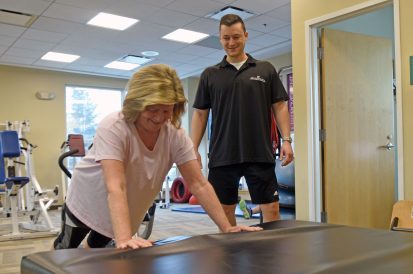
As the Biggest Winner competition progresses, the contestants are learning to make healthy lifestyle changes.
That doesn’t just mean heading to the gym or trying to cut calories. The staff at the Washington Health System Wilfred R. Cameron Wellness Center includes certified personal trainers and dietitians who are helping the competitors transform their bodies and minds through what’s called the EXOS training system. This is comprised of four pillars: mindset, nutrition, movement and recovery, and all four are equally important when trying to improve health and performance, decrease injuries and produce results.
When it comes to movement, the No. 1 goal should be to exercise without injury. After all, you can’t move if you’re in pain.
When the Biggest Winner contestants started their journey, they underwent initial testing of their fitness levels, and they will be retested at the finish to chart their improvement.
If you’re getting ready to start your own fitness program, Eric Schmalzried, exercise physiologist and personal trainer at the wellness center, advises consulting with your doctor if you have any reason to suspect you should not be exercising.
“If you have cardiovascular disease, diabetes, musculoskeletal issues or any other health conditions, there may be restrictions on the intensity or type of exercise you can do,” he said.
He also advised easing into an exercise program.
“One of the biggest issues I see with highly motivated new exercisers is they want to jump right into an advanced training program at high intensities or long durations,” said Schmalzried, “but it’s perfectly OK to start where you are. Your body needs time to adapt to the exercise stimulus. Don’t make the mistake of jumping in and overdoing it. You can only train what you can recover from. Exercise is something you commit to for the long haul, so set small goals initially and go from there.”
How can you tell what type of exercise or intensity is right for you? Trainers at the wellness center use what’s called the Functional Movement Screen and other tests to evaluate the movement quality for new clients and members.
“Tests allow the skilled trainer to identify potential issues with movement patterns (i.e. a basic squat) and prescribe exercises accordingly,” said Schmalzried. “This can be done to a great extent with individual clients. In a group program such as the Biggest Winner, even a few basic movement pattern evaluations can reveal useful information about a client’s abilities guiding exercise selection.”
Schmalzried generally starts with basic, foundational body weight movements with low risk of injury, such as squat variations – getting up and down out of a chair – or push-up variations.
“Almost any human body should be able to do these movements with modifications, if necessary,” he said. “Evaluating how well your clients are able to perform these basic movements allows you to make decisions about increasing intensity by adding external load or moving on to more advanced exercises.”
He said this is true if you are evaluating your own abilities before starting an exercise program. Start with basic body weight movements, master them, then move on to more advanced exercises.
Many of the trainers coaching Biggest Winner teams are using circuit training, which means to move from one exercise to the next instead of repeating the same exercise back-to-back. This entails short rest breaks, a variety of exercises and using different muscle groups from one exercise to the next.
“It’s fun and makes the hour session of exercise go by quickly,” said Schmalzried. “An important part of adherence to an exercise program is enjoyment, so trainers will definitely take client desires into account when planning an exercise routine, if possible.”
Starting an exercise program means you will probably have some sore muscles. But what’s normal?
“Some soreness following exercise is completely normal, expected and perhaps desirable,” said Schmalzried. “Soreness in your muscles indicates you provided sufficient stimulus to force adaptation. In fact, your body being sore means it’s actually going to have to work harder to repair the damage, burning calories in the process.”
That being said, muscle soreness should be mild to moderate.
“If you find yourself in so much pain you cannot complete normal daily activities or sleep, you overdid it and should back off a bit in your next exercise session,” he said.
Also, pain in a joint generally signifies a problem. Avoid any activity that produces pain in the affected joint and seek advice from a qualified medical professional if the pain persists.
One final point Schmalzried emphasized is finding your target heart rate when it comes to doing cardiovascular activity, such as running or walking, taking a dance or spin class or using an elliptical machine.
“I have seen individuals totally new to exercise become frightened at even a mild increase in heart rate,” he said. “Don’t worry. If your doctor hasn’t given you a restriction, you can safely increase your heart rate.”
How do you find your target heart rate? Subtract your age from 220 and that will give you quick idea of your maximum heart rate.
Schmalzried said, “Start with exercise that raises your heart rate to 60 to 75 percent of that, and you’ll be fine.”