

Service organizations, seeing drops in membership, try to find new members
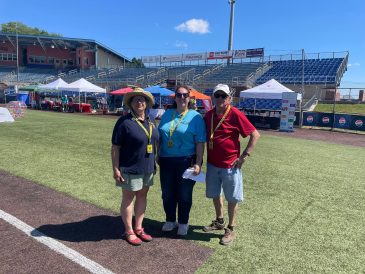 Courtesy of Washington Rotary
When Kathy Sabol was president of the Washington’s Rotary Club in 2002 and 2003, the organization counted more than 100 people as members – business owners, lawyers, doctors, some of the leading professionals in the community.
Sabol is president of Rotary again, serving another one-year term that will take her into 2025. This time, though, she is confronting a landscape that has changed considerably from what it was two decades ago. Now, membership has been sliced in half in Washington, with just 53 people taking on the mantle of “Rotarian.”
“We are striving to rebuild our numbers,” Sabol said.
Washington’s Rotary chapter is far from alone, though, when it comes to shedding members and grasping for ways to bring new recruits into the fold. Across the world, Rotary has been losing more members than it has been gaining, with about 44,000 new people signing up every year, but 51,000 departing. Stephanie Urchick, the Canonsburg resident who is president of Rotary International until next June 30, has conceded that Rotary has a “Romeo” problem – short for the perception that the organization consists of “Rich Old Men Eating Out.”
Other longstanding civic organizations have been faced with similar problems. Nationally, the Jaycees, Lions, Optimists, Civitans and Kiwanis have all confronted declining membership numbers. In fact, Washington’s Kiwanis Club will be officially folding at the end of September after lasting a little more than 100 years, simply because its membership has been reduced to about five people, all of them retirees.
“We’ve run out of people, run out of steam and run out of energy,” Wil White, the club’s secretary, said last month. When White first joined Kiwanis in 2000, he noted that there were more than 100 members.
When civic organizations first took root in communities in the early part of the 20th century, they dedicated themselves to doing good through offering scholarships, leading litter removal efforts, helping children and collecting eyeglasses. They also provided striving professionals a way to connect and network. The prominence they have had in many small towns has been highlighted by the club logos that are frequently featured on the road signs that greet people as they cross into the city limits. If you were anyone in these communities, you almost invariably had to belong to one of these groups.
However, membership in civic groups has been slowly declining for decades, and lately seems to have gathered speed. As long ago as October 1992, The New York Times was reporting on service clubs rallying “to reverse their slide.” And it’s not just service groups like the Kiwanis or Rotary that have been slumping. Parent-teacher organizations no longer attract the interest they once did, veterans groups like the Veterans of Foreign Wars and the American Legion have lost members, and church attendance has tumbled to the point where almost half of Americans say they rarely or never go to a house of worship.
Sociologists and other experts have pointed to a number of factors for this, including greater mobility and roots in communities that are not as deep, and even the fact that we often consume entertainment in solitary settings, such as when we watch television or play games on smartphones. When it comes to civic organizations, some experts have pointed to the hectic schedules that many younger professionals now maintain, and the networking opportunities that once made membership in civic organizations so enticing can now be accomplished by signing onto Linkedin or friending someone on Facebook.
Irene Fiala, a sociology professor at PennWest University’s Edinboro campus, explained that now people often do not work in the communities where they live. The rise of remote work in the wake of the COVID-19 pandemic has led to “a loosening of social ties,” she said.
She also points to “a cultural shift” that has seen people moving away from formal organizations, and the dues and obligations that are attached to them. Instead, they are picking and choosing what causes and endeavors they want to volunteer for.
“People have more options when it comes to joining organizations and groups,” Fiala said.
For better or worse, those who have maintained their memberships in civic organizations tend to be older. Eleanor Chapman, secretary of the Waynesburg Lions Club, believes “the new generation isn’t interested in service.”
Vicki Furmanek, the president of Washington’s Lions Club, pointed out that she is in her 60s and she is one of the younger members of the group.
“Most of us are retired,” Furmanek said. “We need more young people.”
It’s much the same story for the Kiwanis in Uniontown. Ashley Perez, the group’s president, explained that there are about eight really active members for their activities through the year, which include gathering coats for kids in the wintertime and bell-ringing at Christmas for the Salvation Army.
“We’ve really struggled,” Perez said. “We’re trying to do different things to bring different people. If we could grow a bit, we could do more.”
Urchick first joined the Rotary club in McMurray in 1991. In a recent interview that appears on the Rotary International website, Urchick said Rotary’s falling membership numbers should lead some local Rotary clubs to take a look at what they are offering and changes they could make to increase interest. She explained that “some people are not finding value in their club experience. They’re not really leaving Rotary; they’re leaving a Rotary club. We need to get clubs to examine what’s happening.”
In Washington, Sabol believes that COVID-19 “was a big factor” in the decline in the Rotary club’s membership, but some of the other factors were the result of a format dictated by Rotary International. The club’s dues were “very high,” Sabol acknowledged, coming in at about $1,000 per year, and members were held to a rigid schedule of meeting attendance – they had to be at 75% of the organization’s weekly meetings over the course of a year in order to keep their membership current. Following new directives from Rotary International, the meeting schedule has now been whittled down to twice per month, with a “brown bag” lunch approach. Happy hour events have been instituted and the annual cost of membership has dropped to $360.
“Membership is picking back up,” Sabol said, adding that she hopes to add one new member per month.
And as she leads Rotary again, what does she tell people about why they should perhaps be that one new member?
“It’s a great way to network with a wide range of people from different backgrounds, different professional backgrounds and get involved in the community,” Sabol said.