

Finding faith: Younger generations find God in traditional worship

Tradition is trending.
Nationally and locally, a younger generation is skipping brunch to spend Sunday morning inside Catholic and Orthodox Christian churches.
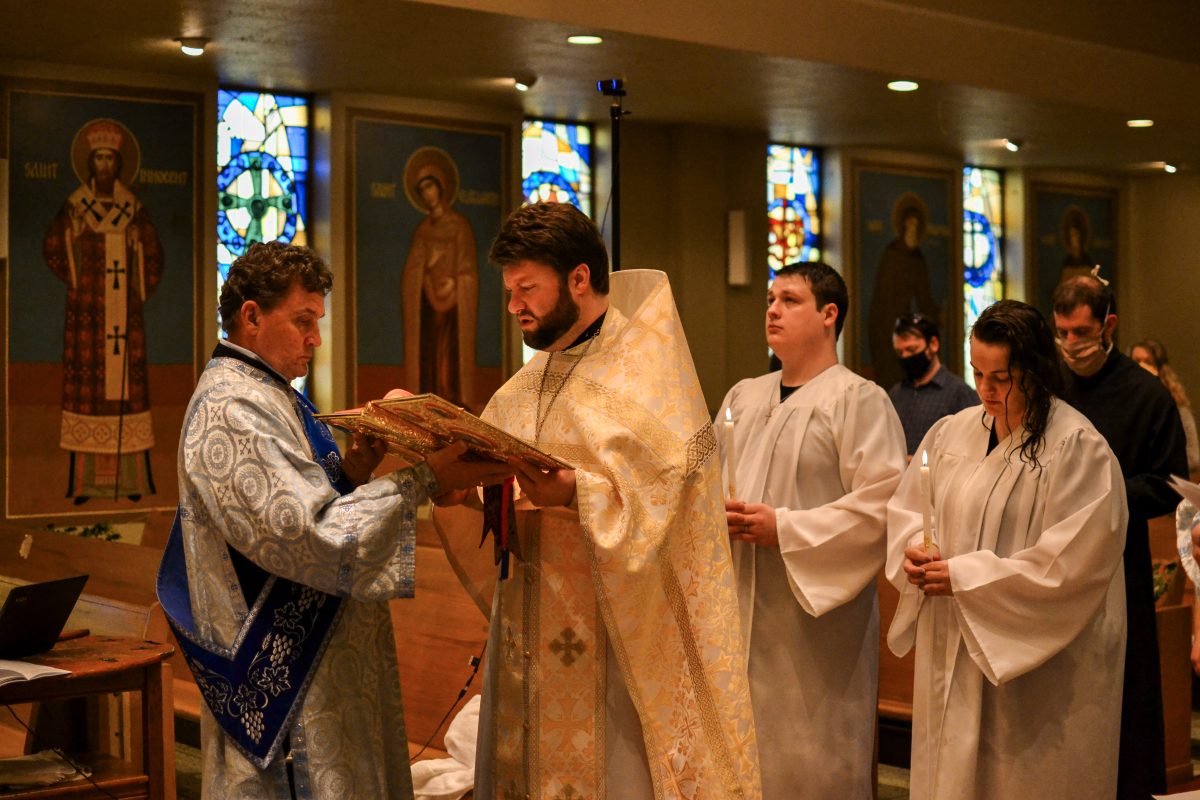
“When me and my wife started attending (the Orthodox church), we were in our mid-20s. It was a lot of legacy families. It was kind of your standard Pittsburgh parish situation: It had seen better days and, over the decades, declined significantly,” said Daniel Thacker, who, together with his wife, Emily, was baptized into the Orthodox faith at St. John the Baptist Orthodox Church in Canonsburg in 2020.
“These days, we have several catechumens who are seniors in high school. We have people who are coming as teenagers. People keep having kids. There’s a lot more crying in the services, thank God. It was never a parish that felt completely dead, but it has sort of been given new life.”
The parish has grown exponentially in the past five years; currently, there are currently 27 catechumens (people converting to Orthodoxy) and inquiries all Gen X and younger, according to the Rev. John Kotalik, who presides over St. John the Baptist. That growth is in line with national trends. While the Orthodox Church operates under several jurisdictions, including the Orthodox Church of America and the Ukrainian Orthodox Church of America, a survey of Orthodox parishes nationwide saw a 78% increase in converts in 2022 compared with pre-pandemic levels reported in 2019.
Statistics confirm there has been a shift away from Sunday services that feel megachurch-light toward more reflective, traditional worship. Along with the influx of Orthodox converts, according to the 2023 Cooperative Election Study by Harvard, the number of Millennials and Gen Zers identifying as Catholic rose between 2022 and 2023, from 16 to 20% for Millennials and from 15 to 21% for Gen Zers.
The reasons for becoming Catholic or Orthodox are as diverse as those converting. Some newly converted fell away from the faith and are returning; others have converted from different Christian denominations; and still others recently found faith.
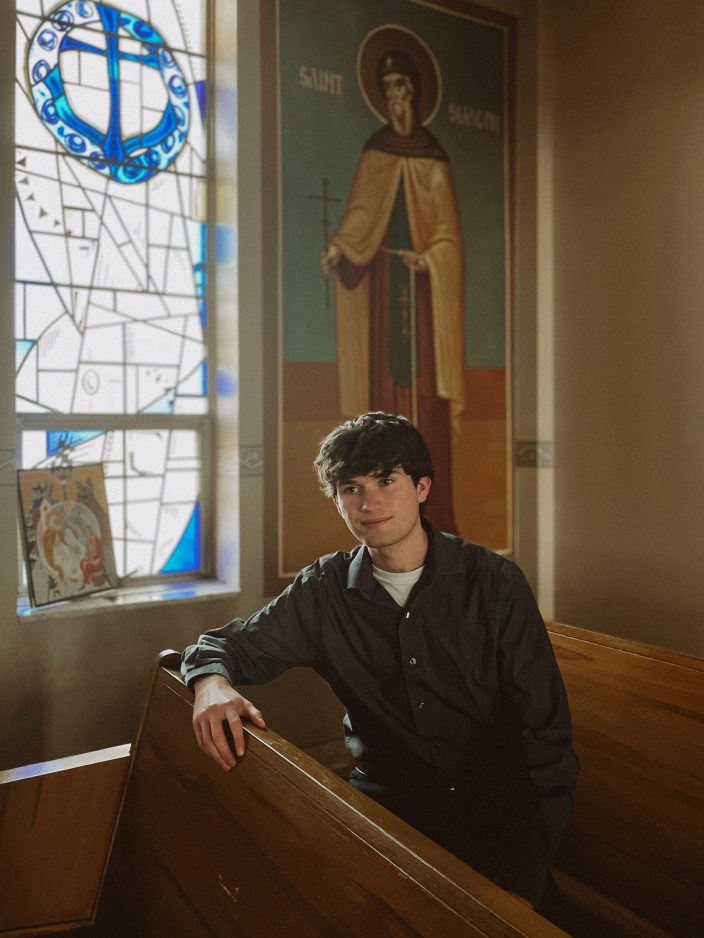
“You just go on social media, you just see all this, for lack of a better word, degeneracy, and you’re like, this isn’t right. We’re living in a wrong manner,” said Mason Kengor, a senior at Trinity High School who walked through the doors of St. John the Baptist on Jan. 1, and hasn’t stopped attending divine liturgy since.
Sometime last year, Kengor, of Washington, who stopped attending church as a teen, decided it was time to return. He tried out various denominations at churches throughout the area, but “Everyone had their own opinion,” he said. “There was no connection to God. I kind of doubted he was real.”
Kengor had ties to a more ancient faith: his great-grandparents were Serbian Orthodox Christians, and some family members practiced Catholicism. Around Thanksgiving of last year, the Gen Zer started researching both Orthodoxy and Catholicism, and the former appealed to him.
Divine Liturgy is an experience difficult to put into words. Typically, services last about 90 minutes, much of that is spent standing (for those able), and the liturgy is often, at least partly, delivered in that Orthodox church’s native language. The church walls are decorated ornately, glowing with candlelight, and the sanctuary smells of incense. Kengor’s first Divine Liturgy moved him.
“It’s definitely something I’ve never felt anywhere else. It’s inexplicable,” Kengor said. “Now, I have almost, I want to say 100, but 99.9% perception that God’s real.”
Emily-Kate St. Sinclair and her husband, Jacob, considered themselves believers and religiously attended a local nondenominational church, but were inspired to look into Orthodoxy after witnessing a transformation in Emily-Kate’s mother, who converted several years ago.
“In all honesty, in the beginning, I was concerned for her,” said Emily-Kate. “It was so different than a nondenominational church.”
The family attended Divine Liturgy at St. Peter and St. Paul Ukrainian Orthodox Church in Carnegie a couple years ago. Emily-Kate and Jacob were impressed by the parish’s hospitality – one parishioner brought the kids toys and books, to keep them occupied, and several others introduced themselves following the service – and the more the St. Sinclairs learned about the faith, the more they wanted to be part of it.
“The Orthodox Church, I felt like, was giving me the tools to do what I had driven to do my entire life as a Christian, tools to live more righteously,” Emily-Kate said. “Before we joined the Orthodox Church, I felt like I had heard everything there was to say in the sermons. Nothing ever felt new. I feel like now, there is an ocean of knowledge. I will never be able to understand even the smallest part of it.”
The St. Sinclair family, of Cecil, was received into the Orthodox faith in December 2023 and now actively attends; Jacob serves on the church council, his wife teaches Sunday school, and the family volunteers at church events.
“There’s a really strong sense of community,” Jacob said, adding, “I think Christians … seek the truth. What’s the closest thing to the worship of Jesus’ time? It can be argued, but at the end of the day, this (Orthodoxy) is what it is. You can trace the roots back to Peter and Paul and Andrew and all of the apostles.”
The St. Sinclairs aren’t the only young family attracted to the ancient faith: In recent years, Sts. Peter and Paul has welcomed nearly 20 new converts, including at least three families with small children, and several Millennials and Gen Z individuals and couples.
“There’ve been too many articles saying this is all a masculine thing. That’s not what my evidence suggests,” said the Rev. John Charest, who presides over Sts. Peter and Paul. “We are seeing more families. I’m seeing the pattern that people are wanting more. People are wanting to come back. They’re finding safety, comfort and love in Orthodoxy.”
Recent converts are heavily involved in parish life, Charest said; some serve in the kitchen, preparing pierogies and sweets for the church’s locally famous Ukrainian Food Festival and Cookie Walk; others serve on parish council. Some are fostering friendships in the Mom’s Group, or diving deep into Scripture at bi-weekly studies. Those new to Orthodoxy have rekindled the fire for God within the parish.
“It’s brought a little bit of perspective, that we can learn more about our own faith. We’re seeing people so curious, and asking these big questions that, when pushed, the people who grew up here didn’t think about. They just lived what they were told,” Charest said. “We have our cradle, converts, and reverts, people who are getting excited about the faith they grew up in. We’re just starting to get some of the reverts going, ‘I want to come to more services, I want to participate on a new level.'”
Some of the reverts have actually begun attending catechumen classes – which teach church history and doctrine, usually to those considering conversion. In ancient times, catechumens would become Orthodox on Pascha (Easter Sunday), Charest said, but his parish does not follow that particular tradition.
St. Andrew’s Parish, a Catholic parish in the Mon Valley, however, will receive new parishioners into the faith Easter Sunday. At churches in Charleroi, Donora and Monongahela, 30 individuals will receive their sacraments this Easter morning. Those catechumens becoming Catholic include Tyler Zelenick, a Gen Zer from the Fredericktown area, who always felt religious but started going to church casually two-and-a-half years ago with his girlfriend, who sings in the choir.
Zelenick is looking forward to fully committing to the faith.
“I think with how social media is, and different things like that, it makes it hard when you’re growing up to really stay on the right path, or to even find the path. But the path’s always there,” Zelenick said.
Since he started attending Mass, Zelenick, of Fredericktown, has felt increased peace in his life, and purpose.
“Before, I’d come home; most of the time, I watched funny YouTube videos or stuff that wasn’t really benefiting me in any way. Just entertainment. Or play video games. Now I come home and watch stuff like … ‘The Chosen,'” Zelenick said.
Sam Kiger, 16, who grew up Methodist, will also become Catholic this Easter Sunday, and never misses an opportunity to talk about his faith. Kiger attends Greensburg Central Catholic and had his first spiritual encounter at a school retreat.
“The priest said, ‘Can I pray for you?'” Kiger recalled. “He put his hand on my shoulder and I felt like the same … love, it was the same feeling I felt whenever I hung out with my friends, or hugged my grandparents. I’m like, I know what this is. The first time I’ve ever truly felt God’s love was at a Catholic event.”
Kiger began diving deep into Catholic history and tradition – and then committed fully to converting. His Instagram, he said, is 90% Catholic, Orthodox and other religious accounts, because “a lot of churches have something we can learn from,” and he uses his Bible and rosary apps daily.
Kiger also wears his faith, literally: the Gen Zer sports a trendy leather bracelet called a Yappy that, when held to his iPhone, brings a Bible verse onto the screen.
While neither Emily Stefanelli nor Eric Beres grew up with Bible apps and techie jewelry, their children will. Already Beres’ oldest daughter, Nikita, wears her cross proudly.
“They have that blind faith. Nikita will wear a cross happily, even to school. It’s really cute to see,” said Beres, a 33-year-old single father from Monongahela.
Beres grew up Catholic but was never confirmed, and, though he never lost faith, spent his twenties “doing all the things I wasn’t supposed to do,” he laughed. When Nikita began asking questions, Beres started searching for a church, and found St. Andrew parish. The family of three (the littlest girl, Alesia, is 4) began attending Mass regularly more than a year ago, about the same time as Emily Stefanelli and her two children.
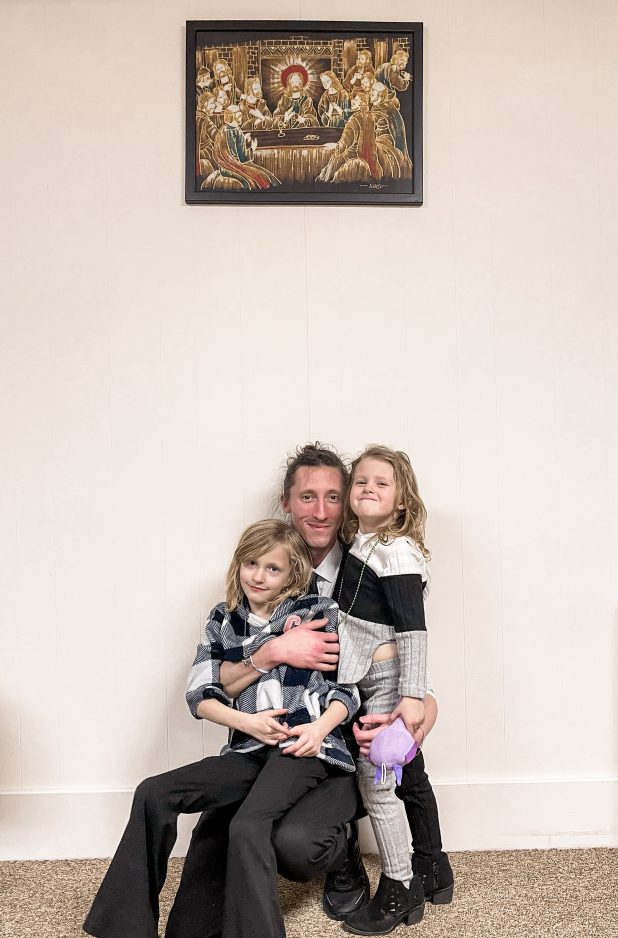
“Last time I was in a church was when I was baptized,” said Stefanelli, a Millennial mother of two who lives in Monongahela. “My hope for them is that it will be natural.”
Stefanelli took her kids, Brinlee, 6, and Bradley, 4, to their first Mass after realizing something in her life was missing.
“I kept kind of coming up empty, is the way I can best describe it. No matter how good things were going, it seemed like there was always a piece that wasn’t there,” Stefanelli said.
That first Mass was nerve-wracking.
“I didn’t know what to do,” she recalled. “We sat in the back and we just tried to follow along. It’s funny because it’s like Catholic calisthenics: You’re up, you’re down. I had a ton of questions.”
She found the answers through dialogue with friends and other Catholics, and in books, including “Mere Christianity.”
“I kind of went back to early Christianity and just followed truth, and this is where it led me,” Stefenelli said.
Now, Stefanelli is all in. Since the family began attending church, she’s found the supportive community she dreamed of, and has seen a change in her children – Brinlees has developed a stronger moral compass, Stefanelli said, and Bradley is more focused – and in her own life.
“It’s made parenting almost easier,” Stefanelli smiled. “Everything is brighter. I look at everything around me, I look at my kids, and I appreciate every little thing about them, even when they’re driving me insane.”
Stefanelli will receive the sacraments for the first time alongside her children this Easter morning. Beres is looking forward to his official initiation into the faith, and his daughter’s first sacraments. Along with the peace that comes with knowing Christ, Beres said, he also has an appreciation for the church’s approach to family.
“Church allows kids to be kids. They just come as you are. That is very beautiful,” he said.
The inclusiveness, he thinks, is leading to a Catholic revival.
“I think the younger Millennials are more drifting toward it,” said Beres. “No more of this chaos and antique, old movement. I also think they’re going to bring an opener message to the church.”
That’s the hope of the Rev. Levi Hartle, who leads the St. Andrew parish, and has plans to host prayer walks through the streets and other engaging events that cultivate spiritual growth for Catholics of all ages.
“It’s very exciting to be in the church at this time,” said Hartle, himself a Millennial. “We are definitely seeing young families coming back to church. People that hadn’t come to church in years are starting to come back to church. I just feel like the holy spirit is just doing amazing things, and we’re just watching.”