

$1.7 billion power project would cross Greene, Fayette counties
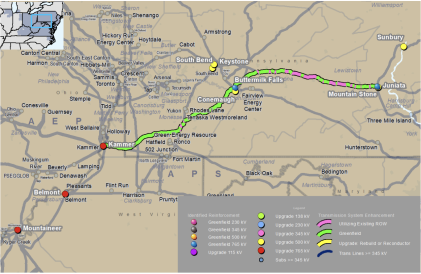
A proposed pathway of high-voltage electric lines would run through Greene, Fayette, and eight other counties in the state.
The project would create a succession of 765-kilovolt lines running 220 miles from the Kammer substation in Marshall County, W.Va., to the Juniata substation in Perry County, primarily along routes without existing lines.
Regional grid operator PJM approved the proposal from NextEra Energy and Exelon Corp. in February as part of a slate of upcoming projects intended to improve reliability amid increased demand from data centers.
About 3.5 gigawatts of electricity were projected to be added to the load in 2026, with more to come, PJM said.
About an equal amount of capacity is going offline, due to generators being deactivated, PJM said. Offshore wind farms in New Jersey and Delaware, which had been proposed to add power to the grid, have been delayed or canceled, adding to the need to reduce the strain on overloaded facilities, PJM said.
The line is projected to be operational by June 2031.
It would be the first line above 500 kilovolts in Pennsylvania, although it would connect to pre-existing 765-kilovolt line that now terminates in West Virginia.
Kaitlin McCormick, senior director at NextEra, said the lines would transmit about two to three times more power than a 500-kilovolt line, while also minimizing the power loss as it moves through the grid.
She described the project as “the most elegant solution to meet the needs of the electric grid in the region.”
NextEra said the line would have economic benefits through improving stability and access to lower-cost power, and potentially save customers millions of dollars during extreme weather events.
“Without the upgrades that (PJM) put in that window, bottlenecks could occur on our electric grid, and that could potentially increase energy costs or result in reliability problems going forward,” McCormick said.
An estimate prepared by PJM put the cost at around $1.7 billion.
PJM’s analysis shows that about 5,400 acres would need to be acquired to secure a 200-foot right-of-way along the route. More than 70% of that would be greenfield construction that does not parallel lines already in place. In the 114-mile section running between West Virginia and Indiana County that includes Greene and Fayette, only 3.8 miles is along the existing right of way.
“The large amount of line for the land required for the line increases risk,” PJM said of that segment. “Resistance is expected in some areas, but there is plenty of availability to reroute where resistance is encountered.”
Some state agencies had recommended PJM hold off on approval.
Pennsylvania Consumer Advocate Darryl Lawrence said his office has concerns about the magnitude of the project, and the environmental impact. He also wondered whether something of that scale would be necessary.
He pointed to a recent ratepayer protection pledge developed by the Trump administration and signed by seven major artificial intelligence companies that they would build, bring or buy their own generation power, as well as shoulder any costs associated with building the centers.
“If you know that pledge is going to be adhered to, then you know it seriously calls into question the need for this project,” he said.
Instead of the new line, Lawrence had recommended other less disruptive alternatives, such as boosting the capacity of existing lines with state-of-the-art conductors, wires and towers.
The Pennsylvania Utility Commission, which is responsible for reviewing energy projects in the state, wrote to PJM in January urging it to “conduct an exhaustive evaluation of all possible solutions,” saying the 60-day window may not have been long enough for potential submissions. Alternatives could include exploring new generation nearby, the PUC said, or a phased approach that took care of the most immediate concerns while allowing PJM to adapt to any changes in the forecast energy needs.
Co-location with existing lines could minimize pushback, as well as environmental risk, said non-profit The Nature Conservancy. In a letter to PJM, it said the line could create “significant” impacts to climate migration corridors in the state.
McCormick said the project was approved as part of a “thorough and robust analysis” by PJM looking at how to serve needs across the entire region.
“This project is not planning for any single user, any single sector,” she said. “It’s meant to address all of the broadened and changing needs that are happening across the electric grid, whether that’s changes in where power is coming from, whether that’s a retirement changing in generation sources, whether that’s additional growth or demand from manufacturing or other advanced technology users.”
The line also drew letters in support. Economic development non-profit TeamPA said projects such as the Kammer-Juniata line would create more potential for energy generation and aid the state’s long-term development.
“…[A]lthough there is appropriate scrutiny on near-term transmission costs, the benefits of building a more resilient backbone system will accrue over decades, supporting customer reliability, grid flexibility, and economic competitiveness across the region,” Team Pennsylvania President and CEO Abby Smith wrote to PJM.
In a statement, Shapiro, who co-chairs Team PA’s board of directors, said in his role as governor he has communicated with developers to “voice his expectation that if they are to proceed, they will respect the legal rights of local communities and landowners along the proposed route and ensure that the data centers — which the line would benefit — pay their fair share of its cost.”
Beyond the feedback from state officials, the high amount of greenfield development could also create a higher level of community pushback, Lawrence said.
He spoke at a recent town hall on NextEra’s Mid-Atlantic Resiliency Link, which would include about 11 miles of line in Greene and Fayette counties. The town hall in Smithfield, which lies along an alternate proposed route for MARL, drew more than 160 people.
“Look at the amount of public outcry, the public that showed up,” he said. “You’re talking about 200-plus miles going across Pennsylvania and a lot of it is greenfield. Imagine what those town hall meetings are going to look like.”
McCormick said the proposal is still in its early stages, with no route set. NextEra still has to perform a routing study, which would evaluate environmental, landowner and community impacts among other factors in deciding upon a preferred route. It will also send out surveys and meet in-person with local stakeholders.
Once the study is completed, NextEra will hold open houses similar to the ones held last year for the proposed MARL routes, where residents can provide feedback that can help shape the eventual recommended route.
“There’s going to be many opportunities for public input, and that input is going to play a direct role in shaping the project as it moves forward,” McCormick said.
Open houses and other events will be announced at the project website, kammerjuniatatransmission.com.