

Educators, policymakers discuss ways to bring more people into teaching
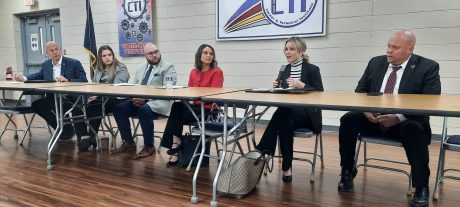
There was a time when the supply of teachers in Pennsylvania so outnumbered the available spots that prospective teachers had to bide their time for years substitute teaching while waiting for a full-time job.
Those days are over.
The number of certified teachers coming out of Pennsylvania’s preparatory programs has fallen by 75% from its peak, and teacher attrition rate is at an all-time high, said Lenny Sweeney, state director for National Center on Education and the Economy.
The end result, according to an analysis from Penn State University: It would take an additional 8,469 qualified teachers in the state just to meet the current needs — let alone the ones that will come up as more teachers retire or leave for another profession with higher pay.
A roundtable including lawmakers, local educational administrators and student teachers met Wednesday at the Fayette County Career & Technical Institute to discuss ways to address the teacher shortage crisis, teacher stipends, barriers for career and technical education teachers and ways to improve the CTE certification process.
“Today, we want to take the time to hear from our practitioners, from our experts, and to really get a better sense of what all of this is about, how the student teacher crisis is affecting these individuals, how the state has helped,” said Sweeney, also a member of the advocacy group PA Needs Teachers, which organized the panel in collaboration with Learning Lamp and Fayette CTI.
Administrators said the difficulty of filling vacancies had created additional problems. In Brownsville, they’ve had to use emergency-certified teachers working outside their area of expertise, said Assistant to the Superintendent Andrea Costabile. When they’ve been able to find teachers, they’ve had to entice them by bringing them in at a higher step level for salary — and often still lose them later to another district that offers more.
“We’re trying to implement a ton of interventions in our classrooms, but when the instructor isn’t consistent, neither is what our kids are getting,” she said.
On the CTE side, districts trying to recruit teachers also have to compete with industry. A recent search for a power line teacher, where workers can make up to $300,000 in the private sector, was “probably the most difficult employee search I’ve ever had to go through,” said Jason Lucia, vocational director at the Westmoreland Career & Technology Center. He lucked out in that case, finding a newly retired lineman who wasn’t ready to stop working.
He’s not always that fortunate.
“Welders are making a really nice above-living wage right now,” Lucia said, and matching that is “just not feasible.”
They are also trying to figure out ways to prepare teachers at an accelerated pace so they can not only teach, but follow the regulations required by the state, Lucia said.
There, he thanked state Sen. Pat Stefano for recent legislation that made it simpler to get teachers certified.
“You’ve kind of cut through the red tape for us, and we can get people to at least the starting line a lot faster,” he said.
Another recent aid is the student teacher stipend program, which is slated to receive $35 million in Gov. Josh Shapiro’s proposed 2026-27 budget, up from $30 million at its creation.
Beth Guty, a student teacher who graduated from Carlow University in December, had gone back to school later in life as a mother of two.
She said the Teach Scholarship had made it possible to pursue an education degree without taking on more student debt. She also credited the apprenticeship program at Carlow with allowing her to take courses while continuing to work full-time.
The $10,000 student teacher stipend was also helpful — though, because of the delay in passing the state budget, she did not receive it until February.
“I didn’t go into (teaching) casually. I chose it intentionally,” said Guty, who is now substitute teaching at the Albert Gallatin School District. “If these financial things weren’t put in place … I wouldn’t be doing this. So I think that if we can get financial supports put in place that are sustainable, that are timely and reliable, I think more people could go into the profession.