

Pennsylvania moves to evidence-based reading curriculum
 Courtesy of Canon-McMillan School District
Pennsylvania schools are preparing for a major change in how children are taught to read.
For the 2027-28 school year, all schools in the state will be required to use evidence-based reading curriculum, which uses methods such as phonics, a method that teaches students to decode words by sounding them out.
The new requirements – which also call for new literacy instruction training for teachers – come as part of Pennsylvania’s 2025-26 budget.
It calls for reading instruction in early years to follow research-led methods, particularly those aligned with the science of reading, a body of research showing that young children benefit from phonics and vocabulary-building teaching.
Gov. Josh Shapiro said the approaches will help children to “learn to read well” and equip teachers to “teach reading effectively.”
The budget includes $10 million earmarked for structured literacy implementation.
The reasons for the switch were evident in recent data. National test results showed that only about 1 in 3 fourth-grade students in Pennsylvania were reading at proficient levels last year.
In school districts across the country and in Pennsylvania, several districts’ reading curriculum didn’t align with research-backed methods.
But several area school districts – including Canon-McMillan, Chartiers-Houston, California Area, Charleroi, Bentworth, Washington, and Jefferson-Morgan – have already moved toward evidence-based reading.
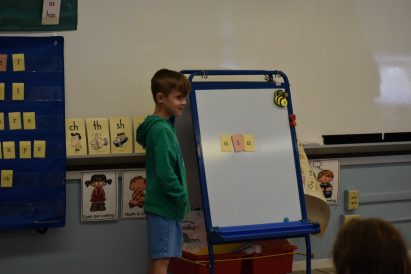
At Canon-McMillan, educators were alarmed several years ago when tests showed that 14% of fourth-graders were not reading at grade level. The district overhauled its reading curriculum and then trained its teachers on the best ways to teach its youngest students how to read. Today, 96% of fourth-graders are reading at grade level – only 4% aren’t reading at their grade level.
“Our district introduced structured literacy rooted in phonics and evidence-based instruction long before the state’s new mandate,” said Canon-McMillan Superintendent Dr. Gregory Taranto. “We now know that reading doesn’t come naturally. You have to train the brain to decipher words. Speaking and listening are natural, but you have to learn how to decode words. There’s a lot of evidence out there now that says, hey, this is how you learn to read.”
The district’s model includes Wilson FUNdations as the core curriculum, which focuses on decoding and phonics instruction in early grades, and uses knowledge-building curriculum that boosts students’ content knowledge, vocabulary, writing and language skills in grades three through six.
“In kindergarten through second grade, there is a strong emphasis on learning to read, and in third grade on, it’s about reading to learn,” said Taranto.
Under the new guidelines, school districts can choose which curriculum they adopt, as long as it meets research-based standards.
Those standards include teacher training, early screening (schools must screen students in kindergarten through third grade for reading competency three times a year), and intervention plans that call for students who are behind to receive individual reading intervention plans.
At Jefferson-Morgan School District, which has already shifted to structured literacy, the move is “both necessary and overdue,” said Superintendent Dr. Brandon Robinson.
“While we are still early in implementation, the results already show the approach is working,” said Robinson, noting that core reading success since the school district adopted Amplify, a reading program built on the science of reading that uses phonics and comprehension, has increased to 80%, a 50-percentage point gain across the grade level.
Bentworth School District Superintendent Scott Martin said the school district has been implementing a structured literacy approach for the past 18 years, and lauded the state’s new standards.
The school district has focused on comprehensive programs that focus on phonics, word study and higher order thinking skills.
All Bentworth elementary teachers have been trained in multiple evidence-based instructional programs and assessments, including LETRS, Wilson Reading System and Wilson FUNdations.
“Since 2007, we have been committed to the implementation of structured literacy grounded in the science of reading,” said Martin.
Anastasia Andronas, principal at Allison Park Elementary School in Chartiers-Houston School District, said the school district supports the statewide transition to evidence-based reading programs, and overhauled its reading program for the 2025-26 school year, adopting Wilson FUNdations for students in kindergarten through second grade. Before the school year started, teachers were trained on the science of reading strategies.
“Our early results reflect stronger foundational skill development, more intentional instruction, and improved alignment across grades. We believe this work will significantly strengthen student outcomes,” said Andronas.
Before adopting FUNdations, Andronas visited several school districts in Washington County, including Canon-McMillan’s Muse Elementary School.
“Their success with structured literacy and FUNdations stood out to us, and observing their classrooms reinforced our confidence in selecting an evidence-based foundation program for our students,” said Andronas.
State Rep. Jason Ortitay (R-Washington/Allegheny) said in a statement after the budget was passed that the $10 million investment was a “win.”
“Every school will now be required to use evidence-based reading instruction, screen students early, and intervene when a child is struggling,” said Ortitay. “Only about one-third of our fourth- graders are reading on grade level and that’s not because our kids can’t learn. It’s because we aren’t teaching them the right way. This changes that.”
Taranto, who extensively researched structured reading after becoming a principal in the school district, said that learning to read is the foundation for students’ success.
“I love that the state is using this and I’m really proud of our teachers and principals for embracing this,” said Taranto. “We owe the kids the gift of literacy. That’s their foundation. If they can’t be literate, they will be hard-pressed to be successful in life.”