

Annual calendar celebrates Greene County’s heritage
Artist hopes to make history come alive for local students
 Garrett Neese
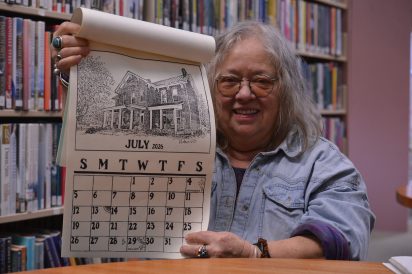
Every year, Colleen Nelson’s calendar captures a new collection of Greene County sights.
For the nation’s sesquicentennial, she’s also turning it into a learning experience for local students with artwork and information about local history.
Nelson began making the calendars with her friend Wendy Saul in 1979. They were both young parents looking to make a holiday gift for their friends.
She saw them as a way to showcase the beautiful landscapes that had convinced her to move to the county.
When a friend of hers who’d opened a store in Rogersville told her she needed crafts, Nelson and Saul got to work.
“In about three weeks, we threw a calendar together, and then we walked door to door, selling it to everybody that we could think of, and gave the rest away as presents,” she said.
From then to now, they’ve created more than 600 pieces of art for the individual months documenting what they’ve seen in the county, from historic sites to everyday living.
Nelson’s writings in the calendar explain the significance of the artwork. That led her to become a writer for the Observer-Reporter and other publications. And her love of art has intersected over the years with art shows at the Bowlby Library in Waynesburg, and programs geared toward bringing in kids.
“We do a lot of children’s programming, and it’s all tied in with people trying to come up with these ideas to educate the next generation,” she said.
Nelson, a school board member for the West Greene School District, is making plans with local teachers about ways the calendar could be incorporated into lessons.
“We have from now till July to come up with some little program that the kids might be really interested in, and we have teachers that are interested in making that happen,” she said.
Nelson is inviting teachers throughout Greene County to use this year’s calendar as a teaching tool.
“Kids can color in it, read the history, and just start a conversation about where they live,” she said.
Justina Arena, executive director of the Bowlby Library, said one option could be a summer program relating to the county’s history. While details still need to be worked out, she’s excited to bring in local history whenever she can.
“Just learning new things and having children understand their past, even if they’re just learning about where they came from — their city, their town, their village, the roots — would be really neat,” she said.
This year’s art combines historic sites with modern touches like the open mic at RBG Coffee in Waynesburg, which might generate the historic figures of the future.
July’s drawing is of the historic Garrison House, which freed slaves built for Civil War veteran James Garrison.
Garrison, who died in 1931, was said to be the last person alive in Greene County who had voted for Abraham Lincoln. Workers made the bricks onsite for the house located near Jollytown by the Pennsylvania-West Virginia border.
“If you look at the brick work, you know that they knew what they were doing,” Nelson said. “It’s a beautiful house.”
Gracing the cover is the Blaker Farm, which dates back to 1815. The Blakers, a Quaker family from Loudoun County, Virginia, stayed in the area to raise sheep to take advantage of the county’s booming trade in Merino wool. The farm has stayed in the family ever since. Current owners Mike and Janet Blaker Mawhinney have kept the tradition alive, raising medium-wool Dorset sheep.
The farm’s 211-year history has created its own compelling stories, such as the saga of Sheep 302, which escaped a coyote and was able to make it back to the farm safely.
“Stories like that can tie kids in to the history without them even knowing it,” Nelson said.
For more information about the calendar, including where it can be purchased, visit facebook.com/GreeneCountryCalendar.