

Ticking upward
Lyme disease cases in Pa. among highest in U.S.
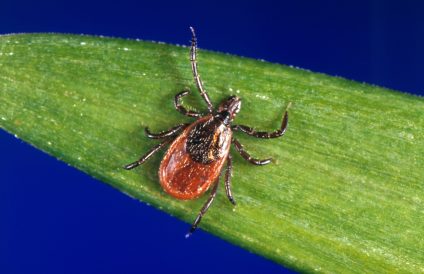
As temperatures rise and more people head outdoors, experts say tick season is already underway across Pennsylvania, a state that consistently ranks among the highest in the nation for Lyme disease cases.
May is Lyme Disease Awareness Month, and Pennsylvania is, indeed, a Lyme disease hotspot, with its abundance of wooded areas creating an ideal environment for ticks, according to Erika Machtinger, associate professor of entomology in Penn State’s College of Agricultural Sciences.
Machtinger, an expert who studies ticks and other arthropod pests and the risks they pose to humans and animals, said there are more than 900 species of ticks worldwide, at least 25 of which are thought to exist in Pennsylvania.
Of these, two species account for more than 90% of identification requests submitted to Penn State: blacklegged tick and American dog tick.
Surveillance has confirmed that ticks carrying the bacteria are now present in all 67 Pennsylvania counties.
The scale of Pennsylvania’s tick issue is reflected in the most recent state data. In 2024, Pennsylvania recorded 16,624 lab confirmed cases of Lyme disease, and while 2025 data is still being finalized, preliminary reports suggest numbers are trending higher.
Pennsylvania Department of Health officials and the Centers for Disease Control caution that these figures represent only a fraction of the reality, estimating that actual cases could be significantly higher due to underreporting.
Beyond Lyme disease, both the DOH and CDC are increasingly concerned about other tick-borne diseases, including anaplasmosis, babesiosis and ehrlichiosis, and rare but serious infections such as Powassan virus disease.
Machtinger said a combination of ecological and social factors are contributing to the increase in the number of ticks and cases of Lyme disease.
Among them, said Machtinger, are abundant wildlife hosts – especially deer and small mammals; fragmented forests that create ideal edge habitat where these animals thrive; suburban development that brings people into closer contact with ticks; and longer, warmer seasons that extend tick activity.
“Historically, land use and settlement patterns have reshaped forests into patchy habitats that favor ticks and their hosts, while reductions in predator populations — like mountain lions, wolves and the American marten — that once helped regulate deer and small-mammal populations have further amplified host availability,” said Machtinger in a press release. “At the same time, increased outdoor recreation, residential expansion into wooded areas, and improved awareness and diagnosis all contribute to higher reported cases. It is less about one behavior and more about long-term environmental change intersecting with how and where people live and work.”
Climate shifts are also playing a significant role in the surge. Milder weather patterns mean the tick die-off is not as effective during winter, allowing populations to emerge in larger numbers once the ground thaws.
Pets and livestock are at risk from ticks and tick-borne pathogens, said Machtinger, with dogs and horses both susceptible to Lyme disease and anaplasmosis.
Livestock, particularly cattle, have been increasingly impacted by the Asian longhorned tick, which can reach very high numbers on a single host and is associated with transmission of Theileria orientalis, a pathogen that can lead to theileriosis that can cause anemia, weakness, decreased production and, in severe cases, death.
Regarding human health, pets are a major factor in the seasonal surge. Dogs and cats often act as “taxis,” bringing ticks from the yard directly into the home.
Prevention remains the most critical defense against Lyme disease. Machtinger recommends simple daily habits like wearing long sleeves, long pants and closed shoes, using repellents registered with the U.S. Environmental Protection Agency and containing the active ingredient DEET, using insecticides like permethrin to treat clothes, performing immediate “tick checks” after being outside, and avoiding high-risk vegetation when possible.
“Active ingredients such as picaridin, oil of lemon eucalyptus — not the essential oil — and IR3535 can also be used as repellents, as long as they are registered with the EPA,” said Machtinger. “The most important thing is that whatever repellent you use should be EPA-registered, which means it has gone through rigorous testing for safety and effectiveness against ticks and mosquitoes.”
There is significant progress on the horizon regarding medical prevention. In March, Pfizer and Valneva announced that their Lyme disease vaccine candidate demonstrated over 70% efficacy in Phase 3 trials.
While the vaccine is moving toward regulatory approval, simple precautions remain the most effective current defense.
The public can register for a free webinar on Lyme disease presented by Penn State Extension on May 26 from noon to 1 p.m. ET. Register at https://extension.psu.edu/biting-pests-the-history-of-lyme-disease.