

Kara Walker exhibit at Frick explores “annotated” Civil War history
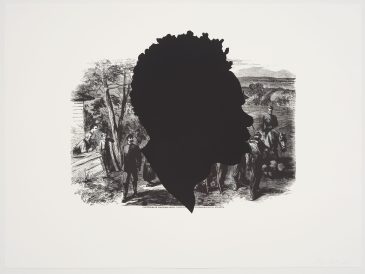 Courtesy of the Frick Pittsburgh
PITTSBURGH-As the Civil War was raging, thousands of American readers would wait to get news on the conflict every seven days from Harper’s Weekly, then the most widely-read periodical in the United States.
Along with its coverage of the battles between Union forces and the Confederacy, Harper’s Weekly kept an eye on happenings both here and abroad and served up excerpts of novels and comics. Its remit was so broad that Harper’s Weekly carried the legend “Journal of Civilization” on its front cover.
Because photography was still relatively young when the Civil War was unfolding, Harper’s Weekly relied on a corps of illustrators to create images to go along with its battlefield dispatches. The illustrations were, not surprisingly, idealized and designed to appeal to the mostly Northern audience that read Harper’s.
Black people and those enslaved south of the Mason-Dixon line were, for the most part, conspicuously absent from the illustrations, even as their fate was ostensibly at the center of the Civil War.
Once the war ended, the illustrations were gathered in a two-volume 1866 anthology, “Harper’s Pictorial History of the Civil War.” Kara Walker, a California-born and Atlanta-bred multimedia artist known for her works that use black cut-paper silhouettes to make points about race, gender and slavery used those long-ago illustrations as a jumping off point to show how Black people were excluded from those images – and the cultural conversation – a century-and-a-half ago.
They have been gathered together in the exhibit “Kara Walker: Harper’s Pictorial History of the Civil War (Annotated).” Created in 2005, it consists of 15 large-scale prints of renderings from the Harper’s anthology that have Walker’s trademark black silhouettes overlaid on them. The exhibit has been at several museums around the country since its creation two decades ago, including the Smithsonian American Art Museum in Washington, D.C., and the New York Historical Society, and it will be at the Frick Pittsburgh Museums and Gardens in Point Breeze through May 25.
Walker, who gives relatively few interviews, once explained, “The whole gamut of images of Black people, whether by Black people or not, are free rein in my mind.” Another quote by Walker is featured on one of the exhibit walls: “I’m not an actual historian. I’m an unreliable narrator.”
The 55-year-old “unreliable narrator” has managed to make quite a splash since graduating from the Atlanta College of Art in 1991. Walker has been called one of the most important American contemporary artists. She was the second-youngest recipient of a John D. and Catherine T. MacArthur Foundation “Genius” grant, and was named one of Time magazine’s 100 most-influential people in 2007.
Some of the works in “Kara Walker: Harper’s Pictorial History of the Civil War (Annotated).” include “Cotton Hoards in a Southern Swamp,” which has Harper’s image of a rifle-holding white man standing in a boat in a swamp between two Black people, presumably both enslaved. To the left of the image, a ghostly silhouette has been imposed. Another work, “Confederate Prisoners Being Conducted from Jonesborough to Atlanta” has a silhouette imposed over much of the image.
Alongside Walker’s prints, the exhibit has original Civil War images from Harper’s Weekly, some created by Winslow Homer, one of the great American artists of the 19th century.
Dawn Brean, chief curator and director of collections, said that Walker is one of her favorite artists and “one of the most thought-provoking artists of her generation.” Brean appreciates the way Walker “plays with the idea of history and how history is made.”
“Kara Walker: Harper’s Pictorial History of the Civil War (Annotated)” is at the Frick at a moment when controversies rage about how history is taught, particularly the history of slavery and racism within the United States. By presenting the exhibit, the Frick is “hoping to get people thinking,” according to Amanda Gillen, the Frick’s interim executive director. “We’re not telling (visitors) what to think, but we want to pose questions. There are moments in the show that are resonating with where we are right now.”
Shaun Myers, an associate professor of English at the University of Pittsburgh, said “Walker’s art prods us like a boot spur. It goads us to abandon the declawed histories shaping our museums, memorials and textbooks.”
Several events are planned in conjunction with “Kara Walker: Harper’s Pictorial History of the Civil War (Annotated).” The singer KEA will offer a performance inspired by the exhibit Saturday, March 29 at 4 p.m. Guided evening tours are planned for Wednesday, April 16 and Wednesday, May 7. Dr. Edda Fields-Black, a professor of history at Carnegie Mellon University, will discuss her book on abolitionist Harriet Tubman Thursday, April 24 at 7 p.m. and the Hill Dance Academy Theatre will perform Saturday, May 17 at 1 p.m.
Additional information on the exhibit and its associated events can be found at TheFrickPittsburgh.org.