

Some old toys were meant to make a point
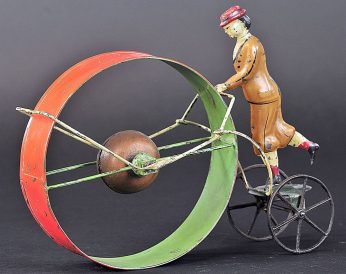
Children’s toys reflect the world of adults, so it is not surprising that sometimes a toy represents the political ideas of the parents and the children just think of it as a toy.
George Brown, the famous toymaker from Connecticut, patented a suffragette toy in 1874, a few years after the first national organization seeking the vote for women was established in 1869. Women organized, protested and attempted to vote in the 1870s. They were arrested, but they gained publicity for their movement. When the Supreme Court ruled against them, they started a campaign at the state level for an amendment to the Constitution to give them the right to vote. It was not until Aug. 26, 1920, that women in the United States were given the right to vote.
The George Brown toy has a bell, a large wheel and a woman dressed in clothes worn by suffragettes. It is a clever toy. As the wheel turns the bell rings and the woman’s legs move, so it looks as if she is pushing the wheel.
The rare toy sold at a Bertoia auction in Vineland, N.J. for $6,000 in November 2014.
Q. I recently found ceramic figurines of Caroline and “John-John” Kennedy as children. John-John is modeled in his famous salute pose. They are 5 3/4 inches high and on the back of each is a green stamp that reads “Inarco Cleveland.” Do these have any value?
A. Inarco stands for International Artware Corporation, started in Cleveland, Ohio, by Irwin Garber in 1960. In the 1940s, Garber worked at NAPCO (National Potteries Corp.), a company near Cleveland that imported and distributed decorative accessories. Garber helped promote head vase planters, popular in the 1950s and ’60s. He left NAPCO in 1960 to start his own giftware import firm. Your figurines are from 1963. A set sold in 2013, the 50th anniversary of President Kennedy’s assassination, for $185. They can be found in online shops listed for about $40 to $100 for the pair, but selling for $25 to $50.
Q. I bought a large, mechanical baby doll at a local auction. The doll lies in a 33-inch long wooden basket. Her arms and legs move in the air, and her head moves up, down and to one side. There is a paper sign on the front of the basket that reads, “My First Sweetheart.” Can you tell me anything about the doll? I paid just under $300 – did I pay too much?
A. Your doll was used as an advertising display for Sweetheart soap. The brand was made by the Manhattan Soap Co. and advertised as “the soap that agrees with your skin.” The doll has a head, arms and legs that are made of composition, and an electric motor that keeps them moving. It was made by Mechanical Man Inc. of New York. It was sold to retailers who sold the soap, probably during the 1930s, when Sweetheart soap sponsored several popular radio shows. Sweetheart Soap dolls have sold for prices ranging from $450 to $1,400 at auctions during the past few years.
Q. I have a color photograph made by Michael Miley, a pioneer in color photography. The photograph is of a painting of a woman in a red scarf. It’s in an ornate gilt frame. What’s it worth?
A. The first color prints in the United States were made by Michael Miley (1841-1918). He and his son, Henry, filed an application for a patent on their process of producing color photographs on March 28, 1902. The patent was assigned to the Miley Colour Photograph Company of New York. The process involved using plates and screens in red, green and violet to produce color. Only about 500 color prints were made by Miley. The value of your photograph depends on rarity, condition, and subject matter. A rare color photograph of Peale’s 1772 painting of George Washington sold for $1,888 at auction a few years ago. The portrait of a woman in a red scarf has been reproduced many times. Your photograph should be seen by an expert in photography to see if it’s an original photograph or a print and to determine the value.
Tip: To remove a sticky price tag or instruction label from a glass or metal object use a hair dryer. The heat should soften the flue and the paper will be easy to peel off.
Current prices are recorded from antiques shows, flea markets, sales and auctions throughout the United States. Prices vary in different locations because of local economic conditions.
• Penny toy, gnomes sawing wood, tin lithograph, articulated hand saw, Meier, Germany, 4 inches, $175.
• Butcher block, French Provincial, oak, carved, iron banding, round, splayed square tripod legs, 19th century, 31 x 14 inches, $180.
• Wood carving, man riding fish, pine, initials A.D.S., Mar 62, 13 1/2 inches, $185.
• Pin, Victorian, 15K gold, diamonds, applied rope and bead work, bar shape, England, 1 5/8 inches, $195.
• Radio, Crosley, dashboard, D-25, light green, clock, 1950s, 13 inches, $210.
• Easel, artist’s, beech, carved, adjustable, trestle supports, early 20th century, 77 x 21 1/4 x 19 1/2 inches, $365.
• Rug, hooked, dove, on branch with berries, repeating triangle border, multicolor, cotton, wool, burlap, Eredene Unger, York County, 33 x 46 inches, $765.
• Silver, bowl, center, sterling, chased, pierced, rim with scrolls, flowers, plated liner, metal grill, Black, Starr & Frost, 18 inches, $2,040.
Write to Kovels, Observer-Reporter, King Features Syndicate, 300 W. 57th St., New York, NY 10019.