

Nate Powell talks about life in comics, graphic novels
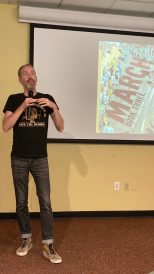 Brad Hundt/Observer-Reporter
MT. LEBANON – Nate Powell’s life changed as a result of a couple of comic books.
One of them was a so-called “silent issue” of a “G.I. Joe” comic book from 1984 that had its characters speaking not a bit of dialogue. Its story is told entirely through the panels drawn on its pages. It made Powell realize that “everything in a comic is information” and it is not conveyed solely through dialogue.
Not long after, Powell’s eyes were opened by “The ‘Nam,” a Marvel Comics series about the Vietnam War that was launched in 1986. As a child growing up in a Southern military family, he said he was “very much drinking the Kool Aid, with the ‘Red Dawn’ vibe” of the era, but that “The ‘Nam” shook up his assumptions.
With a page of the comic book projected on a screen in one of the Mt. Lebanon Library’s meeting rooms, Powell explained, “This comic changed my life, because I had all kinds of questions for my dad.”
Powell was at the library last week to talk about his award-winning work, which encompasses graphic novels, comics and music. It’s now a full-time pursuit for him – up until 2009, he was a caregiver for developmentally disabled adults – but he noted the work is not without its pressures.
“I’m glad I can do comics,” Powell said. “I’m glad I can do it as a full-time job, but it doesn’t make it any less stressful.”
Powell is perhaps best known for his work on “The March,” a series of three graphic novels on the Civil Rights Movement centering on the late congressman John Lewis. It won a National Book Award and widespread acclaim. But he has also put out a graphic adaptation of “Lies My Teacher Told Me,” the book by James Loewen that criticizes school textbooks and how history is taught, and several other graphic novels.
He pointed out that, yes, comic books are not just kid stuff, and can be seen as “agents of empathy and democracy,” pointing to the X-Men as an example. Comics can also be heartbreaking, with Powell recalling a “Calvin and Hobbes” strip where Calvin comes to terms with the loss of a raccoon he unsuccessfully tried to nurse back to health.
Now 47 and a resident of Bloomington, Ind., Powell was like many other boys with his interest in comics in the 1980s and 1990s. He developed an interest in music, joined punk bands and had his own do-it-yourself record label. A 2008 graphic novel on the struggles of adolescence, “Swallow Me Whole,” was nominated for a Los Angeles Times Book Prize, and it was not long after that he started work on “The March.”
Before embarking on “The March,” “I had to look at a lot of still photos,” Powell said, explaining that he tried to avoid re-creating the most well-known photos of the Civil Rights Movement, because, in his mind, it would take readers out of the story – he characterized it as “a mediated barrier.”
Wearing a T-shirt that said, “Ban the fascists, save the books,” Powell took aim at individuals and groups that have tried to have books banned from schools and libraries around the country. Graphic novels, like those that Powell creates, are frequently targeted in book-banning drives. Earlier this year, Mt. Lebanon Library declared itself a “book sanctuary” that will protect endangered books.
Book banners “care about power and control,” Powell said.