

AI tools shape local design industry
Technology helps improve productivity, efficiency, designers say
Artificial intelligence programs are quickly becoming a facet of everyday life for millions of Americans, from students using OpenAI’s ChatGPT to solve homework problems, to national politicians using AI-powered tools to draft campaign materials.
And for better or worse, it is transforming dozens of locally owned graphic design and commercial printing firms across Southwestern Pennsylvania.
For Washington-based Quality Quick Printing, AI tools are just another technological innovation to embrace.
Manager Kim Main compares AI to fax machines and digital design software like Adobe’s Photoshop, of which Quality Quick was among the first to adopt after its release.
The commercial signage and printing operation, which was founded in 1978, has always taken pride in being a “tech leader” in the industry, she said.
And whether it comes to AI or any other tool, Main said the guiding philosophy is “can it serve our customers?”
Quality Quick uses AI tools in a variety of different ways, including analyzing customer project trends, developing client communications and brainstorming creative direction for different projects.
Main said the small shop has been able to grow a national client base using marketing and communication materials that have been developed using AI tools.
This includes updating internal Standard Operating Procedure manuals, which Main said took her less than an hour for a task that would typically require up to a week of effort.
“It can really improve your productivity and efficiency. It’s a really great tool for that,” she said.
The company employs two full-time graphic design artists, with no plans to eliminate those positions due to AI.
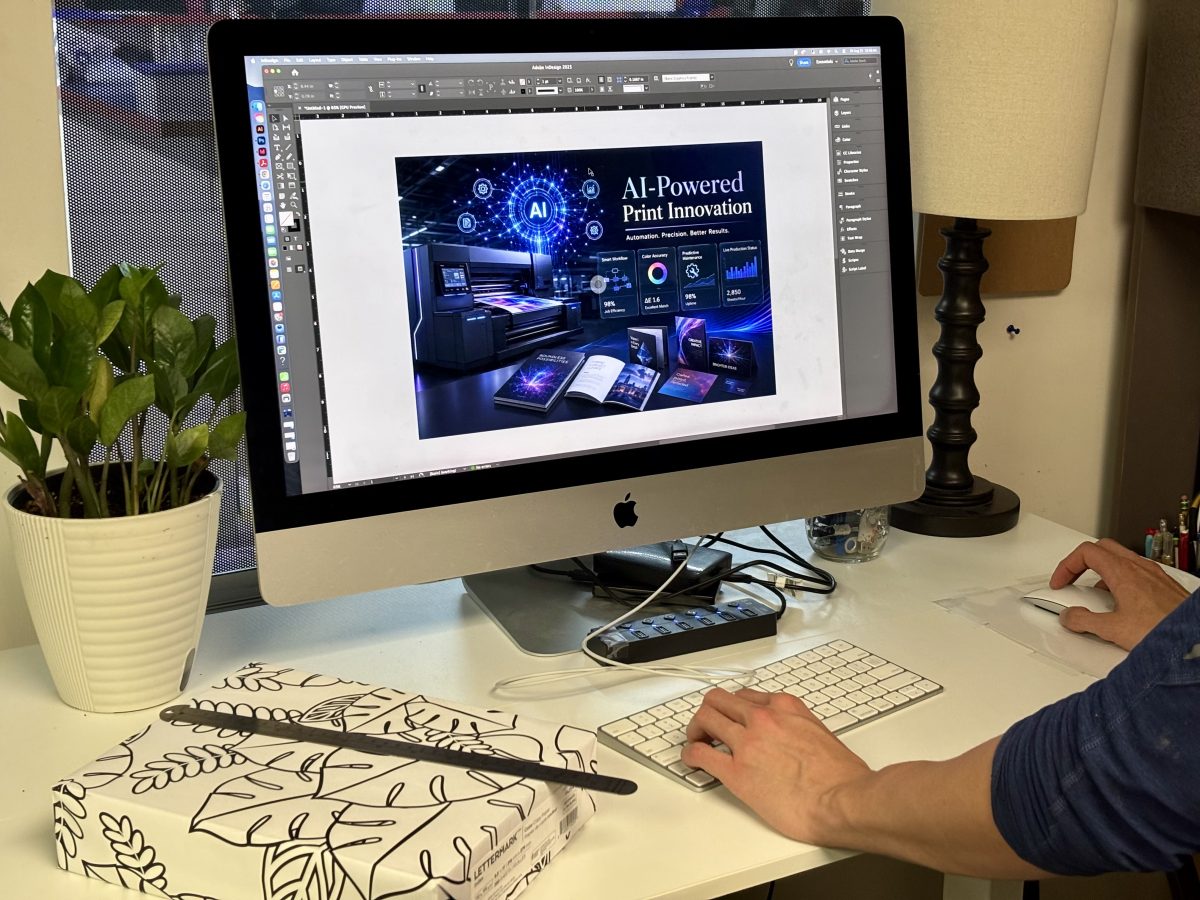
Main said the designers have the ability to use AI tools just like they use traditional programs like Photoshop, Illustrator or InDesign or Canva.
They are encouraged to use the best tool for each particular project, with special emphasis on “cost containment” for customers, she said.
That means instead of paying a designer to draft a logo from scratch, the designer will ask the client to use an AI program to generate a number of potential logo concepts, so the designer can refine the best option into a finished product, which would typically result in fewer billable hours.
Main said Quality Quick mandates human review and final approval for any project that incorporates AI tools.
“You still need to double check AI’s work for errors,” Main said, “especially anything depicting humans, which can look weird when done with AI … It has a place, but you need to be hyper-vigilant and keep your eyes on it.”
Retaining the ‘human touch’
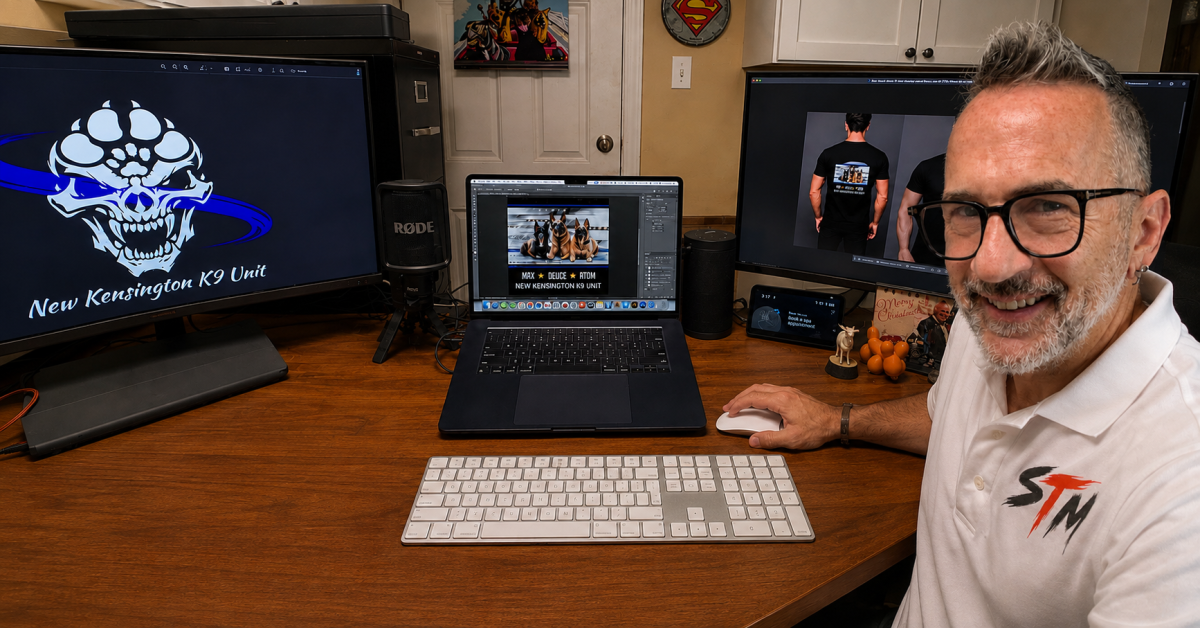
George McLaughlin has wholeheartedly embraced AI at his Canonsburg-based creative services firm, Striking Tiger Media.
He uses a range of AI programs to generate and refine the creative briefs brought to him by clients, including ChatGPT, Claude and Lovable.
This often includes AI generating upwards of 50 different ideas for a project, then finishing the design using another software such as Illustrator.
“It’s a good tool to use for shooting ideas off of it, if I need to be creative,” he said, noting that the degree of AI use is specific to each customer’s preference and project requirements.
After more than two decades working in the business software industry using his two degrees in accounting, McLaughlin pivoted to running a photography business in the mid-2010s. He eventually reformatted the effort post-pandemic into a multi-faceted creative services firm that offers digital design, website development and custom merchandise printing and more for clients.
McLaughlin said he makes a point to discuss and disclose his AI capacity to clients ahead of any potential projects, since some of them have varied feelings on the new technology.
“One of my friend’s daughters is a writer, so she’s vehemently against (AI), so I get that as a writer, but there are others that do like it, so it’s mixed,” he said.
So far, McLaughlin has not had a client explicitly request “no AI” in their project, saying that their preference is that “we use the best tools that we have.”
He emphasized that he remains hands-on throughout the duration of every project, even those that incorporate AI elements, in order to ensure the final product retains the “human touch” necessary to make it successful.
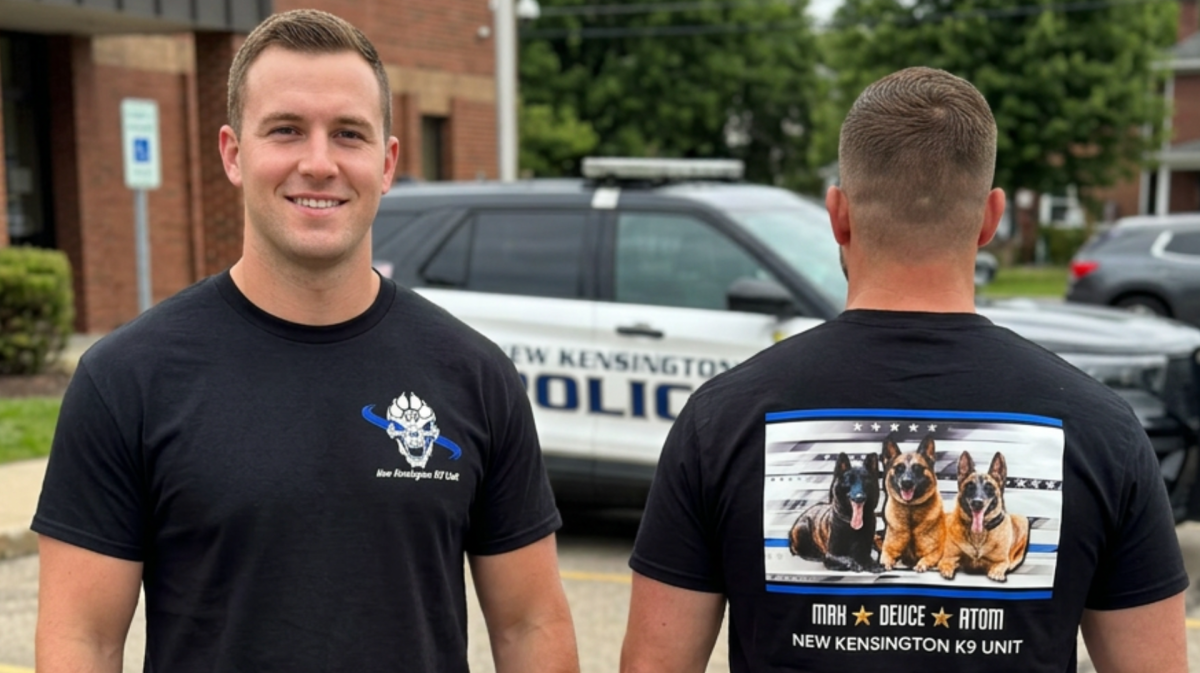
McLaughlin recently used the process to design and print a range of shirts for the New Kensington Police Department K9 Unit for its annual fundraising drive, saying that they were incredibly pleased with the final product.
Efficiency a goal
Hopwood-based digital marketing and web development venture Unit4Media owner Steve Barber said his academic art background and business experience allows him to take advantage of the full capacity of AI tools.
“Like how traditional artists must use pens and paper, in my business you need to use Photoshop and whatever other software comes across your bow,” he said.
Barber, who holds a bachelor’s degree in fine art from West Virginia University, said one of the best uses for the tools is as a creative reference source, like an encyclopedia.
“You can give it your ideas, and it can take it in a direction you may not have thought of,” he said.
Barber said he is careful not to outsource crucial creative decisions to AI, since clients pay for his expertise as a human and an artist.
“I feel like if you can do it by creating (a design) by yourself, that is the first direction I will go to,” he said. “What the client wants is the most important thing.”
According to Barber, having a skilled hand at the wheel is essential, even with a low barrier to entry-technology like many AI programs.
“It’s like how everyone can take a photo, but a photographer can capture the moment quicker and easier. They already know what shutter speed and lens to use,” he said.
Barber said his clients rarely specify a certain level of AI use in their projects. Instead, they “trust his quiver of arrows,” and professional judgment to choose the best approach for their job.
“Clients ask for a final vision, not how you make it,” he said.
AI has the potential to disrupt dozens of industries, but not necessarily in a negative capacity, according to Barber.
“A lot of things are going to be replaced (as AI becomes more prevalent), like radiologists and writers. They’re all going to be affected by AI in the future,” Barber said, noting that artists may be affected “for the better.”
Artists and multi-disciplinary creatives like Barber are “learning and benefitting” from incorporating AI use into their workflows.
Uniontown business owner Seth Caton says AI has shaped both his IT and creative services/digital design companies, calling it a tool that has “served me so well.”
By using AI to complete some of the initial creative brainstorming, it has allowed him to work through projects more efficiently, he said.
Caton said high-quality prompt writing is the essential skill to effective AI use, which is the aspect of AI with the steepest learning curve.
AI works best when given a narrow, specific task or part of a task, as opposed to working on the entire project at once, he said.
Caton learned how to use AI and improve his prompt writing through video lessons on YouTube.
“I think the combination of my formal education and almost two decades of writing content in many forms has played a major role in successful prompt writing,” he said.
Some degree of guardrails surrounding AI use are still necessary, especially for data security and collection, he said.
According to Caton, many mom and pop businesses in the region could benefit from the low cost of AI-aided design services over the coming years.
Some of these businesses are currently priced out of using traditional graphic design firms, so affordable AI alternatives could become increasingly popular, he said. “It’s a good foundation to build upon.”
It’s tough to predict how this technology will shape the industry as a whole over the next decade, but Caton said continual improvement of the AI models and growing public adoption of them is likely.
“I don’t know whether it will harm our business, but it’s going to be a transition, like how the people who made stagecoaches got scared when cars were introduced, but eventually cars and factories making cars were everywhere,” Caton said.
Technological innovation isn’t inherently a bad thing, however.
“I don’t think it’s a gloom and doom thing at all,” he said, “I think it’s best when people are committed to being lifelong learners and you can apply your critical thinking skills and apply your learning to something like this.”