

Meadowlands Food Pantry marks decade of community service
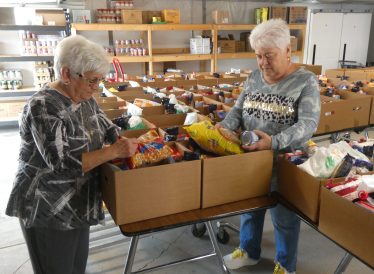
A dedicated core of volunteers from Our Lady of the Miraculous Medal Church – St. Oscar Romero Parish has served a growing number of local families through the church’s food pantry since it began in 2016, bringing a tight-knit community even closer together.
According to Toni Vallone, who co-founded the food pantry alongside her sister Maggie Havelka, she felt inspired to start the program after learning about a need in her rural Washington County community.
Volunteers from the Holy Name Society men’s ministry at St. Oscar Romero told her that they saw needs in the community that were left unaddressed even after their community service projects concluded.
“They saw poor people, hungry people, they saw that the need was to feed them,” Vallone said.
Vallone and Havelka then went to Fr. Carmen D’Amico to ask whether they could convert a garage attached to the rear of the church into a food pantry.
And with his blessing, they began the long task of converting the crowded storage space into a clean, efficient area for packing and distributing boxes of food to around 80 families.
The pantry now serves between 130-140 families a month, with half of that total representing first-generation Latino immigrants.
The pantry partnered with the Greater Pittsburgh Community Food Bank (GPCFB), which has been a “beneficial” relationship, Vallone said.
This relationship has allowed the food pantry to utilize the GPCFB’s connections to major food companies to provide a diverse, rotating selection of foods for its clients.
According to Vallone, they even sent a professional nutritionist to the pantry to teach staff how to assemble boxes with healthy, well-balanced foods.
“They’re a well-oiled machine, and they’ve made us a well-oiled machine,” Havelka said.
A growing family
The Latino community that arrived in the area over the past 15 years has transformed the rural church, and its food pantry.
Now, two of the church’s priests are bilingual, fluent in both English and Spanish. Church bulletins are printed in both languages and more than half of the pantry’s client families are Latino.
At first, there was a “hesitation” among some of these immigrant families surrounding the pantry, Vallone said.
“They were very nervous with us … but as they got to know me and got to know us more, they started coming,” she said.
These families present a unique challenge to the food bank, since their needs vary from non-immigrant counterparts.
Since many of the men in these families work seasonal jobs such as landscaping or in agriculture, they often stop by the food bank more often in the spring, summer and fall, but stop coming entirely during the winter, Vallone said.
Pantry staff have also increased how often they include products like rice, beans and peppers in their distribution boxes to better accommodate their client families.
Vallone said the pantry conducts regular surveys to make sure their boxes and overall service are in line with what their clients need, with the most recent survey conducted earlier this year.
“They were very honest with us, and sincerely told us about their needs,” she said.
One of Vallone’s favorite memories from her time at the pantry was one of the first Thanksgiving seasons after it opened, when pantry staff distributed coupons for free turkeys to the client families.
Some of the Latino families didn’t know how to cook turkey, so pantry staff arranged a community night with them where they showed them how to properly prepare a Thanksgiving turkey dinner.
“They didn’t know (how to cook the turkey), but they wanted to know what it was all about, and they got to know me and my sister,” Vallone said. “We showed them how to fix a turkey dinner, it was very fun.”
Vallone described these families as very hardworking, very religious and very involved in the church, saying that they’ve become an integral part of the community.
“Our grandfather came over to the U.S. from Italy to Ellis island, so we’re all immigrants whether the current administration wants to believe it or not,” she said.
Some of these families have stopped coming to the food pantry in the past two years as federal immigration enforcement has ramped up, causing anxiety in this community, according to Havelka.
“Sometimes we’ll pack 40 boxes for pickup, and 19 of these families won’t show up, and we’re like what’s going on,” Havelka said.
Havelka and Vallone credit a consistent group of volunteers and community support for the pantry making it to its 10-year anniversary, especially as other pantries in the region have closed.
“We’ve had our ups and downs, but we’re proud to say we’ve maintained all this time,” Havelka said. “Some of them have stuck with us for 10 years, we would be nothing without our volunteers.”
And although Vallone has recently stepped back from her leadership role earlier this year in order to provide care for her 97-year old mother, she says that she and her sister remain committed.
“It’s a humbling experience to work with people in need … It’s humbling to see how happy people’s faces are when they walk out of here,” she said.