

Women’s History Month panel tackles topic of technology
Right now, to borrow from the title of a James Brown song, the technology industry is a man’s world.
Even as women make up 58% of undergraduates enrolled in colleges and universities and make up almost half of the United States’ labor force, just 27% of those employed by tech companies are female. And just 3% are Black women.
“This is still a very male-dominated industry,” according to Cheroc Slater, a senior customer success account manager with Microsoft. “I didn’t let that deter me.”
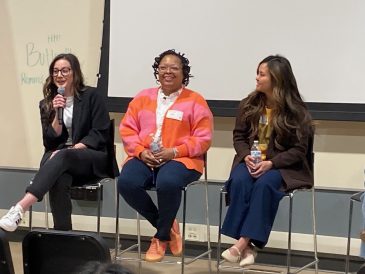
Slater was one of five women panelists who discussed their work in the tech industry at South Fayette High School March 18. They talked about the twists and turns they’ve experienced in their careers and what might be on the horizon in the tech field, particularly as artificial intelligence gains more of a foothold.
The panel was put together to mark Women’s History Month by the South Fayette High School organization SHOUT (Social Handprints Overcoming Unjust Treatment). Along with Slater, other participants were Lynette Lortz, a cybersecurity and computer science teacher at South Fayette High School; Kolica Davis, an identity and access management project manager with PNC Bank; Taryn Malavite Bagg, manager of IT business applications for Eos Energy; and Christine Htoon, senior engineering program manager with Google.
All five participants agreed on the importance of developing people skills, having mentors and being flexible. Lortz noted, in fact, that she concentrated in history, art history and library sciences when she was an undergraduate and found herself in the tech world because “I needed a job. I never would have expected it.”
And while being able to carry out tasks like coding is important, Htoon said people skills and “trying to get other people to align with you and their vision” is also critical. She added that being able to do everyday things like writing an email message and scheduling a meeting are important.
Lortz explained that “getting out there and talking to people” is also essential, along with finding experienced professionals who will act as mentors.
Continuing to learn and be flexible is particularly crucial as artificial intelligence continues to upend the technology realm and other industries. Slater said, “It’s not going away. AI is here to stay. It’s moving fast and furious and it’s not going away.”
Despite some prognostications that AI will be a wholesale job killer, Slater has a more optimistic outlook. She forecasts that rather than making whole categories of jobs and workers redundant, AI will “create more jobs, it’ll create new roles in an organization. It’s not going to take over our careers or jobs.”
Few would question that technology is a growing field. It’s believed that thousands of jobs will be added in the industry over the next decade. Malavite Bagg said, though, “Anyone can be in IT, but it still is a lot of work. You have to put in the work.”
She added, “Make sure you are pursuing what you want to pursue, not what someone else wants you to do.”