

Miners hang out to dry at Robena bath house
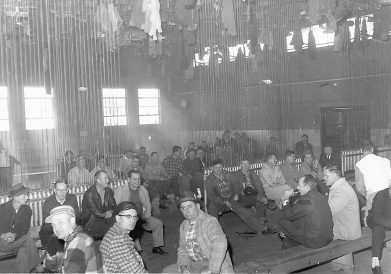
This room with a crew looks to be a strange sight, what with all that clothing hanging from the ceiling. But it wasn’t unfamiliar at all to dozens of readers who worked at coal mines and steel mills in the mid-20th century.
This print from the Observer-Reporter’s archives had but a single, cryptic word written on the back: “room.” Some mill workers and miners called it a cage room, changing room or locker room. But coal miners in Greene County, where this photo was taken, usually referred to it as the bath house.
“The chains took up dirty mining clothes and aired them,” wrote J.D. Haley in an email to us. “Baskets are hanging for their clean clothes, and there may be individual padlocks at the bottom of each chain to secure them.”
After finishing their shifts, workers would run their wet clothing up the wires to dry by way of ceiling fans, and lower their street clothing and personal items that had been kept secure in the baskets.
The purpose of the room was familiar to Weirton, J&L and Universal Cyclops mill workers, as well as coal miners, but which mine’s bath house this was, and when and why the picture was taken, was information known only to those familiar with the book “Robena Photographs,” published by Lonnie Miller of Carmichaels in 1998 – people like Aaron Carson, who wrote a college seminar paper in 2002 on the Robena Mine disaster and remembers coming across the photo in the Washington Observer in his research.
We contacted the author of the book, who was able to identify as many as 10 of the miners in the photo. “Some of them are still living,” said Miller, who has written several books about Southwestern Pennsylvania coal mining.
Miller explained the picture was taken in the bath house room of the Garards Fort shaft of U.S. Steel’s Robena Mine during hearings following the Dec. 2, 1962, explosion at Robena No. 3 that trapped and killed 37.
The photo was taken by an Observer photographer and published Jan. 4, 1963. The crowd had overflowed from the hearing room at Garards Fort, which could hold only 80 persons. So, more than 200 miners listened to the hearings on a public address system set up in the bath house.
One of the miners in the photo, Bill Malinosky, was able to identify 10 of the men in the photo for Miller’s book. The man in the front left corner is Hagar Randolph. The four seated on the bench behind him are, from left, George Rilleck, Herb Stuck, Joe Yanosik and Malinosky. Just to the right and behind Malinosky is Selmo Salvi. At center in the foreground is Mike Tuskan, and the two seated on the same bench to the right are Steve Rattay and Ed Voithofer. Across from them, with his legs spread, is John Hroblak.
Asked if he had attended the hearing himself, Miller said, “No, I was in the service at the time. A few years later, I went to work at the Robena mine, and I didn’t know anything about the disaster.”
The explosion at Robena took the lives of members of two continuous mining crews working about two miles from the base of the mine’s Frosty Run Shaft. The force of the explosion was so strong it knocked down men working underground more than two miles away. One hundred and seventy miners were in the mine at the time, and 133 escaped unassisted.
The U.S. Bureau of Mines later determined the explosion was caused by a buildup of methane gas ignited by a friction arc or an electric arc. The recovery effort took five days.
The Robena Mine opened in 1944 and was for many years the nation’s largest underground bituminous coal mine. At its peak in 1954, the mine employed 2,981 workers. Production ceased in 1983.
Robena was the worst mine disaster in Greene County since an explosion at the Mather Mine on May 19, 1928, killed 195 miners.
The great number of deaths in the coal fields, including the disasters at Robena and Consolidation Coal’s Farmington, W.Va., mine in 1968, where 78 miners died, eventually led to the passage of the Coal Mine Health and Safety Act of 1969.
Look for another Mystery Photo in next Monday’s Observer-Reporter.