

Burgettstown student inventors succeed with STEAM
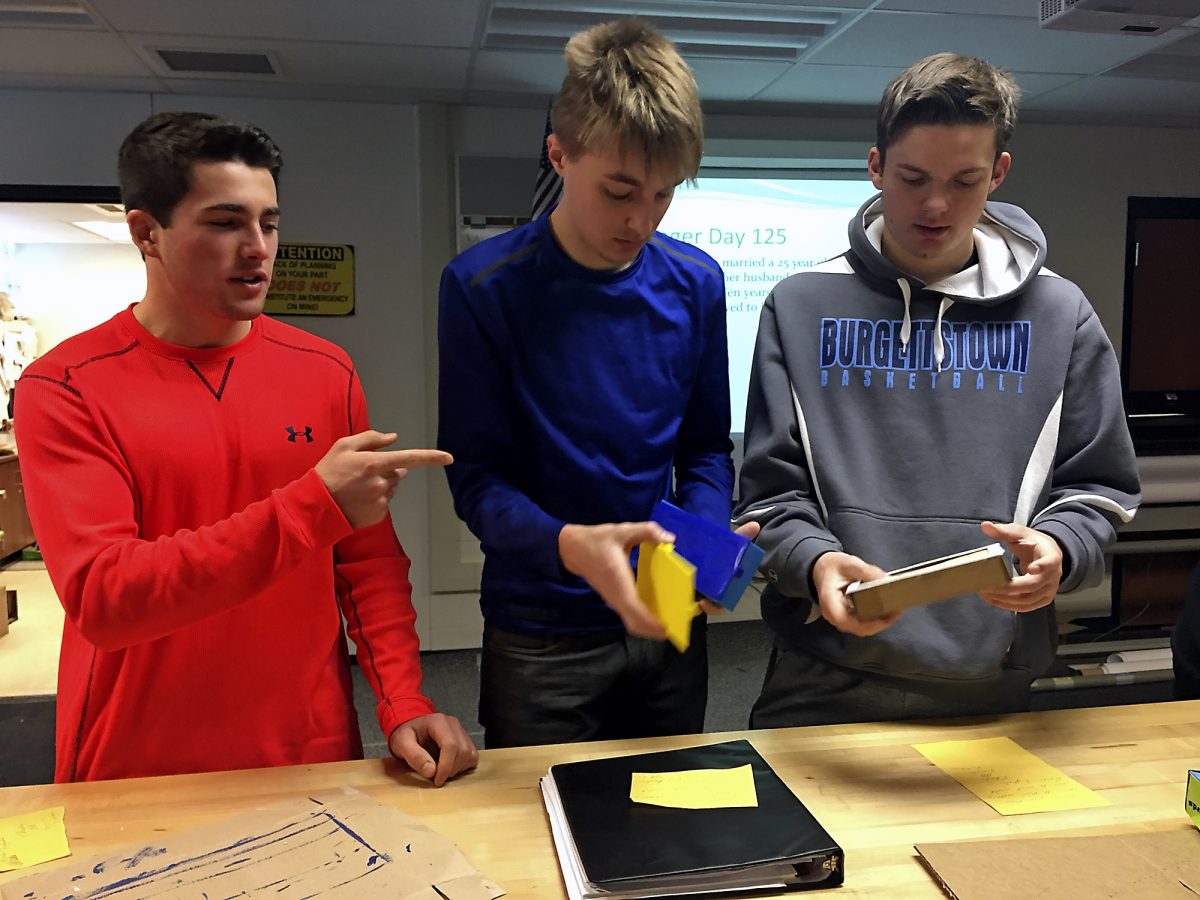
Burgettstown juniors, from left, Joe Demario, Connor Markish and Max Shaw, took top prize against their peers in a “Shark Tank”-like competition at Inventionland in February. The team will compete against other schools in a first-ever regional competition May 17.
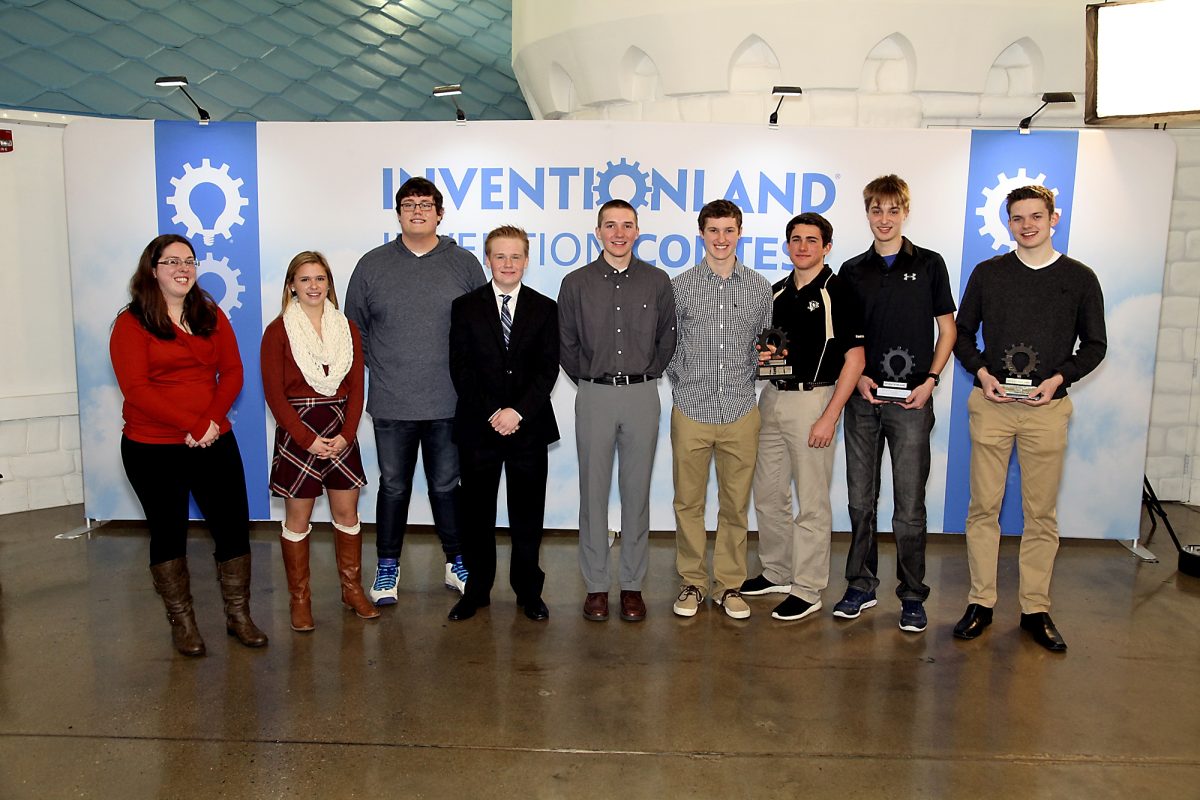
Students in Laura Wells’ STEAM class competed in an inventors competition at Inventionland in February. They are, from left, Wells, Olivia Resnik, Blaine John, Garret Stephens, Clark Miller, Ryan Lounder, Joe Demario, Connor Markish and Max Shaw.
BURGETTSTOWN – Tasked with developing a solution to an everyday problem, Burgettstown Area High School juniors Joe Demario, Connor Markish and Max Shaw pictured a common occurrence: their teachers spraying the whiteboards with water and wiping them with paper towels.
“Even when you erase it, it never gets rid of everything,” Demario said. “You always have a shadow left on the board.”
After months of planning, developing and refining, the team created the Blazer Eraser, a refillable device that attaches to the board and is ready with a new, premoistened towelette for the next cleaning.
Enrolled in Laura Wells’ STEAM class – short for science, technology, engineering, arts and mathematics – they were victorious against their peers during an inventors competition at Inventionland, a Pittsburgh-based factory where retailers, companies and inventors develop their products. This school year, Burgettstown used grant money to introduce Inventionland’s curriculum into senior high classes.
Demario, Markish and Shaw head back to compete against other schools’ winning teams on May 17 in a first-ever regional competition.
“The judges were really impressed with their idea,” said Mandi Figlioli, assistant to the superintendent. “There really aren’t any products on the market that are refillable. It would continue to make money because people have to keep buying wipes. It’s innovative.”
Though the team ultimately had success, members altered the original design several times to fix unforeseen problems.
“That’s OK. This course celebrates failure,” said Nathan Field, Inventionland executive director. “If something didn’t work, you failed, how can you now do it again? Our motto is ‘Fail your way forward.'”
Dubbed an “indoor Disneyland,” Inventionland “creationeers” work amongst 16 scenes, including a motor speedway, a castle and a treehouse, to take ideas through a nine-step method to bring them to market. Their products include everything from household items to pet products and automotive equipment.
The curriculum, being used by Burgettstown and other schools across the region, is based on founder George Davison’s inventing process, which was registered a trademark in 1997.
“We’ve taken those steps and turned it into a course,” Field said. “It’s the same thing we do on a day-to-day basis – how to come up with an idea and walk through the steps, with a prototype at the end to pitch during an invention contest.”
Students and teachers can access the curriculum at any time, from any location. Creationeers train teachers and provide guidance and mentorship to students throughout the process.
Burgettstown students have access to computer-aided design software, 3-D printers and laser cutters. But Field said the course, which is years in the making, can be done with no more than cardboard and hot glue.
Field and Davison started working on the curriculum about a decade ago.
“We were going into a lot of schools and noticed they were taking away art and shop classes and replacing them with computer classes,” Field said. “If you lose that knowledge of how to build things and design things, you’re losing the history of America.”
About four years ago, a visit from South Fayette students spurred the Inventionland team to complete the curriculum.
“I had a lot of course work on the wall in my office. The teacher (Frank Kruth) asked about it (and I told him) it’s something we’ve been working on,” Field said. “He could not wait. He kind of piloted it for us. After that, we thought, ‘OK, maybe we have something.'”
With STEAM education catching on, Field says this course goes a step further to help students apply problem-solving strategies using the technology.
“That’s what I’m excited about – lifelong skills, thinking through a problem and coming up with a solutions,” he said. “The reason why this has taken root in schools is, we were hearing schools were starting to go out and buy 3-D printers and laser cutters. But then, it’s very clinical and asking, ‘What are we doing with this equipment?’ … They don’t know how to use it practically. The curriculum is not just STEM and it’s not just STEAM. It’s applied STEAM. You’re actually applying these theories – applications that can be used in many different ways.”
Inventionland recently formed a relationship with Intermediate Unit 1 administrators to get the curriculum into more schools. Field said the program fosters better attendance, achievement and attitude.
“It’s leveling the playing field,” he said. “We’ve had schools, from private to charter, middle to high school, even college, from very advantaged kids … to students with hardly any stability. The students get excited because it’s all from their idea. That’s why they get so passionate. The course becomes student led instead of teacher led.”
Wells said the students in her classes are in control.
“I try to keep on them, but as far as taking initiative, that’s on them,” she said. “I’ll push them when they need it.”
Field encourages teachers to take a back seat.
“We teach them how to break out of the shell and think differently. Be a facilitator, not just a person in front of a room. Teachers are getting aware there are students out there who are very skilled and talented. It’s so not true that tests tell how smart (a student is). A course like this really brings that to life.”
“None of this is possible if it wasn’t for the teachers … owning it,” he said. “Teachers get so excited. I get excited just talking about it. It changes the culture and way of thinking.”
Figlioli said the participating students have gained confidence.
“The curriculum really encourages the kids that anyone can do it, and everyone can do it,” she said. “It’s really about exposure to different careers. We really want the kids to know the opportunities are endless for what they can do.
“If they don’t get out and see it, they’ll never know about it. One of greatest things about this curriculum is showing the kids what they can do and giving them a path to get there.”