

Merging schools common in the ’60s
In early August, three weeks before classes were to begin, a small group of parents attended a Monessen School Board meeting. Two mothers, contending the district provided limited educational and extracurricular options, urged the directors to consider a merger with another district.
That request did not go far. Dr. Leanne Spazak, the superintendent, told the board previously she had studied mergers and discovered, in many instances, some students ended up with even fewer academic programs and activities from which to choose. She concluded that a merger is feasible only under dire circumstances.
“If we can ever not sustain ourselves financially and we are not providing our students with what we consider a quality education, then (a merger) would be my recommendation,” she said.
Monessen School District, with a 7 percent decline in students since 2011, remains Monessen School District. And may continue to do so.
Public school district mergers are almost a thing of the past in Pennsylvania – the very distant past. There has been only one since the court-ordered Woodland Hills merger in 1981. That occurred in Beaver County, when Center and Monaca came together in 2009.
Fiscal, personnel, infrastructure and transportation issues – and community identity – preclude many districts from even considering a merger. It could very well be costly – not cost-effective – with the resulting district needing building renovations to accommodate a larger enrollment, more instructors and administration than initially targeted, and other facility upgrades.
In the past decade, finances have forced two Southwestern Pennsylvania districts to send some of their students elsewhere. Duquesne, beginning in 2007, kept kindergarten through eighth grade, but gave students in grades nine to 12 the option to attend East Allegheny or West Mifflin Area. And just this school year, Wilkinsburg students in grades seven to 12 started to attend Pittsburgh Westinghouse Academy.
But neither is a full merger.
This is in stark contrast to Pennsylvania’s academic climate 40 to 50 years ago, when mergers were prevalent across the commonwealth – though not commonplace in Washington and Greene counties. The state Department of Education mandated mergers beginning in 1966, and by the end of the 1960s, the number of public districts plummeted from 2,277 to 669. That figure fell to 505 by the end of the ’70s.
Woodland Hills made it 501, when U.S. District Judge Gerald Weber ordered five districts – General Braddock, Churchill, Edgewood, Swissvale and Turtle Creek – to come together in an effort to achieve racial desegregation. Weber handed down his decision in Pittsburgh in April 1981.
Central Valley was born 28 years later, by mutual agreement of two neighboring districts, leaving Pennsylvania with 500 … and holding for now.
Steve Robinson, spokesman for the Pennsylvania School Boards Association, wasn’t aware of the Monessen merger request, as small-scale as it was. But the subject is semi-familiar.
“We always hear rumblings on (mergers),” Robinson said. “We have heard of communities that have talked about mergers like the one Central Valley did, but none have crossed the finish line.”
Those rumblings were more resounding in 2009, when then Gov. Ed Rendell proposed in a budget address that the state slash the number of public districts to 100, each with 5,000-plus students. That 80 percent cut obviously didn’t occur.
Robinson praised the Center and Monaca districts for doing their due diligence en route to forming Central Valley, adding a voluntary merger “is more successful” than a forced consolidation.
“They didn’t walk into that. They studied the situation for years,” Robinson said. “It’s always best to start with a feasibility study to see if it makes sense. Often, people come into the consolidation process assuming it will save money, then find out that isn’t the case.”
John Menhart, superintendent of the Carmichaels Area district, recently has heard talk of forced consolidations in Pennsylvania, but nothing specific. He said Carmichaels did do a merger feasibility study with Southeastern Greene and Jefferson-Morgan, two of the other four Greene County districts, “but that never came to anything.”
“No one wants to give up their community identity,” added Menhart, who plans to retire in June 2018. “We’re so small, we can’t afford to offer as many (academic and extracurricular) things.”
Dr. Charles Stacey opened the interview with an apology.
“My memory is a little foggy,” he said, chuckling. But within minutes, his memory transformed into a bright summer day.
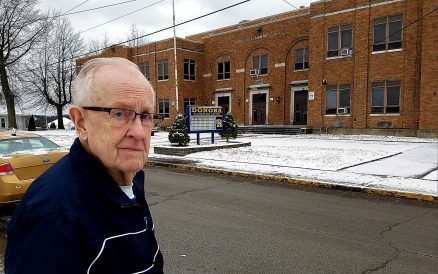
From the beginning. Stacey was involved with one of the most visible ’60s mergers in Western Pennsylvania. That was in 1964, when Greater Monongahela Area and Donora formed Ringgold.
It was a merger of contentious communities, and districts that were staunch rivals athletically and otherwise. There were rifts among the student bodies, but Stacey – a longtime teacher and administrator – said youth weren’t the main sources of vitriol.
“The kids got along better than the parents,” he said. “Parents worried about so many things. We had arguments at school board meetings, one time a fight. People couldn’t believe we had police at these meetings.”
Ringgold, in some ways, operated as split entities for years. High school students attended classes in their “regular” buildings – known as the Monongahela and Donora campuses. And they did so until 1979, when construction of Ringgold High was completed.
Sports teams at both campuses continued to play separately until the 1969-70 academic year. But even after they united, travel dynamics weren’t optimum in a geographically large district. Basketball games and practices, for example, were conducted at Monongahela, a 25-minute commute for Donora kids. Football games and practices, conversely, were held at Donora’s Legion Field.
The transition to a new high school wasn’t easy for many students. Many were riding buses for the first time. Scott Frederick, a retired teacher, said, “We had hundreds of walking students when we had two high schools. We had eight when the new school opened.”
Then right after that school opened, there was a teachers strike.
“After 10 days (of classes), the teachers went on strike for 50 days – the longest strike in Pennsylvania at that time,” Stacey said. “We were just getting the kids settled and the strike happened. We came back and had to start over.”
Both high schools had rich athletic traditions, which, not surprisingly, continued after the teams joined forces. The 1972-73 basketball Rams – featuring Ulice Payne, Joe Montana and Scott Nedrow – were outstanding, finishing with a 29-2 record after falling in the PIAA boys semifinals. That squad also had a significant impact on other students, Frederick said.
“I think that team really pulled the two schools together,” he said. “I really think it was a unifying force.”
Stacey was an assistant principal at the new high school, after years of teaching in the Donora district. He also was the last principal at the Donora campus, and later served as district superintendent (1989-93). Stacey is now retired and satisfied overall with the district.
“It’s worked out well,” he said. “There is still some animosity.”
Ringgold certainly hasn’t been the only newly minted district to be immersed in discord. Consider Belle Vernon Area, a lashup of Rostraver Township and Bellmarette. BVA was created in 1964, but the merger did not become official until two years later, when it was recognized by the state Department of Education.
A member of that first graduating class, in 1967, was Steve Russell, a future BVA superintendent and current general chairman of the Mid Mon Valley All Sports Hall of Fame. He also was the son of James W. Russell, a Rostraver school director.
“Dad became part of the newly merged nine-member school board,” Steve Russell said in an email. “It was a contentious time, and I did hear a number of heated telephone calls. Issues about school district debts and who would be on the final merged board highlighted major issues. Problems existed with adults trying to bring harmony between the Bellmar and Rostraver constituency.”
That, he said, wasn’t the case with students brought together at that time. Russell decribed his teenage peers as “cordial.”
BVA marked its 50th anniversary in August and will celebrate a half-century in operation with a banquet April 29. Russell added work is being completed on a 64-page book detailing the district’s history.
Here are some notable facts, anecdotes and fun-filled nuggets gleaned during the research process for this story:
• Washington is the oldest school district in the Observer-Reporter coverage area, dating to 1867, two years after the end of the Civil War. Next in line is Trinity, which dates to 1925.
• A Scenery Hill resident, who preferred to remain anonymous, recounted her days as a student immersed in the Bentworth merger. She completed junior high in Ellsworth in 1961, months before the Ellsworth and Bentleyville districts consolidated, then was in the first class to complete grades 10, 11 and 12 in the new high school.
“It was called Bentleyville-Ellsworth Area Joint High School at first,” she said. “I was in the band, and we had BE sweaters. Bentleyville and Ellsworth were definitely rivals, and everybody worried about that. But because the towns are so close, you knew everybody from the other schools. We came together quickly. Kids that age are quite bendable.”
• Bentworth’s mascot, the Bearcat, likewise is a byproduct of the merger. It evolved from the Bentleyville Bears and Ellsworth Cats.
• Areawise, McGuffey is the largest district in Washington County at 198 square miles. Burgettstown Area (106) is a distant runner-up, with Trinity third (87).
• West Greene, however, is the runaway largest district in the O-R area, covering 256 square miles. Central Greene (168) is the Greene County runner-up.
• The area around the Fort Cherry school complex was actually a fort at one time, built and occupied by Tom Cherry and his family. It was leveled to make way for the schools.
• The large district west of Washington was named for William Holmes McGuffey, a 19th century educator who developed McGuffey Readers, the first widely used textbooks in the United States.