

Middle East expert and Washington County native speaks at Washington & Jefferson
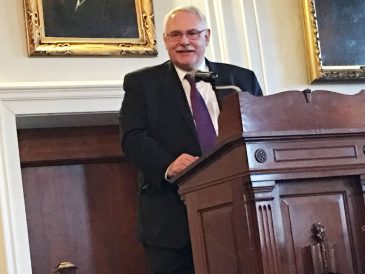
Thirty-four years ago, CIA veteran Norman Roule stood at the front of the auditorium in Old Main on the campus of Washington & Jefferson College, nervously waiting for his bride, Lorie, to walk down the aisle.
On Friday, Roule, an expert on the Middle East and a graduate of Washington & Jefferson College, returned to his alma mater to deliver an address, “The Middle East in 2018: Iran and the Region.”
The lecture, one of the final events of W&J’s annual International Week, included Roule’s analysis of the conflicts in the Middle East, the role of the United States in the region and prospects for peace and prosperity there.
An engaged group that included W&J students, professors, Roule’s parents, in-laws and wife, listened intently and asked questions as Roule shared his expertise and experience in the turbulent Middle East.
A graduate of Beth-Center High School, Roule served for 34 years in the Central Intelligence Agency, managing several programs related to Iran and the Middle East. He served as National Intelligence Manager for Iran (NIM-I) at the Office of the Director of National Intelligence for nine years, until his retirement in Sept. 2017.
Roule, who has worked with five presidents and was involved in the Iran nuclear deal, described the Middle East as “numbed by violence and conflict” that has left hundreds of thousands dead, millions displaced and countries – led by autocrats and monarchs – facing challenges on several fronts, including the war in Syria and Russia’s alliance with Bashar al-Assad, instead of working with European allies to bring stability to the region.
Roule also noted nearly two-thirds of the population in the Middle East is under the age of 30, but the unemployment rate is about 30 percent.
But, he said, despite the challenges, good things have happened in the region: ISIS has been defeated; Iraq has held together; technology and social media is sweeping the region, which can increase prospects for some versions of democracy; dependence on oil is decreasing and the education populations are now considered the most valuable resource in the region.
In Saudi Arabia, particularly, women’s rights have improved.
In other areas, however, including Iran – where women are jailed for removing their hijabs – progress is slower.
Roule said the United States historically has tried to make the world a better place, and that the country has an obligation to help the region succeed.
“If we don’t come up with a way to help the region succeed, we’ll face problems here,” said Roule. “We will face Islamophobia, we will face terrorism, we will face cyberthreats, we will have boys and girls, our nation’s treasures, go to die in the sands of faraway worlds, and we’ll have ourselves to blame.”
He concluded, “I’m still cautiously optimistic. I think we have plenty of reasons for concerns. This is a mess. But there’s so much opportunity for growth.”