

Be on the lookout: Agriculture officials warn of spotted lanternfly’s peril to fruit crops
Barbara S. Miller/Observer-Reporter
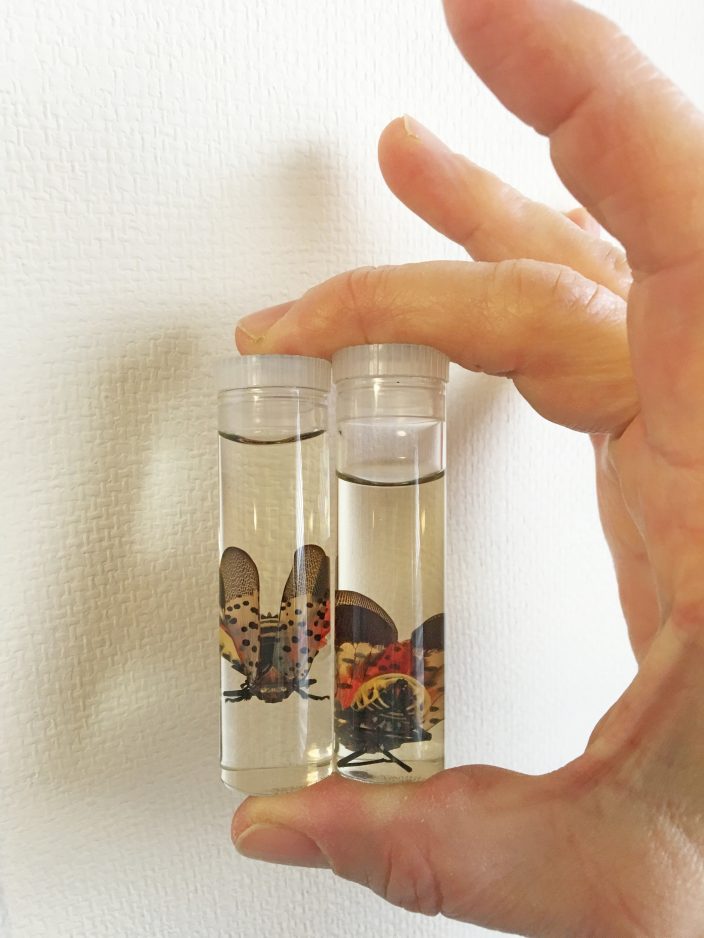
These preserved specimens of spotted lanternflies have been rendered harmless, but the pests have the potential to cause significant damage to fruit crops.
Barbara S. Miller/Observer-Reporter
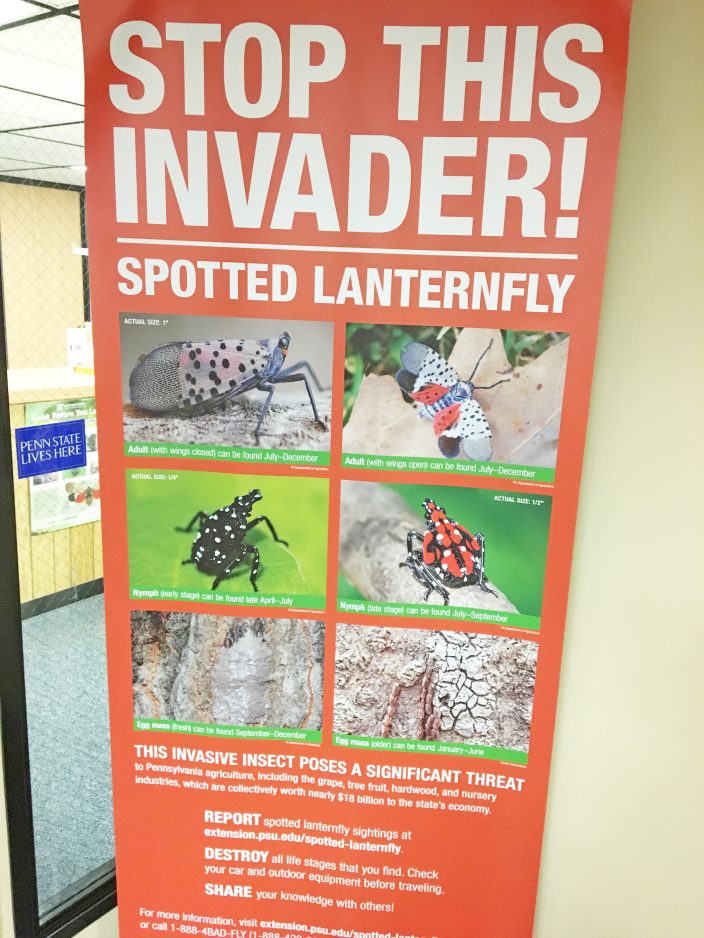
This larger-than-life display outside the Penn State Extension office in Washington County’s Courthouse Square building draws attention to the spotted lanternfly threat.
There’s a dangerous pest positioned in eastern Pennsylvania, and agriculture officials have taken steps in hope it doesn’t spread to this part of the state.
Given its eastern orientation, perhaps this news story will serve, to some, as an introduction to the spotted lanternfly.
The inch-long insect native to Southeast Asia isn’t itself dangerous to people or animals through stings or bites, but it’s very bad news to fruit that we consume or wine that we drink.
“They do a lot of damage, attacking grapes, apples” and what are known as “stone fruits” such as cherries, peaches or plums, said Laura Delach, coordinator for the Penn State Master Gardener program in Washington County.
Loggers, nurseries and brewers also need to be aware. This fly also attacks both hardwoods and pines and hops.
It sucks the juice from fruits and sap from trees, leaving a sticky residue that attracts fungus and mold.
“We all had to take training on it. They’re not nice creatures,” Delach said.
As an example of the importance of the grape crop, Pennsylvania’s wine production ranks fourth in the nation after California, Washington and New York.
A quarantine has been imposed on 13 Southeastern Pennsylvania counties in the Philadelphia area to try to contain the spotted lanternfly.
The state has approved $3 million to combat the spotted lanternfly in 2018-19 to supplement $17.5 million in federal funding from the U.S. Department of Agriculture.
“Penn State is working with the Department of Agriculture to keep this from spreading,” Delach said. “Businesses are required to check out trucks, because they can hitchhike.
“In Korea, it only took four years and it went really far,” Delach added.
According to the state Agriculture Department, South Korea, at 38,622 square miles, is a bit smaller than Pennsylvania’s 46,055.
Lisa Candelore, regional supervisor for the state Department of Agriculture, said there was one report of a possible sighting from the northern Mon Valley in Washington County, but it turned out to be negative. Similar negative reports have originated from southern Allegheny, Westmoreland, and the border area of Beaver and Butler counties since August 2017.
The state has set up a reporting hotline to Penn State Extension staff at 1-888-4BADFLY. There is also a reporting tool at extension.psu.edu/spotted-lanterfly.
Female spotted lanternflies lay egg masses that overwinter in mud mixtures on any available vertical surface, whether it be tree bark or chair cushions.
The flies are especially attracted to another non-native species, the tree of heaven, also known as the ailanthus, which is native to China and Taiwan.
An ailanthus tree can be used as a type of living “trap” when they are treated with a systemic pesticide that the lanternfly will suck, killing them.
Cheryl Allerton, a former Bellevue resident who now lives in Berks County, about 30 miles east of Reading, said she lost five trees to spotted lanternfly in 2016 and another five this year on a 25-acre property, about half of which is woodland.
Once the family began treating their trees, there were so many lanternfly carcasses they had to rake them.
Although it has eye-catching bright red wings speckled with white, Allerton said the color is visible only when the insect’s wings are spread. Otherwise, it’s camouflaged to blend into grayish-brown tree bark.
With no native predator, the spotted lanternfly has flourished.
Allerton walked to a doctor’s office where the pest swarm was thick on a railing and sidewalk.
“I’d step on every one I could,” she said Thursday in a phone interview.
The bugs start laying eggs in late August and September.
“It looks like a little patch of mud,” she said. Egg-laying takes place on cars, bricks of a house, or exterior and interior walls of a barn.
Once she was aware of them, she would scrape them off and crush them.
Seeing the 500 to 600 bugs at the peak of her home’s roof, she feared they’d enter her attic, but that didn’t seem to be the case.
Lanternflies penetrated her apple trees, and she lost two pink dogwoods, but she didn’t know if the dogwoods fell victim to the bugs or rain so constant that foliage couldn’t effectively be sprayed.
She’s pessimistic that the spotted lanternfly can be contained.
“It travels so well,” she said. “It lays its egg sacs everywhere, and if I don’t realize they’re on my car, I’m bringing them to you.”
It’s probably inevitable that unless somebody comes up with something that’s cost-effective from an extermination standpoint, it will be up to individual homeowners to take action.
If they’re not policing their own property, killing the bugs and killing the egg cases, it’s going to spread. If you spend money on chemicals and your neighbor doesn’t, you’re going to have problems.
“We’re kind of all in this together,” said Allerton.