

The last battle of the American Revolution
What was the last battle of the American Revolution?
Easy question, right?
It was the Battle of Yorktown in October of 1781. Well, weren’t there skirmishes in New Jersey in 1782? Oh, and how about the Siege of Fort Henry near Wheeling? That took place from September 11-13 in 1782.
That must surely be the last battle.
But what if I informed you the last battle of the American Revolution took place after Fort Henry, and that it was in Washington County?
That Battle of Yorktown pitted Gen. George Washington and his combined French and Continental force of 17,000 men against Lord Charles Cornwallis and his 9,000 British troops. With the help of the French naval fleet, Washington was able to surround Cornwallis in Yorktown. For three weeks, Cornwallis endured around-the-clock artillery bombardment from land and sea, before he finally surrendered Oct. 17.
Not long after the defeat, peace negotiations began, but this was not the end of the hostilities. Fighting persisted for another year in the western frontier.
The British regiment, Butler’s Rangers and their Shawnee allies, were still very active in the west, and laid siege to Fort Henry in the fall of 1782. Capt. Pratt, commander of the combined British and Native American force surrounding the fort, demanded the surrender of the defenders.
Col. David Shephard had fewer than 50 men to defend the fort, but refused to surrender.
The men successfully defended the fort for two days before they began to run low on gunpowder. Knowing there was a store of powder in a nearby cabin, Elizabeth “Betty” Zane made her famed run from Fort Henry to retrieve the powder. She was successful, and the new supply of powder allowed Col. Shephard and his men to successfully defend the fort until reinforcements arrived.
The British and Shawnee were forced to retreat.
Pratt made the decision to pull back Butler’s Rangers to regroup and resupply before continuing their western offensive. Meanwhile, 100 Shawnee warriors were sent to attack outposts along the frontier.
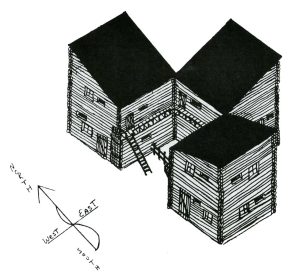
On Sept. 14, the warriors arrived at Daniel Rice’s homestead at the Dutch Fork Settlement near present-day Claysville. There, a large fort was located on the edge of a large terrace. As the Shawnee came over a small hill that overlooked the terrace, they saw men, women and children working the field that surrounded the fort. An account of what followed was published in “Notes on the settlement and Indian wars of the western parts of Virginia and Pennsylvania, from 1763 to 1783” by Joseph Doddridge.
“The Indians had surrounded the place before they were discovered; but they were still at some distance. When discovered the alarm was given, on which every man ran to his cabin for his gun and took refuge in the block house,” Doddridge wrote. “The Indians answering the alarm with a war whoop from their whole line, commenced firing and running towards the fort from every direction.
“It was evidently their intention to take the place by assault; but the fire of the Indians was answered by that of six brave and skilled sharpshooters. This unexpected reception prevented the intended assault and made the Indians take refuge behind logs, stumps and trees.”
The firing continued for about four hours until at 10 p.m., the Native Americans set fire to a barn about 30 yards from the fort, Doddridge wrote.
“The barn was large and full of grain and hay,” he wrote. “The flame was frightful and at first it seemed to endanger the burning of the fort, but the barn stood on lower ground than the fort.
“The night was calm, with the exception of a slight breeze up the creek. This carried the flame and burning splinters in a different direction so that the burning of the barn, which at first was regarded as a dangerous if not fatal occurrence, proved in the issue the means of throwing a strong light to a great distance in every direction, so that the Indians durst not approach the fort to set fire to the cabins, which they might have done, at little risk, under the cover of darkness.”
After the barn was set ablaze, the Native Americans waited on the side of the barn opposite the fort, Doddridge wrote.
The Native Americans were looking “to have the advantage of the light and kept a pretty constant fire, which was steadily answered by that of the fort, until about two o’clock, when the Indians left the place and made a hasty retreat,” Doddridge wrote.
The fort was defended by Jacob Miller, George Lefler, Peter Fullenweider, Daniel Rice, George Felebaum and Jacob Lefler Jr., Doddridge wrote.
“George Felebaum was shot in the forehead, through a port hole, at the second fire of the Indians and instantly expired, so that in reality the defense of the place was made by only five men,” he wrote.
At about 10 a.m. the following morning, 60 men collected at Rice’s fort to provide relief to the battle weary men, Doddridge wrote.
“They pursued the Indians who kept in a body for about two miles,” he wrote. “The Indians had then divided into small parties and took over the hills in different directions, so that they could be tracked no farther. The pursuit was of course given up.”
What Doddridge does not mention in his account is as the first day wore on, the defenders of the fort began to run low on their supply of musket balls and the lead needed to make more. George Felebaum’s wife, in a show of resourcefulness, began fashioning musket balls from pewter utensils.
Although more brittle than those made of lead, the pewter musket balls were sufficient and helped the men to successfully defend the fort. The story of the pewter musket balls was always thought to be a myth. No evidence to confirm the story had ever been found.
In 2012, Washington County Historical Society partnered with National Geographic to film an Episode of the NatGeo show “Diggers” on the history of frontier forts in Western Pennsylvania.
During National Geographic’s survey of the site of Rice’s Fort, George “KG” Wyant uncovered an intact pewter musket ball. The musket ball is likely one of those made by Mrs. Felebaum for the defense of Rice’s Fort in 1782. The pewter musket ball is now part of the collection of Washington County Historical Society.
Back to the question of the actual final battle of the American Revolution.
The two most common answers, the Battle of Yorktown and the Siege of Fort Henry, took place before the Attack at Rice’s Fort. Yorktown was a full year, and Fort Henry was several days before Rice’s Fort.
So the next time it comes up in conversation, you can proudly confirm the last battle of the American Revolution was in fact the Attack of Rice’s Fort September 14-15 of 1782 in Washington County.
Clay Kilgore is executive director of Washington County Historical Society.