

Washington County won’t allow voters to ‘cure’ defective mail-in ballots
Elections officials seeing errors with ‘misdated’ envelopes that won’t be counted
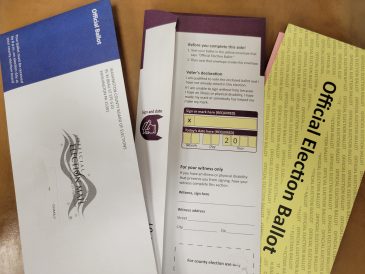 Mike Jones/Observer-Reporter
Washington County will not allow voters who make mistakes with absentee or mail-in ballots to “cure” the errors in order for their vote to be counted.
The county’s elections board, which contains the three commissioners, voted 2-1 to not allow ballot curing in the upcoming primary, with Republicans Nick Sherman and Electra Janis voting against the option, while Democrat Larry Maggi said he wanted to give voters the chance to fix mistakes.
“So we’re not going to notify them to correct that?” Maggi asked before the vote.
“Correct. We want to follow the Third U.S. Circuit Court of Appeals’ ruling,” Sherman responded, alluding to a recent federal court decision determining that undated or misdated ballots should not be counted in Pennsylvania.
Elections Director Melanie Ostrander discussed the issue at length during the board’s meeting Thursday in which she laid out a menu of options on how to handle ballots with defective errors, even if they are minor.
As of Wednesday night, the elections office sent out 13,663 mail-in ballots for the April 23 primary – 10,139 for Democrats and 3,524 for Republicans – and has received a total of 3,834 ballots back. Of that total, 62 have fatal deficiencies on the outer envelope, which are either with missing signatures or are undated or misdated.
But Ostrander noted a quirk she and other county elections officials across the state are seeing in which people are not filling out the final two digits of the year despite the first two numbers of “20” being printed in the date section. The state Department of State redesigned the mail-in ballots and envelopes this year with the hopes that they would offer clearer instructions to voters in order to avoid errors.
“I was very surprised with the new dating issue,” Ostrander said. “That was a new thing to me. Seeing all the ones we’ve had so far with the issue, (the numbers are) going to grow.”
Of the 62 defective ballots, 31 are missing the final two digits in the year, while 21 had no signature and date. Five were signed, but not dated, while one was dated, but not signed.
Three other ballots had the wrong year in which the voter wrote the date of 2022, 2023 and even 2004. Another voter wrote his birthday and then scratched out the “20” and scribbled in “19” in order to finish writing his birth year as part of the date.
All of those votes will not count, although the voter will get an email notification that their ballot has been “received” by the elections office.
“Whatever you decide with curing, these (undated) ballots cannot be counted as they stand now,” Ostrander said.
Ostrander said counties have the option to contact the voter to let them know about the error and give them an opportunity to fix it, or they can mark the ballot as “canceled” so the voter will be notified that they need to take immediate action to request a new ballot or vote provisionally at their polling place. The elections board decided to take the final option, which is to do nothing, meaning the defective ballots will be segregated, but not counted.
Sherman made the motion to “not allow curing” and received an immediate second from Janis. The board was on the verge of voting when Maggi asked if they could discuss the issue further because he had concerns about not counting ballots over a “bureaucratic” step.
“We’re playing right into the hands of the people who say my vote doesn’t count,” Maggi said. “I think we’re going against (voting rights) to not let someone who made a mistake to correct an error.”
“When do you draw the line on procedure? That’s my issue,” Sherman said. “You gotta draw the line somewhere.”
“Isn’t someone’s vote that important?” Maggi said. “I think we should give people the opportunity at least once (to fix the ballot deficiency).”
Ostrander said she’s spoken to elections directors in Beaver and Mercer counties who are seeing similar issues with the misdated envelopes. In all likelihood, Washington County’s decision not to cure ballots will come under fire in the form of a lawsuit.
“The ACLU will come in on one side and the Trump campaign will come in on the other side and there will be a court ruling to change (our decision) anyway,” Sherman said. “No matter what we do today, I’ll bet dollars to doughnuts that we’ll get sued.”
“We’re talking about someone making a bureaucratic (mistake),” Maggi said. “That’s difficult.”
After the lengthy discussion Sherman and Janis voted to not allow ballot curing while Maggi opposed the decision. The final day to request a mail-in or absentee ballot is on Tuesday, and all ballots must be returned to the elections office no later than 8 p.m. April 23.
Also during the meeting, the elections board set up a mechanism for a designated representative with each candidate to be allowed to view the ballot counting process in person while standing in a cordoned off area inside the elections office. The general public will be able to watch the process on a closed-circuit television feed inside the commissioners meeting room.