

Ansys software deployed for Olympic events
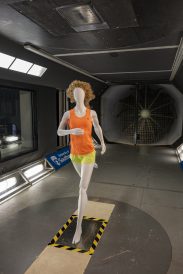 Courtesy of Ansys
Elite athletes have had to rely on a bedrock of skill and sheer determination going back to the first Olympics in 776 B.C., but a little science is now part of the equation.
There’s perhaps no greater evidence of this than the fact that simulation software developed by Ansys, the Southpointe-based company, has been deployed by British researchers to determine whether small personal choices as fundamental as a hairstyle or clothing can add or subtract a precious couple of milliseconds from a sprint or slice centimeters off a jump distance.
The women’s long jump finals are scheduled for the Summer Olympic Games today, and the researchers using the Ansys software at Heriot-Watt University in Edinburgh, Scotland, and KU Leuven University in Leuven, Belgium, have been exploring the aerodynamics of 20 different clothing styles and 10 different hairstyles worn by female athletes in the long jump and 100-meter dash to determine how it would impact performance.
What did they discover? If a female athlete participating in the long jump has long, curly hair, combined with clothing that fits loosely, it can trim up to 10 centimeters off their jump distance, and could be critical in whether they go home with the gold or leave empty-handed.
“There’s a surprising misconception that persists up to the present day among some athletes and their coaches that aerodynamic resistance would not be significant in track and field events,” said Bert Blocken, a professor of aerodynamics at Heriot-Watt University. In a news release from the university, he pointed out that athletes and coaches in other sports, such as cycling, skiing and speed skating, have long factored hair and clothing into their calculations on performance, even as track and field athletes and coaches have resisted.
Blocken added that “this opinion is fundamentally wrong and that hairstyle and clothing can cause significant drag in long jump and 100-meter sprint events. In both events, the impact on performance is enough to lose out on a gold medal.”
Science has been used in a variety of sports in recent years. Researchers have examined the aerodynamics of pitching in baseball and strength training in hockey. To carry out their studies, Blocken and his fellow researchers put plastic, life-sized mannequins in a wind tunnel, and, using the Ansys simulation software, tried varied combinations of clothing and hairstyles. They also used 28 different postures for the long jump.
The results were enough that it could send some athletes straight to a hair stylist. It found that long, curly hair can increase drag by 8.7% in both 100-meter sprint and long jump competitions. The news was even worse for athletes who aren’t fond of body-hugging apparel – the study found that drag goes up by 23% for female athletes wearing shorts and tops that are loose-fitting.
Male athletes were not part of the study, since they traditionally have short hair or shaved heads.
Blocken explained that “even for top athletes, hair caps have almost never been used before in the long jump and 100 meters and that athletic clothing is not systematically tested in wind tunnels. This would certainly reduce the athlete’s aerodynamic resistance and level the playing field for them.”
Future research will examine the impact of various types of socks and shoes.
“Sporting victories are determined by increasingly small margins, and using simulation to improve factors including aerodynamics can provide the competitive advantage to deliver a winning performance,” said Thierry Marchal, the chief technologist for health care and sport in Ansys in Europe, Africa and the Middle East.
Ansys simulation software is also used in such areas as health care, construction and transportation. Earlier this year, it was announced that Ansys is being acquired by Synopsys, a semiconductor and software company in California, in a deal worth $35 billion.