

End of an era
Brownson House to be razed; new building planned across street
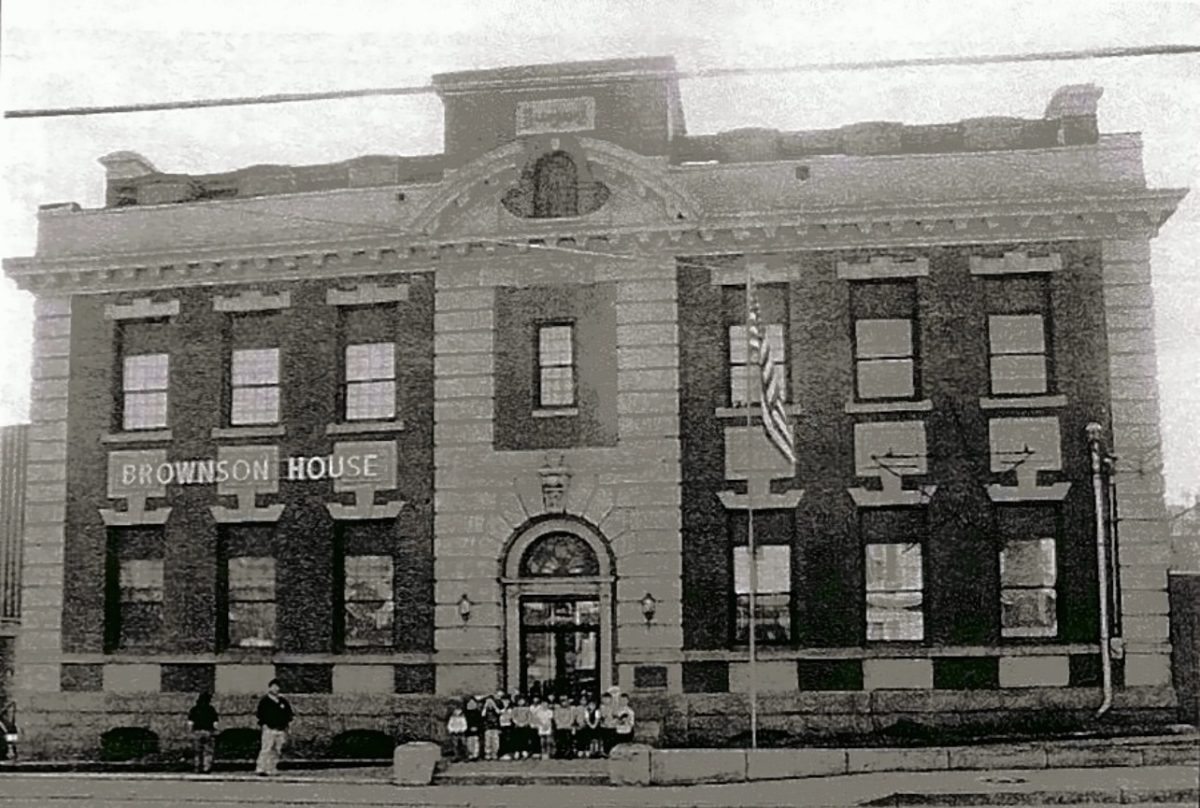


The Brownson House, the sports facility that gave countless Washington area youth their start in athletics, is coming down.
Operating the crumbling 115-year-old building at 1415 Jefferson Ave. has become cost-prohibitive, said Jon Celani, executive director of the Brownson House nonprofit sports organization, who said the decision to demolish was among the most difficult he’s made.
But plans are in the works to construct a new building across the street from the current one.
Celani said the building, constructed in 1910, has a bad roof, water is seeping into the building through the crumbling facade and the boiler is in need of repair.
“We’re looking at extensive amounts of dollars to repair the facility,” Celani said. “Once the facade of the building started to go, I couldn’t keep up with the water coming through the walls. There’s no insulation because it’s such an old building and all the water runs in between the sandstone and the facial brick and the interior brick. Financially, it was probably somewhere close to the millions to get the building back up and running to where we would need it to be.”
Celani said plans for a new building have been in the works for a few years, and he placed a rough cost estimate at about $8.5 to $9 million. No time frame is set for demolition or construction.
The decision was not an easy one for Celani, who has been a Brownson House employee for 36 years, serving as executive director since 2016.
“I grew up here,” he said. “I’ve been involved with the Brownson House in one way, shape or form my whole life except for the four years I was away at college. I have a love for that building. For my first seven years as executive director, I did as much as I could to keep that building open. Everyone has memories in that building. I’m sad to see it go. For us to move forward as an organization, these are some of the things that we have to do.”
Ron Faust, former longtime boys basketball coach at Washington High School, said the building holds many fond memories.
“I’m sorry to see the building torn down, but progress is progress,” he said. “There are an awful lot of memories in that building; the little gymnasium that has a pole in the middle of it. It’s sad to see from a standpoint of how many families came through the Brownson House. When they pass that building I know they have flashbacks to the time they played there or were just there to have some friendly conversation. It’s certainly a loss on one point, but on the other hand, I’m sure the progress is going to be serviceable for many families to come.”
Faust said his grandchildren spend time at the Brownson House now.
“They look forward to that,” he said. “I spend a lot of time in the gym there and I see a lot of familiar faces there.”
Dan Burt, Duquesne University’s women’s basketball coach, said he played football and basketball at the Brownson House, and officiated in the summer basketball leagues for 20 years. He was a member of the seventh-grade basketball championship team in 1983.
“I proudly display that championship trophy in my office at Duquesne,” Burt said. “The Brownson House was always an important part of childhood. ”
Burt called it a “sad day” for the community.
“We have to find resources, grants, and members of the community to develop new ideas and revenue streams to build a facility that meets the needs of our community and honor the Brownson House legacy,” Burt said.
The nonprofit sports organization was formed in 1926, and in 1937, moved into its current space on Jefferson, previously occupied by the former Tyler and Pipe Co. James I. Brownson, a former Washington County judge, eventually purchased the building. It was named in his honor at the time of his death in 1939.
Celani said most of the activities take place in the Brownson House gymnasium, which was built in 1963 and serves as a location for many sports. Some organizations, such as Soccer Shots, rent the facility, while others rent the gymnasium for personal training. Boxing is held in the building’s basement, but Celani said the same will be moving to the third floor of the Freedom Center on East Chestnut Street.
With the Brownson House closing in on its 100th anniversary in 2026, Celani said the timing is ideal to kick off the organization’s capital campaign to raise funds for a new two-court facility that will be built across the street.
“For us to compete with the new facilities that are coming up all around us, we have to provide new facilities,” Celani said. “With two gym courts, we could generate more revenue and we would be able to compete a little better against some of these big facilities and be able to offer more programming. I want to move the organization to the point where in four or five years, when it’s time for me to move on, the kids have a new facility.”