

Potential data center dominates conversation in South Strabane
 Jon Andreassi
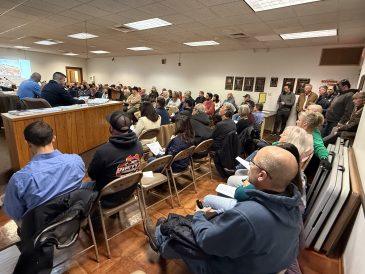
Despite the topic not appearing on the agenda, South Strabane residents turned out in big numbers Tuesday to voice concerns about a potential AI data center in the township.
The public comment portion of Tuesday’s meeting lasted nearly an hour, with discussion focusing mostly on the CNX Resources-owned land that is being marketed as a site for a data center.
Dennis Makel, South Strabane’s solicitor, said supervisors will hold a public hearing on an ordinance regulating data centers at their January meeting. He suggested to Bob Weber, chair of the board of supervisors, that the matter may be worth calling a special meeting.
“What we may want to do, Mr. Weber, is have a meeting just for that one thing, that one item only,” Makel said.
Real estate firm JLL is marketing the 1,400-acre tract of land off of Zediker Station Road as having 400 buildable acres for a data center. A brochure created by JLL shows a couple potential layouts, each featuring more than 40 buildings.
However, South Strabane officials have received no applications to build one. Dan Adamski, executive managing director for JLL, said in a phone interview Wednesday there is currently no buyer for the property.
He also stressed any potential buyer may not have the intentions of building a data center.
“We believe the highest and best use is a data center. That doesn’t preclude other uses,” Adamski said.
Makel suggested that an ordinance could regulate data centers, but that outlawing them would likely not survive a court challenge.
“Whatever we do must be legal. You cannot say, ‘We can’t have data centers in this township,'” Makel said. “Whatever we do has to be meticulous, has to be well thought, and so forth. I don’t want to pass something and have it challenged and then it gets kicked out, and we have no protections.”
South Strabane resident Diane Ecker spoke at Tuesday’s meeting to voice concerns about the potential pollution caused by a data center, both from chemicals released by such a facility and the noise they generate.
“With noise pollution, these data centers emit decibels that range from 75 to 96 decibels, when 85 decibels can cause hearing damage. The chronic, high-level noise will disrupt sleep, cause headaches, raise stress hormones and increase the risk for hypertension and cardiovascular disease, as well as prevent those living nearby from opening windows or enjoying outdoor space,” Ecker said.
Adamski argued Wednesday that the decibel levels produced by a data center are “much lower” than other permitted uses of the land, and that it would be far enough away from neighbors.
“At the property line, you won’t even know it’s there,” Adamski said.
Residents at the meeting also questioned the touted economic benefits a data center brings, with concerns that the construction jobs provided would be temporary, while more permanent jobs would be filled by remote workers out of the state.
Adamski pushed back on these concerns by saying that jobs would be “absolutely local” and well paid.
“These are multibillion-dollar facilities that are physical assets. You have to have people on the ground. You have to have technicians,” Adamski said.
He also suggested that a data center would become the biggest source of property tax revenue in Washington County, while requiring little in the way of municipal services.
According to Adamski, the number of buildings involved in the development of a data center would provide a “decade of work” for those involved in their construction.
Also at South Strabane’s meeting, the supervisors opened public hearings on ordinances related to solar energy and battery energy storage systems. These hearings were continued, and no action was taken on the ordinances.
Linda Rumbaugh spoke out against solar farms with concerns about their environmental impact and noise pollution.
She suggested the supervisors amend the current ordinance to expand the setback for solar farms from the current 300 feet.
“I am asking all the supervisors to make the change on the ordinance to 1,000 feet from the property line and residential housing,” Rumbaugh said