

Commissioners approve formation of committee to review opioid grants
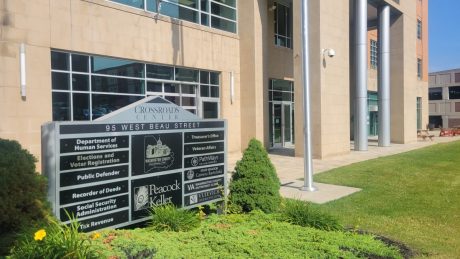
The Washington County commissioners are forming a committee to review applications from organizations seeking grants from the nationwide opioid settlement.
The board voted unanimously during its Thursday meeting to create the “Opioid Advisory Committee” that will be tasked with evaluating and recommending which project should receive grant approval from the commissioners through the state’s Opioid Trust Fund.
An initial proposal for the committee’s make-up would include seven members appointed by the commissioners, which would have a representative with experience or expertise in public education, health care, drug addiction, counseling, treatment and prevention. The committee could also include community members from the city of Washington and Cecil, North Strabane and Peters townships since they were the four municipalities that joined the lawsuit against the pharmaceutical companies, although those discussions are still in the preliminary stages.
While there was no discussion by the commissioners before voting at Thursday’s meeting, they did briefly speak about the committee during Tuesday’s agenda-setting meeting.
“Have we chosen the makeup of the board yet?” Commissioner Larry Maggi asked.
“My recommendation would be to consider and approve the policy (first), then in January you make the appointments,” county solicitor Gary Sweat said.
Sweat said it was “not mandatory” to draw representatives from the four participating communities, although Commissioner Chairman Nick Sherman said that was recommended during a recent statewide meeting by the County Commissioners Association of Pennsylvania.
“Inevitably, we don’t have to do that,” Sherman said.
“Are we going to have a legitimate discussion on this?” Maggi asked about who will sit on the committee.
“Yes,” Sherman said. “We just haven’t had it yet.”
Once the members of the committee are named, they will review grant requests submitted through the county Department of Human Services, schedule workshops with the applicants and hold public hearings to allow organizations a chance to explain how they will use the money. There will also be a “scoring criteria” with several topics that will be evaluated during the process.
Previously, a three-person committee that included county Administrator Daryl Price, Human Services Director John Tamiggi and his deputy, Tiffany Milovac, reviewed applications and sent a list of grant recipients to the county commissioners for final approval.
The process has come under scrutiny after the Pennsylvania Opioid Misuse and Addiction Abatement Trust’s dispute resolution committee met Dec. 4 to review more than 200 grants from across the state. That committee determined eight grants in Washington County were “non-compliant,” while another nine were listed as “still under consideration.” Eleven other grants from Washington County were approved, along with an additional 22 from the March reporting period.
Laura Dieterle, who serves as director of Clinical and Case Management Services for Washington Drug and Alcohol Commission, spoke during public comment at Thursday’s meeting and said she is concerned about the appointments coming from the board of commissioners. She claimed the commissioners have made “questionable” decisions with opioid settlement grants over the past year, which resulted in some being non-compliant while others remain under review.
“These funds represent both an opportunity and a responsibility to improve the health of our community,” Dieterle said. “The structure being proposed today raises serious concerns about governance, representation and public trust. A review board charged with stewarding these funds should reflect the full reality in Washington County.”
She hoped whoever was named to the board would have a diverse background that included people with “lived experiences” with substance abuse, family members who have lost relatives or are supporting someone in recovery and experts in the field.
“These perspectives are not optional,” Dieterle said. “They’re essential in making decisions that align both with community needs and the intent of this money.”
Others who spoke in public comment – including several who received opioid settlement grants that were deemed either non-compliant or still under review – praised the work of Sherman and fellow Republican Commissioner Electra Janis, who are the majority on the board.
Mel Blount, who is a former Pittsburgh Steelers defensive back and runs the Mel Blount Youth Home in Buffalo Township, thanked Sherman and Janis for “getting involved in the community, working with people and programs like myself to make a difference.” His organization helps disadvantaged youngsters, and it recently received a $15,000 opioid grant to provide scholarships to participants in four inner-city youth programs, although that request is still under review.
“There’s an old saying that an ounce of prevention is worth a pound of cure,” Blount said. “I don’t want it to go unnoticed that since we’ve had this leadership with the commissioners that we have now, they have not only gotten involved in my program, but other programs in the community.”
He told the commissioners he thought grants for such programs would help prevent substance abuse later down the road.
“I look forward to even a better future,” Blount said. “If we can continue to invest in our young people, then we’re investing in our future.”
The county has allocated $4.7 million in opioid settlement grants over four rounds since September 2024. The county will be able to allocate these grants annually for 18 years as part of the nationwide opioid settlement, with the money being sent to individual states and then filtered to the counties to determine how it should be used.
Also during the meeting, the commissioners voted 2-1 to ask Sweat to draft an ordinance to repeal and replace the current disbursement model for hotel tax revenue that goes to the county’s Tourism Promotion Agency. The plans call for 76% of the hotel tax revenue to go into a joint account between the tourism agency and county that will give the commissioners a say on how it’s spent, along with 20% that goes directly to the agency and 4% to the county treasurer’s office as an administrative fee.
Questions have been raised about whether a joint account is legal under the Pennsylvania County Code since the money is supposed to go directly to the county’s designated tourist promotion agency.
“I think we’re going against the county code and I think there’s going to be lawsuits against this,” said Maggi, who voted against the measure.
Sherman said he wants the change for “transparency, full clarity, where money’s going (and) how it’s being spent” on tourism projects.
“We have asked for clarification on audits that have already been given to us and we have not gotten that,” Sherman said. “I believe that the money needs to go back directly to you, the taxpayer. … I believe questions need to be answered.”
Jeff Kotula, who is president of the Washington County Chamber of Commerce & Travel Promotion Agency, said he was “shocked” by the decision to move forward with the proposed changes, although he expects the legality of the ordinance will be challenged in court if the commissioners ultimately pass it.
“However, it is early in the process, and we are certain that as the county solicitor continues his legal review, he will advise the commissioners that the entire ordinance directly conflicts with the language of the law and would not recommend enacting an ordinance that could draw the county into a lawsuit because it was illegal from the start,” Kotula said.
The hotel tax brought in more than $2.2 million last year, and the tourism promotion agency received 96% of that revenue.