

Creator of McDonald’s Big Mac hailed from Uniontown
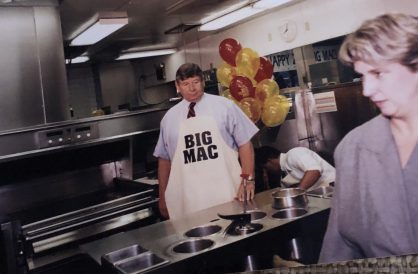
This is the fast-food jingle you know, even if you don’t know it.
“Two all-beef patties, special sauce, lettuce, cheese, pickles, onions on a sesame-seed bun…”
It was the musical recipe for the Big Mac, the multi-decker sandwich sensation from the McDonald’s ad campaign that went viral in 1974 — or, what passed for viral 52 years ago — when the commercials featuring it were unleashed on TV and radio.
Kids sang the jingle on the playground at recess.
Their moms and dads did the same (tried to, anyway) at the McDonald’s counter, where, if they could rattle it off — fast, with no flubs — they could get a free Big Mac.
Meanwhile, Jim Delligatti’s birthday is Sunday.
And, if you’re so inclined, you might even want to consider warbling the above ditty in his honor, instead of that other tune people normally summon to celebrate the yearly trip around the sun.
Who’s Jim Delligatti, you ask?
In the McDonald’s pantheon, Delligatti, who was 98 when he died in 2016, is still a star with a light that shines like the Golden Arches.
That’s what the guy who was born in Uniontown, and grew up in Fairmont, W.Va., gets for inventing the Big Mac.
McDonald’s on Sunday is celebrating National Big Mac Day on the occasion of his birth with an arching nod to signature sandwich.
A little burger-backstory is in order.
Order up
Delligatti was born Aug. 2, 1918, in Uniontown, and spent his boyhood and teen years just down the road in Fairmont in neighboring West Virginia.
The McDonald’s franchisee hit the griddle in earnest with the Big Mac in 1967, when he finally convinced the burger brass that such an offering would work — even if it did clock in at 45 cents. That’s $4.50 in today’s dollars.
Before the Big Mac, a regular burger at McDonald’s rang the register at 18 cents ($1.80 in 2026 prices), and the chain feared customers wouldn’t pay for a sandwich costing two-and-a-half more times than anything else on the menu.
“Actually, I wanted to do a big sandwich a couple of years before that, but they wouldn’t let me,” Delligatti told Fairmont newspaperman John Veasey during a visit to his hometown in 2007.
So, he went ahead and did it anyway, offering his own field test for his customers of the McDonald’s he was running in Uniontown then.
“I knew it was gonna be good,” he said.
That’s because he knew fast food.
Adventure — to go
Delligatti knocked around a bit after his graduation from Fairmont Senior High School in 1936, picking up any job he could get in a town still reeling from the Depression.
In 1942, at the height of World War II, he got his draft notice and soon shipped out for the fighting in Europe.
Fairmont didn’t hold much for him after he got back, so he hitchhiked to Southern California, drawn by America’s post-war boom.
He ended up working in restaurants there, eventually opening his own on the beach. He liked the business.
He liked the food preparation, the marketing and the interaction with customers, especially.
After a while, he boomeranged back to this side of the country, where he and a buddy started their own version of a SoCal drive-in burger joint in Pittsburgh.
He stopped by the McDonald’s booth at a restaurant trade show in Chicago in 1955 and struck up a conversation with Ray Kroc. He ended up making a career under the arches.
Delligatti and his family would go on to operate several McDonald’s franchises in the Pittsburgh area.
One in North Huntingdon, around 20 miles from Pittsburgh and just off the Irwin exit of the Pennsylvania Turnpike, even houses, with corporate blessing, an official “Big Mac Museum” — complete with memorabilia and a 14-foot sculpture of the sandwich.
This particular McDonald’s, which is owned and operated by Delligatti’s son, Mike, is also resplendent in the vintage architecture of the chain, with the glass-paneled entrances and arches incorporated into the structure. It’s a bit of a destination.
Food familiarity, beckoning from the highway, packaged as a genuine roadside attraction and its own museum — replete with artifacts and ephemera of which we can all identify.
Two all-beef patties (again)
The Big Mac, amazingly, after all these years, still generates big traffic all its own, even if it is sandwiched between lots of other items on the menu these days. According to national numbers, McDonald’s sells more than 550 million Big Macs in the U.S. alone.
Mike Delligatti sees his dad’s creation as an all-beef metaphor of the American Dream.
“It’s more than a burger,” the son said. “It’s a symbol of creativity, tradition and the power of a simple idea to bring people together.”
People here, there and everywhere – as the sandwich is also sold at franchises in more than 100 countries worldwide.
Jim Delligatti went worldwide, also, following his death 10 years ago at his home in suburban Pittsburgh. His obituary appeared in media outlets from Alabama to Australia.
And, he was true to the brand.
The man who was pushing 100 still enjoyed a Big Mac a week: Two all-beef patties, special sauce, lettuce, cheese, pickles, onions on a sesame-seed bun … and all.