

Two measles deaths reported in Pennsylvania, the first in decades
Cases are spreading across the state
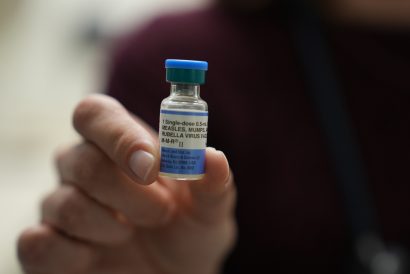
Pennsylvania reached a grim milestone Tuesday with the state’s health department confirming the first two measles-associated deaths in decades.
The last time someone died of the measles in Pennsylvania was 35 years ago, when George H.W. Bush was president, the Soviet Union still existed and artificial intelligence was still the stuff of science fiction.
The deaths of the two individuals, whose identities and ages were not revealed by the Pennsylvania Department of Health, are the first reported amid a measles outbreak that has been centered in Lancaster, Chester and York counties, but is spreading across the state. No cases have been reported yet in Washington, Greene or Fayette counties, but measles has started to appear in nearby counties like Indiana, which has eight cases reported, and Somerset, which has three. So far, cases have been reported in 28 of the state’s 67 counties.
The two people who died were not vaccinated. As of Wednesday morning, there were almost 400 reported cases, with 86 of those cases emerging in the last week. In 2025, there were 16 reported cases of measles in Pennsylvania for the entire year, and in 2024 there were only six.
According to Neal Baker, director of emergency medicine at WVU Medicine Uniontown Hospital, “I grew up in Bentleyville and have practiced medicine for about 16 years, and I don’t believe I’ve ever seen a confirmed case of measles. To me, that is a testament to the success of vaccination. We don’t want to see diseases that have become extremely uncommon begin circulating in our communities again.”
Pennsylvania ranks third in the country when it comes to measles cases, behind South Carolina and Utah. Thomas Corkery, the chief medical officer at AHN Canonsburg Hospital, said “you would have to be naive” to believe that measles will not eventually turn up in this part of the state.
Gov. Josh Shapiro was joined by Pennsylvania Secretary of Health Dr. Debra Bogen at Lancaster General Hospital Tuesday afternoon, where they urged Pennsylvanians to get the MMR vaccine if they have not already done so. The vaccine is typically administered in two doses, first when a child is about 1 and again between the ages of 4 and 6.
“We hope, we pray, these deaths will be the last,” Shapiro said. He added that deaths from measles “are completely preventable. … The disease does not respect county lines or religious lines. It goes after all those who are unprotected.”
Bogen pointed out that because measles was largely eliminated in Pennsylvania for more than three decades, “people are not familiar with this disease and don’t fully understand the potential severity of the illness. We want to ensure every Pennsylvanian has the information they need to protect themselves, their loved ones and their communities.”
She added, “As a physician, I want to make sure that people understand that the MMR vaccine is safe and provides the best protection we have against measles.”
Like other viruses, measles spreads when an infected person breathes, coughs or sneezes. The virus is infectious in the air and on surfaces for up to two hours. At the onset of measles, those who are infected can have a cough, runny nose and watery eyes. Within a few days, a rash starts on the head and spreads downward. Symptoms start within a week to three weeks after exposure.
“One of our biggest concerns with measles is how easily it spreads,” Baker said. “It’s not simply about the rash. Some patients can become very ill, particularly those who may be more vulnerable to complications. That’s why prevention through vaccination and quickly identifying a potential case are so important.”
Though measles commonly affects children, it can also hit older adults and those with underlying conditions, according to Meredith Aumer, the chief nursing officer at WVU Medicine Uniontown Hospital. She explained, “We worry about the complications that can follow, including pneumonia, secondary infections, and, in severe cases, serious systemic illness such as sepsis. That’s why early recognition is so important. We want to identify a potential case quickly, isolate appropriately, and make sure the patient receives the care they need while protecting others from exposure.”
Deaths from measles are relatively rare, occurring in 1 to 3 patients per 1,000 cases.
“These tragic deaths remind us that measles is not a harmless virus,” said Dr. Jeffrey Martin of Lancaster General Hospital, at the press conference with Shapiro and Bogen.