

LSA grants include $1.95M for Washington County’s emergency radio upgrades
54 projects receive portion of $9.526M from casino gambling revenue
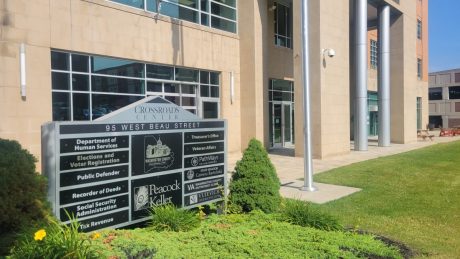
The Washington County commissioners approved 54 projects to receive a portion of this year’s Local Share Account money, including nearly $2 million that will be going directly to the county as it works to upgrade its emergency radio network.
The commissioners during their Thursday meeting unanimously approved the list of grant awards from the $9.526 million that is available from a portion of the gambling revenue at the Hollywood Casino at The Meadows in North Strabane.
More than 20% of this year’s total LSA grant money is going to the county’s public safety department, which will receive $1.95 million as emergency officials are in the process of implementing the new radio network. In a split vote in August 2024, the commissioners authorized a $24.4 million contract with Motorola Solutions to implement the new P-25 public safety radio system, which is expected to be operational early next year.
The amount of revenue was down about $500,000 this year compared to the $10 million available for grants last year. The 11-person LSA review committee evaluated 130 applications last month before sending its recommendations to the commissioners for final approval.
“This year’s LSA process was more difficult than in past years due to reduced local share revenue,” commission Chairman Nick Sherman said in a written statement following the meeting. “I commend the committee for its recommendations, particularly the decision to partially fund the 911 Radio Project. This funding will impact every municipality in Washington County and is an important step in improving public safety.”
Following the county’s grant, the next highest allocations were $700,000 for the Ridge Road Sanitary Lift Station, $600,000 to the Mount Pleasant Township Municipal Authority for the Southview sanitary sewer system and $400,000 for waterline extension projects in Somerset Township.
“This program has proven to be very beneficial to all the communities in Washington County and this year it is providing financial assistance to Boy Scouts, historical societies, and parks, while supporting job training, economic development, and public interest projects,” Commissioner Larry Maggi said in a written statement.
Commissioner Electra Janis said she was pleased some of the money was being steered toward job-training projects, especially at some of the local school districts for students to attain a commercial driver’s license.
“Allowing students to earn (their CDL) before graduating high school creates strong job opportunities without college debt,” Janis said in a written statement. “There is significant demand for drivers locally and regionally, and these programs provide students with a clear path to productive, well-paying careers.”
A full list of the LSA grants can be found online at www.observer-reporter.com.
After the voting meeting, the county’s salary board – which includes all three commissioners and county Controller Heather Sheatler – convened in what became a contentious discussion over whether an unelected government worker should be allowed to cast a tie-breaking vote.
At issue was whether county Human Services Director John Tamiggi should be permitted to vote on the salary board for personnel decisions involving his department. Maggi took exception with Sherman’s insistence that Tamiggi be allowed to be the tie-breaking vote to create two positions – a community strategy engagement director who will be paid a salary of $80,000 and an interagency collaboration manager who will be paid $52,000.
“I think we’re in violation of the County Code,” Maggi said. “I think it will be litigated.”
A similar discussion was held during last month’s salary board meeting, which ended with the commissioners asking solicitor Gary Sweat to research the topic. Sweat said there can be a “floating” fifth member on the board and that an “executive head” such as Tamiggi is permitted to vote under Section 14725(a) of the County Code, although he admitted “it could be challenged.” Sweat added there is no case law for such a situation since there has never been a lawsuit involving the topic.
“I would caution you that if you allow Dr. Tamiggi to vote, there could be consequences to this,” Maggi said. “This will be litigated.”
“That’s the decision of whoever would like to litigate it,” Sherman said.
Maggi said he has concerns that the new positions are designed to create in-house drug and alcohol treatment services to replace the current Washington Drug and Alcohol Commission that is currently the single county authority. Maggi said he spoke to officials with the County Commissioners Association of Pennsylvania recently who told him Tamiggi voting would be an unprecedented move to have an at-will employee cast the tie-breaker for the salary board.
“Are you ready to make history?” Maggi asked Tamiggi before the vote.
Maggi then asked to table the vote, which failed with a lack of a majority. Moments later, the salary board voted 3-2 to create the two new positions, with Sherman, Janis and Tamiggi voting in favor and Maggi and Sheatler voting against it.
In a phone interview following the meeting, CCAP Executive Director Kyle Kopko said “executive heads” are permitted to vote in salary board matters involving their agencies, but he did not know Tamiggi’s job description so he could not comment on whether he was eligible.
“This would be whether they are an executive head,” Kopko said. “It really is a legal issue. It’s a matter of statutory interpretation.”