

‘Virtually unknown’: Washington-born Alexander Clark an important 19th century civil rights leader
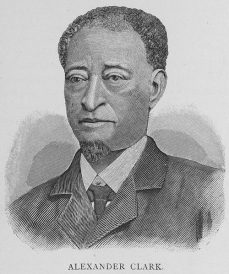
According to historians who have closely studied his hectic life and the tumultuous times in which he lived, Alexander Clark may be one of the most important figures in Black history that you’ve never heard of.
So just who was he?
He was born almost 200 years ago in Washington, on Feb. 25, 1826. He arrived a little more than 30 years after the Whiskey Rebellion roiled the area. John Quincy Adams was in the White House, and slavery was still legal in large parts of the United States. In the places where it wasn’t allowed, Black Americans were still subject to discrimination or laws that barred them from voting, enrolling in public schools and other markers of full civic participation.
Clark’s parents had both been enslaved and freed, and the exact location of Clark’s birth in Washington has been lost to time, though it’s believed to have been near the current location of the Washington County Courthouse. His beginnings might have been inauspicious, but Clark nevertheless went on to become a leading figure in the fight for Black equality and the abolition of slavery in the 1800s.
An acquaintance of Frederick Douglass, the leading American abolitionist of the 19th century, Clark spearheaded a lawsuit that was considered a forerunner to Brown vs. Board of Education, the pivotal 1954 U.S. Supreme Court case that ended segregation in America’s public schools, and was the U.S. ambassador to Liberia at the end of his life.
Kent Sissel, who lives in the six-bay farmhouse in Muscatine, Iowa, that was Clark’s home and has extensively researched Clark’s life, put it this way for a documentary on Clark that was made for Iowa PBS: “He is a very important figure in the history of race relations and law, but he’s also a virtually unknown figure. It’s kind of an oddity.”
In a recent phone interview, Sissel elaborated that there has been “a process of finding ways to promote the heritage of his accomplishments. It’s happening, but it’s been very slow.”
Clark spent his formative years in Washington, when agriculture was still the bedrock of the county’s economy. There was “a degree of wealth in his family,” according to Sissel – Clark’s grandfather was George Darnes, who owned real estate in the Pittsburgh region and helped establish a school for Black students in Washington.
When he was 13, Clark traveled 260 miles west to Cincinnati, where he trained to be a barber and lived with his aunt and uncle, William and Rebecca Darnes, who were also well off due to property holdings. Though it has not been verified, Sissel believes Clark might have attended Oberlin College, the institution outside Cleveland that started admitting Black students in 1835.
His time in Cincinnati was brief – he soon started traveling up and down the Mississippi River on a steamboat, and eventually settled in Muscatine. Why Clark decided to put down roots in the community, which sits on the Mississippi River and is close to the border separating Iowa and Illinois, is still something of a mystery. Sissel believes he knew people in the town who were able to open doors for him. It has also been suggested that in his role as a barber he was able to get to know well-connected people. Muscatine became a haven for Blacks freeing slavery, since it was less than 100 miles from Missouri, a slave state.
While the lives of Black Americans were circumscribed in many ways, in Iowa there was no prohibition on property ownership, and Clark was able to thrive that way and through other entrepreneurial activities. By the 1850s, he became an outspoken advocate for abolition and Black civil rights. He even enlisted to fight for the Union in the Civil War when he was 37.
Two years after the war ended, Clark attempted to enroll his daughter in a Muscatine public school, but she was turned away because she was Black. In response, Clark sued the Muscatine school board. Ultimately, the Iowa Supreme Court sided with Clark and schools in Iowa were desegregated. He also led a fight within Iowa to give Black citizens the right to vote.
Clark himself is credited with saying, “No system of education is complete that does not harden the hands and toughen the muscles, while it also develops the intellect and enlarges the heart. … Only through work do we attain the true symmetry, strength and glory of godly manhood and womanhood.”
Clark’s son became the first Black student to receive a law degree from the University of Iowa, and Clark himself did the same shortly after. Aside from practicing law, he also purchased the Chicago Conservator newspaper, and was its editor for three years. His skills as an orator were praised, and he was active in the Republican Party. The capstone of his life and career came when President Benjamin Harrison appointed him to be the ambassador to Liberia in 1890.
The Monongahela Valley Republican newspaper took note of Clark’s appointment: “It has often been said that it is the plodder who goes there. There are many examples of this ancient adage, but few more striking than the case of Alexander Clark, a colored man of Iowa.”
However, Clark’s stint as an ambassador was short-lived – he died in Liberia as a result of a fever and died just nine months after he was appointed. His body was returned to Muscatine and he is buried beneath a weathered stone in a cemetery along the Mississippi River.
Even if his accomplishments are not widely known, they were substantial, according to Daniel Clark, a longtime member of the Alexander Clark Foundation, and no relation. He possessed “a sense of timing,” Daniel Clark believes.
“He seemed to be able to get along with people,” he added. “He could be a mediator, a good listener and learn, and he knew when to make bold and courageous moves.”