

Here comes the sun?
U.S. House votes to make daylight saving time permanent
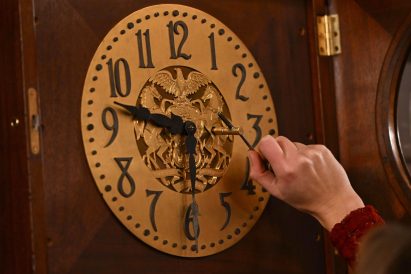
At this time of year, when the sun rises around 6 a.m. and doesn’t set until close to 9 p.m., those winter days that seem shrouded in darkness and chill can seem very far away.
But they were on the minds of members of the U.S. House of Representatives on Tuesday, when a solid bipartisan majority voted to make daylight saving time permanent across the country. It would end the ritual of moving clocks forward in the spring and moving them back in the fall.
A change like that would be fine with Jan Marchezak, who operates a farm and petting zoo in Somerset Township. She points out that “when you raise livestock, they have an internal clock,” and that their feeding times go out of whack every time the hands of the clock are moved around.
“I will take all the daylight hours we can get,” Marchezak added.
Jim Garrity, director of public affairs for AAA East Central, said the automobile association’s focus “is roadway safety, and we support ending the twice-yearly clock changes, because they disrupt sleep and can increase the risk of drowsy driving.”
He continued, “A consistent, year-round clock would allow people’s bodies to naturally adjust to seasonal changes in daylight.”
U.S. Rep. Guy Reschenthaler, a Republican who represents all of Washington, Greene and Fayette counties in Congress, along with portions of Westmoreland, Indiana and Somerset counties, supported what has been called the Sunshine Protection Act. Meanwhile, his Democratic colleagues in the region, U.S. Reps. Chris Deluzio and Summer Lee, both voted against it. The final vote in the House was 308-117, with some Democrats crossing the aisle to support it, and some Republicans heading the other way in opposition.
President Trump has expressed support for making daylight saving time permanent, arguing that the time changes are expensive and inconvenient.
Many polls have also found that Americans have no fondness for “springing forward” or “falling back,” and would welcome doing away with the time changes entirely. It would make mornings in the fall and winter darker, and add an hour of sunlight later in the day during those months. For instance, on Dec. 21 in the Pittsburgh region, the sun would set closer to 6 p.m. rather than its current 5 p.m.
Some studies have also suggested that time changes, particularly going ahead one hour every March, increase the risks for heart attacks, strokes and car accidents as a result of sleep deprivation.
How the measure will fare in the Senate remains an open question. U.S. Sen. Tom Cotton, a Republican from Arkansas, has been a staunch opponent of making daylight saving time permanent, arguing that it would “make winter a dark and dismal time for millions of Americans” and that some parts of the country would not see the sunrise until 9 a.m.
The United States has made daylight saving time permanent before – in 1973, Congress decided to put it on hiatus for two years amid an energy crisis sparked by a war between Israel and its Arab neighbors. While initially having broad public support, it quickly collapsed over concerns about children venturing to school in darkness; in fact, it led some schools to push back their start times.
Only nine months into the experiment, Congress rescinded it and America returned to “springing forward” and “falling back.”