

Data center town hall draws large crowd in Fayette
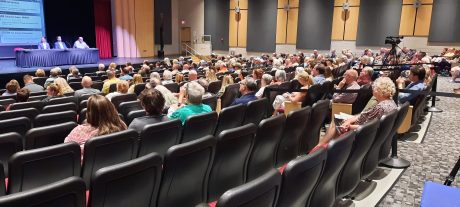
A town hall called to discuss the pros and cons of data centers coming to the region attracted a crowd of about 250 people Wednesday night at Penn State Fayette.
The session included panelists who had researched, marketed or provided labor for data centers. A presentation by Brian Kennedy, senior vice president of the Pittsburgh Technology Council was followed by a panel discussion with Corey Young, director of Washington & Jefferson College’s Center for Energy and the Built Environment; Dan Adamski, executive managing director of JLL; and Sean Steffee, business agent for Boilermakers Local 154.
Though proposals for complexes are underway, no hyperscale data centers have been lined up for the area yet.
Panelists expected that to change.
Kennedy said Pennsylvania has about 182 megawatts of hyperscale capacity. That trails the 3,000 megawatts of Ohio and 13,000 megawatts of northern Virginia — and is less than some of the data center complexes being planned locally expect to generate by themselves.
Within 10 years, that number could go up to 7,000 megawatts, Kennedy said.
A lifelong resident of Indiana County and president of the trade council in the area of the plant being built in Homer City, Steffee said that project and the boom in energy construction had meant work that was helping reverse the fortunes of the struggling town. He was looking to put 500 members of the boilermakers on the Homer City project.
Steffee said if Fayette County residents wanted one there, it could bring economic benefits.
“I’m telling you that we’re going to build this infrastructure somewhere,” he said. “You want to build it here, that’s fine. We’re building it, and I’ll take kids out of your vo-techs, and I’ll take your young men and women that want to apply into the trades.”
Adamski said a Federal Reserve of Cleveland report had placed the area “dead last in every single category” among 30 regional markets.
“Frankly, I have four kids, and I’d like to see them stay in the area,” he said.
Whether data centers alone would result in longer-lasting gains was disputed. Kennedy showed projections showing the employment at data centers would reach nearly the peak number of construction jobs by the 2030s. Young said while the construction would be “very impactful” on the front end, “there’s not a huge number of folks that work in the facilities long-term.”
Moderator Rich Fitzgerald, executive director of the Southwest Pennsylvania Commission, read from a selection of questions that had been submitted by attendees online or in person. They raised concerns on topics from noise, environmental impacts and non-disclosure agreements.
Responding to a question on water usage, Young said more data centers are moving to a closed-loop system for cooling, where the water is brought in at the start and recirculated without having to draw new water.
If he were a local official, Young said, his biggest question would be on air quality, which could be a concern, particularly with diesel generators. Many newer projects are discussing generating their own power on site, from sources like natural gas or nuclear power.
“Does it mean it’s going to worsen air quality in a part of Western Pennsylvania that already doesn’t have the greatest air quality?” he said.
Adamski and Young touted the pros of a community benefits agreement, in which the tech company locating the data center at the site would agree to provide funds or other amenities.
Adamski’s advice: Make “big asks.”
“Maybe you’re against data centers, and it still gets approved anyway … Make sure you’re getting something out of it,” he said. “Get your taxes lower, get playgrounds — whatever your community needs.”
Panelists were also critical of companies asking local officials to sign non-disclosure agreements, a frequent criticism from attendees at data center events.
“It’s frustrating to everybody … if they sign that, you can’t hold them accountable,” Steffee said.
At Wednesday’s panel, they also played a video from Mike Turner, an executive at Loudon County, Va., which saw a rapid increase in power generator and data centers with the rise of artificial intelligence.
He said there were six factors every community considering a data center needed to consider before agreeing to house one: noise, power, water emissions, setback from the property line, and appearance.
“I firmly believe there’s nothing inherently good or bad about data centers,” he said. “It all rests on the shoulders of the local community to make proper managerial decisions based on addressing these six factors.”
He also put forward a list of 15 best practices communities should follow, such as ensuring the centers are built near existing electrical rights-of-way to requiring the data centers hire an independent firm to test noise levels — both audible and low-level frequencies — before and after construction.
Attendees said the session was informative, with many singling out Turner’s section, though they said it had not swayed them from their skepticism about data centers.
“The best practices that they listed sounded like wonderful starting points, and obviously they’ve been doing this a long time, and so they have an understanding of these are some of the criteria we’d want to prevent another county from experiencing,” said Heather Wasler of Uniontown.
Others said the list of speakers should have been less tilted toward data center backers.
“There needs to be another panel held where there’s people on both sides to prove the pros and the cons, and let everybody have a voice,” said Jeff Hughes of Brownstown.
Fayette County Commissioner Scott Dunn said the event had been beneficial for residents, who, as he expected, had been a mix of those open to the idea and those vehemently opposed.
“It was meant to be informational, and I think there was some good information presented,” he said. “There’s more to the story, as always, but I think it was a good start.”
So far, he said, he hasn’t talked to any data companies about locating in the county. Before any do, he said, the county is planning to follow Turner’s advice and build in protections through zoning.
Those ideas would include requiring a closed-loop system for water, proper setbacks for noise, and mandating that companies supply their own power.
“We don’t have the grid capacity now for one data center, so if a data center is going to want to locate in Fayette County, they’re gonna have to bring their own power,” he said.
No concrete data center proposals have come to Fayette County yet, although plans for campuses exist in various stages in the area.
Nadara, a European independent power producer, is exploring an 830-acre site near Gans in Fayette County that could potentially house a data center.
In Washington County, real estate company JLL is marketing a 1,400-acre tract owned by CNX near Zediker Station in South Strabane Township.
The farthest along is in Greene County, where International Electric Power plans to build a plant and two turbines totaling 910 megawatts to attract a hyperscale data center on 1,400 acres at the former site of the Robena Mine in Monongahela Township. The Greene County Planning Commission approved the first phase of land development in December for the site, which IEP hopes to be in operation by 2029.