

Whiplash of weather
Snow falls on St. Patrick\\\'s Day after warm, windy weekend
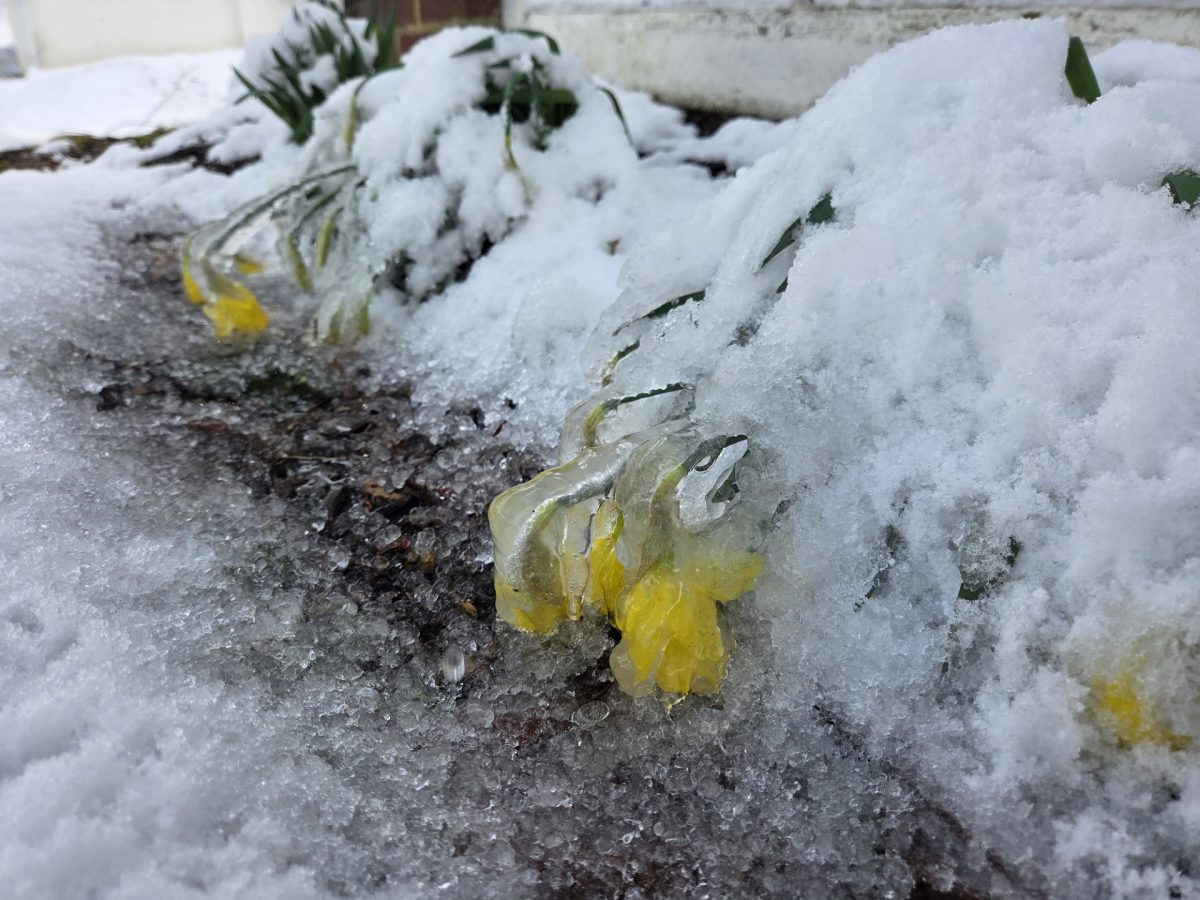


Merry St. Patrick’s Day?
White snow covered green grass on Tuesday as snow showers dropped between 3 to 6 inches of snow in the region.
“It was a whiplash of weather, for sure,” said Alicia Miller, a meteorologist with the National Weather Service in Pittsburgh. “There was a lot going on.”
The region saw temperatures plummet from a 70-degree high on Sunday and a high of 60 degrees on Monday, to a high of 30 degrees on Tuesday – three days before the official start of spring.
According to NWS Pittsburgh, Monday started as a mild day and ended as the snowiest 60-degree day on record.
“Yesterday was the snowiest 60-degree Fahrenheit day we’ve seen in our records (dating back to 1948). Out here in Moon Township, the high was 60 degrees and we measured 6.3″ of snow,” NWS Pittsburgh posted on Facebook.
Schools throughout Washington, Greene, and Fayette counties modified their schedules for Tuesday as snow blanketed the area, days after high winds resulted in power outages and downed trees. Some issued a two-hour delay, while others switched to remote learning after the unexpected snowfall.
“Most people in the area saw 3 to 6 inches, but the band did sit over us a little bit here in Moon, and Washington County was on the higher side of the snow total,” said Miller.
Meanwhile, First Energy continued to make progress restoring electric service to areas in Washington, Greene, and Fayette counties that lost power as a result of the weekend’s severe winds and the snowfall.
Western Pennsylvania was one of the areas hardest hit by the stretch of adverse weather.
Miller noted, though, that the unpredictable weather isn’t unusual for March.
“March tends to be our transition season, where we have periods of warmer temperatures and then we slip back,” said Miller.
Miller noted that in 2025, temperatures climbed into the 60s on March 4 and 5 before dropping into the 30s on March 6, when 3 inches of now fell.
On March 13, 1993, 23.6 inches fell, “one of the most extreme days in March on record,” said Miller.
The “Storm of the Century” produced one of the greatest one-day snowfalls on record and included high wind, blowing and drifting snow, and wind chill temperatures below zero.
On Tuesday afternoon, additional snow showers and localized heavy bands of snow were expected in Washington and Fayette counties. By Thursday, however, temperatures will climb into the 50s.
The colder weather has been unpleasant for humans, but it also has an impact on plants.
With temperatures in the 60s and 70s, many plants, including daffodils and forsythia bushes, have started blooming.
The blooms are beautiful, but plants become vulnerable when a cold snap occurs.
“Warmer weather is causing many plants like daffodils to sprout earlier than usual, which is becoming more common. While this creates a beautiful early spring display, it also comes with risks,” said Jamie Ursic, a master gardener coordinator at Penn State Extension in Washington. “If a warm spell is followed by a cold snap, tender new growth can be damaged by frost, leading to browning, fewer flowers, or stunted plants – especially daffodils and tulips.”
The high winds, too, can knock over tall, blooming plants, breaking stems and potentially damaging flowers.
Fruit trees like apples, pears, cherries, and peaches are also at risk, as frost can damage their buds, Ursic said.
Day lilies tend to be more resilient, but their new shoots can still be harmed by sudden freezes – if the deer didn’t get to them first.
“Overall, fluctuating temperatures can stress plants, disrupt normal growth, and increase the risk of disease,” said Ursic. “Repeated freezing and thawing can even disturb roots. So while early blooms are beautiful, they can also signal that plants are more vulnerable to whatever weather comes next.”