

Washington sewer authority eyes ‘generational project,’ phased rate hike
Treatment plant needs $200 million overhaul
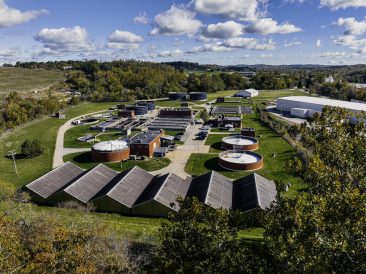
The Washington-East Washington Joint Authority is preparing for a significant project to overhaul and modernize its wastewater treatment plant in order to comply with updated Pennsylvania Department of Environmental Protection standards.
This “generational project” will likely cost well over $200 million, necessitating a multi-phased rate hike for authority customers to cover the resulting debt obligation, according to Executive Director Rob Herring.
A typical Washington-East Washington Joint Authority (WEWJA) customer now pays an average of $41 per month, and will pay around $125 per month by the time the project is put out for bid in 2031, depending on project scope and grant availability.
As a regulated sewer authority, WEWJA must qualify for a National Pollutant Discharge Elimination System permit through the state Department of Environmental Protection every five years to remain legally compliant.
These permits specify the limits of individual pollutants that can be safely discharged into local waterways, which is Chartiers Creek for WEWJA.
The DEP updates the specified limits and total number of assessed pollutants in each permit cycle, adding new pollutants infrequently as environmental science and water quality standards progress.
When WEWJA reapplied for its NPDES permit in 2019, it was found in violation of three pollutant parameters related to the chemical chlorine that were added that year, according to Herring.
The authority tried to correct these noncompliant parameters over the next three years with little success, Herring said, since the trickling-filter system currently employed at the WEWJA Wastewater Treatment Plant located off of Arden Station Road in Washington is an older technology that is ill-equipped for dealing with these types of pollutants, since it was designed to meet NPDES standards from the early 2000s when it underwent its last major renovation project.
When the WEWJA reapplied for the NPDES permit in late 2025, it was found in excess of another newly added pollutant parameter, total copper, bringing the total number of violations to four.
WEWJA is also in violation of permit wet-weather capacity limits, which are guidelines for how well a sewer authority’s treatment system can handle weather events such as flash floods.
The DEP placed the authority under a formal consent order in January, which sets a legally-binding timeline for WEWJA to make substantial progress on a major project to correct these violations by 2031.
Project scope
The authority used the initial violations included in the 2019 permit to launch a broader study regarding the status of WEWJA’s current sewer assets and treatment plant systems.
This study recommended replacing the trickling-filter system with a membrane bioreactor to convert the treatment plant into a modern activated sludge system that will meet updated NPDES standards.
WEWJA would become only the fourth authority in western Pennsylvania to adopt this technology after Clairton, Cranberry and Western Butler, he said.
In addition, this project will build 11,000 feet of new interceptor sewer and several equalization basins to add 13 million gallons of storage capacity to the treatment plant to address wet-weather capacity concerns and overall population growth.
Herring said that municipal authorities typically plan decades in advance in order to ensure they are proactive, not reactive in regards to accommodating the sewer needs for the population growth of their service area.
In total, this project will likely cost WEWJA around $230 million, he said, which represents a “significant investment in our sewer assets.”
This effort is designed to ensure that WEWJA can meet its NPDES parameters and capacity needs for at least 30 years once completed, according to Herring.
He emphasized that the $230 million estimate is a preliminary, “planning-level” figure, which may come down as WEWJA applies for major state grant funding and explores other cost-cutting measures within the project design phase.
This estimate does not include an ongoing project to install 15,000 feet of new cured-in-place pipe within the existing Chartiers Interceptor Sewer and complete an anaerobic digester system to enhance solid waste treatment capacity at a cost of about $4,600,000.
The WEWJA Board of Directors is currently discussing the implementation of a phased rate hike to meet the debt obligations from the major project, Herring said.
The last rate hike for authority customers came in October 2022, with an average household now paying about $41 per month across a quarterly billing cycle.
Under the current cost projections for the project, Herring said that he expects that an average customer will pay around $125 per month at the completion of the phased rate increases in 2031.
This will also come with a switch from quarterly to monthly billing.
The exact schedule and details of the phased increase is still under discussion. He said, however, the authority will communicate with customers ahead of implementing the new rates.
Herring was hired as the inaugural executive director by the WEWJA board in December 2023 to help guide the authority through this substantial project.
“It’s a challenge, but one I’m encouraged by, and we’re excited for the future, for seeing our region grow and thrive,” he said.
WEWJA serves as the nonprofit sewer utility for over 13,000 customer accounts across the city of Washington, East Washington Borough and portions of Chartiers, South Strabane, Canton, North Franklin and Amwell townships.
Further information on ongoing WEWJA projects and news releases are available online at wewja.com.