

CMU researchers present Greene County workforce study
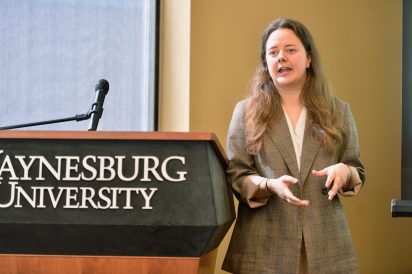
Researchers from Carnegie Mellon University shared preliminary findings from a study on workforce development in Greene County during a presentation Thursday at Waynesburg University.
Researchers Jillian Miles and Valerie Karplus looked at the characteristics of the workforce in Greene County and nine others in southwest Pennsylvania to see how the skills would fit within several leading industries.
“This has been done at the individual level for people who are looking at new jobs, like how might what’s on their resume translate to a new opportunity,” Miles said. “But we’re trying to abstract this to an entire community level.”
The study came after several years of collaborations between Waynesburg University and CMU, was funded through a grant from the Appalachian Regional Commission.
They gleaned several things from the data, Miles said.
First, the number of jobs announced from an investment might be lower in practice. This could happen for several reasons, she said, as open facilities might not be at capacity, or the company had overestimated the number of jobs that would be created.
“If communities are looking at those job announcements, they probably have reason to be somewhat skeptical of that number, or should at least feel empowered to be a bit more purposeful in asking. ‘How are you going to get to that job number? What types of occupations?'” she said.
Lower job creation numbers might surprisingly have an advantage for Greene, as it will be more able to fill the positions, Miles said.
Their second takeaway was that communities will have to weigh the tradeoffs of different industries. Miles presented a chart mapping individual wage premiums versus the total impact the industry would have on the county.
Steel work placed the highest for total impact, though at wages only slightly higher than county average. On the other end were data centers, which would generate salaries at about 1.35 times the county average, but for a relatively small amount of workers.
In the third takeaway, they looked at three other factors to determine which counties might suit an industry — how commonly the skills are found in the area), how much it will cost to pay workers in the area, and whether the area can fill worker demand with its current workforce.
For pharmaceuticals, for instance, if offers high-paying jobs, but might be difficult to fill immediately with the skills locally. Steelwork could have advantages because of the skills already present, she said.
“There might be some bottlenecks, but like it’s a good fit identity-wise because of that density that’s already there,” Miles said.
The information could be used by a variety of groups, the researchers said, from workers trying to see what other careers might be a good fit to schools looking to develop a curriculum.
The research team interviewed employers, skill scouts and workers from the region, as well as pulling data from the state and other sources.
Miles said the next steps would include making the data more usable and attuned to what people in the county might need.
“I think there’s a bit of an unknown at the moment of exactly what direction this will take, but we’re excited to get all the feedback to understand how we can transform it and make it work,” she said.
Miles and Karplus hope they or others will be able to expand on their findings.
“I think that that type of work will continue, but we always want to make sure as we continue that we’re connecting with the on-the-ground realities,” Karplus said. “And in particular, it’s helpful to connect with Greene because these are acute and very current topics of conversation and decisionmaking. So if our work can help Greene advocate for itself, we will be tremendously excited about that.”