

Washington County economy topic at annual event
 Rick Shrum/For the Observer-Reporter
A wise scholar once famously asserted that “knowledge is good.” That was on display Thursday morning during the 13th annual Washington County: State of the Economy event at the Hilton Garden Inn Pittsburgh/Southpointe.
An estimated crowd of 300 gathered to take in a roundtable discussion among three college presidents, but the learning points extended beyond them. A Federal Reserve officer and the Marcellus Shale Coalition’s new president provided enlightenment as well during the two-and-a-half-hour session.
Russell Mills, senior principal and senior regional officer with the Federal Reserve Bank of Cleveland, Pittsburgh branch, kicked off the session saying, “These are my views, not necessarily those of the Federal Reserve.” He was serious, but smiling.
“One of the main things we do is be like plumbers,” by keeping things moving efficiently. “We want financial stability.”
Mills said “consumer spending is driving the GDP (Gross Domestic Product). Consumers are spending, but they’re pessimistic about spending.”
He said wages have kept up with inflation, as a whole. Wages are up 25.7% since the pandemic. Wage growth has bested inflation. But inflation being down doesn’t mean prices are going down.
Service industries, according to Mills, have been strong the last few years. He added that “manufacturing since 2022 has been negative, although we’ve seen a jump in manufacturing recently. Services are continuing to drive inflation. Inflation expectations remain elevated.”
Speaking in Washington County, Mills reflected on his host for the day, calling the county’s population increase since 2013 “one of the success stories locally.” He said the county has gained about 1,300 residents over the past 11-plus years, raising the overall figure to about 210,000.
That success story, he added, has occurred during a time that the Pittsburgh Metropolitan Statistical Area – made up of eight counties – has lost about 9,900 residents.
Mills said that while Washington County’s population has grown, “there are labor force challenges here. About 10,000 people leave Washington County for work.”
On the subject of tariffs, which President Donald Trump has been proposing, Mills said “it’s too early to tell” what type of effect they will have.
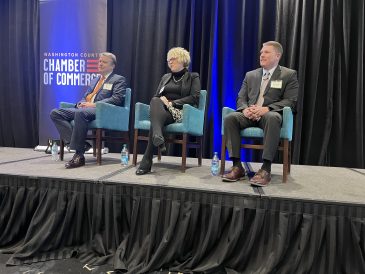
College can have many effects on students, which can carry over into their professional careers. Presidents Douglas Lee of Waynesburg University, Elizabeth MacLeod Walls of Washington & Jefferson College and John Anderson of Pennsylvania Western University, sitting three across on a stage, discussed what they and students face.
“You have to listen to what students want and we have to work with them,” Anderson said. “Students have to learn in multiple ways. Some content is better taught online and some are better taught face-to-face.”
MacLeod Walls said that a disproportionate number of students in the United States do not complete their degrees. “Our job is to evaluate this and understand the impact of it.”
Lee said college students and presidents “have to understand what do employers need from students. What do students need in college? You have to adapt.”
Changes have been made. MacLeod Walls pointed out that heading into the 2023-24 academic year, W&J reduced tuition by 44.4%. “W&J has been around for a long time,” she said. “It’s a college that’s innovative. Our graduates are important, but we have to be affordable. We want innovation and tradition together.”
Waynesburg launched an Entrepreneurial Leadership Program, focusing on entrepreneurship in an academic setting.
“It’s a different environment now,” MacLeod Walls said. “There’s a real gravitation to plans that lead to employability. Vitally important to institutions to be responsive and nimble with AI (artificial intelligence).”
Lee said, “The pandemic drastically changed learning. Students were at home (getting remote instruction). Now with AI, it’s how do you do this? You have to keep developing the minds of younger people.”
“So much has changed during the past five years,” MacLeod Walls said. “We’re talking adaptability. We have to help students create change.”
Jim Welty, the newly minted president of the Marcellus Shale Coalition, closed the event by speaking primarily about natural gas. The coalition, based in Robinson Township, is a leading trade association for the oil and gas industry with about 150 members.
“Natural gas is the most efficient, clean, safe (energy source) across the board,” he said. Gas is being produced in 36 of Pennsylvania’s 67 counties.
Welty was well-aware he was in the focal point of natural gas in Pennsylvania, mentioning that one-third of natural gas produced in the commonwealth comes from sites in Washington and Greene counties.
“We support all forms of energy, but natural gas is where it’s at.”
MSC also supplied some Washington County figures:
It is the state’s third-largest natural gas producing county at about 1.2 million cubic feet (MCF) in 2023.
The county and its municipalities have received more than $222 million in impact fees generated by the state’s tax on natural gas production.
In 2023, more than $834 million in natural gas royalties were paid to recipients in the 14th Congressional District (Washington, Greene, Fayette and Westmoreland counties).