

Region celebrated quietly when V-E Day arrived 80 years ago
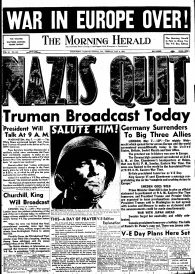
Twenty short blasts from the fire siren.
It happened around 9 a.m. in Uniontown on Tuesday, May 8, 1945. The brief bursts of noise that interrupted the city’s morning routine were not a signal that a blaze was happening somewhere or that a fierce springtime storm was bearing down on the community.
In any other circumstance, it would have sounded ominous. But on that day 80 years ago, it brought news that residents of Uniontown and people in thousands of other places had long been eagerly anticipating – the war in Europe was ending more than five years after it began with Germany’s invasion of Poland. The conflict on the continent resulted in millions upon millions of deaths, including 250,000 American service personnel.
In an address to the nation that morning, President Harry Truman declared, “This is a solemn but a glorious hour. … The flags of freedom fly all over Europe.”
The final victory in Europe came after a hectic month of news, both nationally and internationally, On April 12, 1945, President Franklin Roosevelt died unexpectedly at his retreat in Warm Springs, Ga., a little less than three months after he was sworn-in for a fourth term in the White House. Then, on April 30, 1945, German chancellor Adolf Hitler died by suicide. That happened two days after Italian dictator Benito Mussolini was shot and killed.
Nevertheless, the imminence of victory in Europe had seemed apparent for weeks. The March 30, 1945, edition of Uniontown’s Morning Herald, was headlined, “Allies Push On To Berlin.” Below that was another story, “V-E Day Requests By Mayor,” which noted that Russell E. Umbel, Uniontown’s mayor, was asking all businesses that “dispense beer and other intoxicating beverages to close their establishments the moment word arrives of victory in Europe.”
The story noted that “the mayor further requests that they do not resume the sale of such beverages until after the period of excitation.”
Umbel and other officials in cities around the country might well have been thinking about the bedlam that erupted in many locations following the end of World War I just 26 years before. In Canonsburg, for example, one man died when a bullet fired from a gun in celebration struck him in the head. But such worries were probably misplaced, given that Americans were mindful that war was still being raged in the Pacific against Japan, and that many of their friends, neighbors and relatives had been sent to Europe and had been killed or captured.
Connellsville’s Daily Courier reported the day after V-E Day that “there were no tidings of good cheer” in one home in the community of Trotter, since Martin S. Donin was reported missing in action in Germany. In Uniontown, the parents of 18-year-old Hugh Dingle also discovered that their son died in Germany. There were other casualties from throughout the region in the days and weeks before the war ended, their fate noted on the front pages of local newspapers.
Meanwhile, the Washington Observer reported on May 9, 1945, that five soldiers from Washington County had returned home after being captured in Luxembourg and held in a German prison camp. The Observer said that they each had lost up to 45 pounds, and were “forced to live on a diet of coffee in the morning, soup at noon, a piece of black bread in the afternoon and usually coffee in the evening.”
Students at the Alexander Grade School in Strabane played martial music before school was dismissed on V-E Day, but nearby Canonsburg marked the event in a spirit of “grim determination,” according to the borough’s Daily Notes newspaper. Extra police were placed on duty, but once it was determined that “no unusual disturbances were likely,” they were sent home.
“The full significance of a war only half won largely was responsible for a quiet and peaceful observance of V-E Day hare,” the Daily Notes said. “Local streets were crowded in the morning, but in the afternoon and evening, there was no evidence that yesterday was a holiday. People returned to their homes or visited their respective churches to pray for the end of the war in the Pacific.”
Residents of Monongahela also flooded into churches. William H. Stewart, the city’s police chief, described it as being “just like Sunday – only quieter.” Monongahela’s Daily Herald said Main Street “took on the appearance of an almost deserted village” and that “there was no hilarity, no boisterousness,” and flags were still at half-staff following Roosevelt’s death.
Rabbi Irving J. Rockoff, who led the Tree of Life Synagogue in Uniontown, said, “The Jewish people are especially thankful for the end of the European war because of the suffering of our race. We rejoice with the rest of the civilized world. We are cognizant of the fact that if Hitler had won, it would have meant the extermination of our people.”
The Monongahela newspaper did get a comment on the end of the war from a North Charleroi resident whose older brother was a high-profile combatant. Earl Eisenhower, the brother of Gen. Dwight Eisenhower, who was commanding the Allied forces in Europe and became president of the United States seven years later, was living and working in the Mon Valley as a relay engineer for West Penn Power. The younger Eisenhower told the Daily Herald, “I am as happy as anyone, but my happiness is tempered a great deal by the Japanese situation. I do not think anyone is happier than my brother Dwight today.”
The “Japanese situation” that the younger Eisenhower was referring to still had almost four months to play itself out. And that reality was underscored when Connellsville’s Daily Courier let its readers know that three local draft boards in the northern part of Fayette County would be summoning 108 men for pre-induction physical exams.
“Despite the fact that the war has ended in Europe, the induction of manpower into the armed forces will continue as replacements are needed in the Pacific theater, where the size of the American military presence will be materially increased.”