

‘In the defense of dignity’
Rapid response training for ICE raids held in Washington
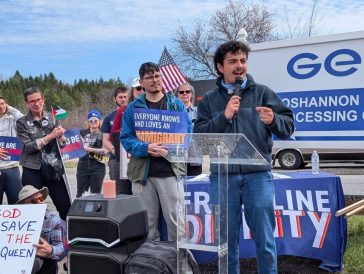
Standing at the front of the First Presbyterian Church 1795 in Washington on Wednesday, Jaime Martinez, executive director of Frontline Dignity, scanned the group that sat in the pews.
The gathering – about 45 people in all – included teachers, a business owner, retirees, a social worker, an attorney, a student.
They had assembled for a “rapid response training” for people who want to know how to respond to Immigration and Customs Enforcement raids occurring in Washington County as the federal government ramps up immigration enforcement in Southwestern Pennsylvania and across the country.
Frontline Dignity is a Pittsburgh-based nonprofit that teaches people how to observe and document ICE raids and activities, and support immigrants being taken into custody and their families.
“We are an organization that builds a community’s capacity to respond lawfully and effectively to immigration enforcement operations, and we do that by training people just like you to become principled organizers in the defense of dignity,” said Martinez, 23.
Martinez provided tips on how to identify enforcement activity – from the types of vehicles and license plates associated with agents’ cars, to what they wear and patches on their uniforms.
He outlined how observers should document and communicate key details about ICE encounters, and what rights observers have.
Chief among them: bystanders’ rights to record law enforcement in public spaces.
“Record everything. Your camera is your most powerful tool. No one can debate your camera. No longer is it, ‘He said/she said’; it shows what happened. It provides the authoritative documentation of an incident. We do not touch law enforcement or yell at them, but you record,” said Martinez, who cautioned against obstructing law enforcement.
Arrests of immigrants without criminal convictions by ICE have surged during the first year of President Donald Trump’s second term, according to an April report by the Deportation Data Project at UC Berkeley.
But, noted Martinez, 73.6% of immigrants currently held in immigration detention as of Feb. 7 have no criminal conviction.
The majority of detainees from Southwestern Pennsylvania are taken to Moshannon Valley Processing Center, a for-profit immigration detention center in Clearfield County operated by the Florida-based Geo Group. The 1,876-bed facility is the largest immigration detention center in the Northeast.
According to Clearfield County records, the federal government pays the GEO Group about $3.4 million a month for the facility, plus additional fees per detained person. Clearfield County receives $200,000 a year, according to agreements with ICE and GEO Group.
Previous studies by the ACLU-PA and Temple University’s School of Law in 2024 reported inhumane conditions at the facility, including physical and psychological abuse, lack adequate access to health care, limited family contact, excessive use of solitary confinement, and issues with food quality.
“This is the reality that people are dealing with today. Right now it’s happening. It’s not happening in some other time period in some other country; this is a two-and-half-hour drive from here,” said Martinez, who in April walked 130 miles from ICE’s field office in Pittsburgh’s South Side to Moshannon to protest conditions. “How do we live with this? To know that every day, our neighbors from our area are being caged like animals in these facilities.”
As of early 2026, ICE is operating a record number of detention facilities, with more than 72,000 immigrants – up from 37,000 a year ago – detained in about 225 active detention sites ranging from dedicated ICE facilities and private prisons to county jails, military bases and newly converted warehouses, according to the Deportation Data Project, which collects and posts U.S. government immigration enforcement datasets.
“These folks do not plan on stopping, they do not plan on dialing it down. They want to house people because it lines the pockets of the rich people,” said Martinez.
Martinez encouraged those who attended to take action.
Frontline Dignity is coordinating a trip to Clearfield County for human rights advocates to voice their opposition to a renewal of Clearfield County’s contract with Geo, which is set to expire in September.
He said Frontline Dignity is also seeking volunteers to help with a response hotline, (412) 53-NO-ICE or 412-536-6423. The hotline accepts calls in several languages, and will be used to coordinate rapid response and analyze immigration enforcement patterns.
Martinez called the immigration system “broken” and encouraged people to contact their local legislators and call for them to implement immigration reform, and he noted the Washington County Sheriff’s office has entered into a 287(g) agreement with ICE, which enables the sheriff’s department to perform some immigration enforcement duties.
Gerry Shurtz, a 75-year-old retired Pittsburgh Public Schools teacher who lives in Peters Township, has volunteered with Frontline Dignity – which has grown to nearly 1,200 volunteers – since February, and attended Wednesday’s training session.
“I’ve lived through a lot in my lifetime, and you get to the point where you say, ‘Here we go again,’ and as a country, we have to do better than what we’re doing,” said Shurtz, who has been traveling to the city of Washington for the past few weeks to document ICE activity. “I’m just doing what I can. We’re responsible for one another, and individuals such as myself need to do everything possible to ensure that the Constitution is being upheld and that due process is occurring for everyone. We absolutely have to do better.”
One church in particular – Our Lady of the Miraculous Medal in Meadow Lands – has been especially hard-hit by ICE arrests, with at least 20 immigrants who are church members detained since July of 2025. Some have been released, but others remain in ICE custody, or have been deported or chosen to self-deport.
Martinez said his efforts are rooted in his Catholic faith, and he is working to help people make a difference at a “hyper-local level.”
“We need to organize block by block. It starts by getting to know your neighbors on our own street. This could be the difference between a family staying together and a family being separated,” he said. “It starts by getting to know your neighbors on our own street. When you involve yourself in your neighbor’s life and you create a relationship with that person, all of a sudden you come so much more than just a person who lives down the street. You’re a person they can rely on, who is investing in their life, and so much beauty comes out of that,” said Martinez.
He acknowledged the ICE presence in Washington County and the impact it has had on families and their communities.
“In Washington County and in Washington especially, we are living through tragedy. Every single day someone’s life is turned upside down. Someone’s family is torn apart, a child has trauma inflicted up on them in a way they did not have to,” Martinez said.
At the end of the training, Martinez shared a story about a call he and other volunteers responded to last summer about three unmarked vehicles waiting outside a Mexican restaurant in Gibsonia. The suspected ICE agents drove off after Martinez, the volunteers, and a cameraman from a local news station appeared.
“Nine people who were huddled in that restaurant were able to walk home that night, they were able to kiss their families good-night all because a handful of people decided to show up and walk around, and that was it,” said Martinez.
“That is the call that we all have,” said Martinez, “to love one’s neighbor, to be in service to one another not because they have something to give us, but because they are a neighbor, a fellow human being, and that is enough.”