

Catholic Diocese creates financial aid program for immigrant families
Catholic Diocese creates financial aid program for families of ICE detainees
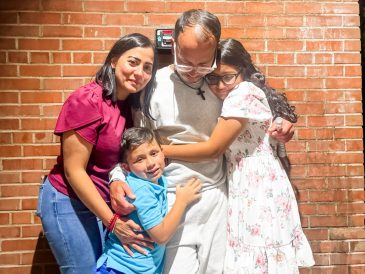
The Diocese of Pittsburgh is establishing an emergency program to hep immigrant families facing dire financial and emotional crises as stepped-up federal immigration enforcement leaves households without primary breadwinners.
On Nov. 13 – the memorial of St. Francis Xavier Cabrini, the patron saint of immigrants – Bishop Mark A. Eckman announced the creation of the St. Frances Xavier Cabrini Family Accompaniment and Emergency Assistance Fund, to help immigrant families cope with what Eckman called their “hardest moments,” including the detention and deportment of household providers.
Parish pastors across Washington, Greene, Allegheny, Beaver, Butler, and Lawrence counties have reported increased activity by ICE and federal agents across the region has left a growing number of families without the income needed to pay for rent, utilities, groceries, diapers, and transportation.
The pastors said the growing demand for assistance for immigrant families “now exceeds what any single parish can meet alone.”
Diocesan leaders cited urgent, unfunded needs for emergency medical, dental and prescription care, alongside widespread psychological distress among children facing family separation and instability.
“Many immigrant families in our region are facing serious hardship, fear, and uncertainty,” Eckman said in announcing the program.
The fund, which will be administered by Catholic Charities of the Diocese of Pittsburgh, is designed to serve as a last-resort safety net to help stabilize families experiencing sudden emergencies.
Financial distributions are scheduled to begin Dec. 12 — the feast day of Our Lady of Guadalupe — and local parishes are working to help affected families by connecting them with community partners for employment, schooling, healthcare and qualified legal assistance.
Eckman pointed to the responsibility of the Catholic community to support vulnerable families during severe personal crises.
“The Church cannot solve every difficulty a family may face, but we can make sure that no family faces its hardest moments alone,” Eckman said.
The fund is supported through private donations to Catholic Charities. Families seeking assistance are urged to speak directly with their pastor or a member of their parish staff. Catholic Charities stated it will ask only for information necessary to provide aid and will protect all shared personal data.
As with much of the rest of the country, Pennsylvania has seen an uptick in immigration enforcement over recent years – and which has intensified in the past weeks – with ICE detaining and deporting undocumented immigrants.
The city of Washington and surrounding areas have been the location of multiple arrests each week for the past several months.
“We’re seeing one or two arrests a day by ICE, at least,” said the Rev. Jay Donahue, parochial vicar at St. Oscar Romero Parish, where Our Lady of the Immaculate Medal Church in Meadow Lands includes a large Latino community. “Our families are living in the shadows: They’re afraid to go shopping, get medical help, go to school. That’s created huge psychological issue, too. There are families and kids who are traumatized, who can’t sleep, are experiencing extreme stress. It’s been hard for them to cope.”
Eckman is inviting Catholics and all people of good will to pray for immigrant families, welcome newcomers in their parishes, and, if able, to give. Gifts may be made in either of two ways:
To donate a monetary gift to Catholic Charities, designate the gift for the Cabrini Fund, online at https://ccpgh.org/cabrini-fund/ or by mail to Catholic Charities Diocese of Pittsburgh, 111 Boulevard of the Allies, Pittsburgh, PA, 15222. Please write “Cabrini Fund” on the memo line of the check.
Through a diocese parish, make a gift payable to Catholic Charities and mark the gift “Cabrini Fund.” The parish will forward it to Catholic Charities.
St. Frances Xavier Cabrini was born in 1850 in the Italian Alps, and in 1946 she became the first American to be canonized.
She arrived in New York in 1889 to serve poor Italian immigrants and spent the rest of her life building schools, orphanages, and hospitals for newcomers. and was the founder of the Missionary Sisters of the Sacred Heart of Jesus.
In 1950, Pope Pius XIII officially named her the patron saint of immigrants, recognizing her lifelong dedication to displaced and marginalized communities.