

PONY Baseball celebrating 75th anniversary
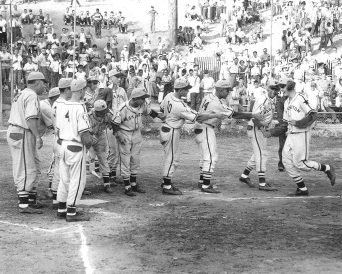
Editor’s Note: This is the first of a series about the history of PONY Baseball and Softball Inc., leading up to the Pony League World Series in August.
When the founders of Pony League Baseball squeezed into the offices at the Observer-Reporter in January of 1951, not in their wildest dreams could they have expected what PONY Baseball and Softball Inc. has become today.
The fact is, they were simply trying to find a way for 13- and 14-year-olds to play organized baseball.
From the initial motto of Protect Our Neighborhood Youth, it has evolved into Protect Our Nation’s Youth.
What started as a local baseball league for 13- and 14-year-olds has turned into a worldwide program.
The aim initially was focused and localized. Expectations were guarded. Clearly, however, a foundation was laid to build upon.
The humble beginnings were perfect.
PONY Baseball’s emergence coincided with the post-World War II baby boom and has grown since. It was apparent the country’s suburban youth needed recreational offerings.
Ultimately, the grass-roots effort worked and eager baseball players had a way to play organized sports to the point before they reached high school age.
“They (the founders) would have never believed how much PONY Baseball has grown in 75 years,” said Bob Gregg, the longtime chairman of Tournaments Inc, and Pony World Series public address announcer. “They wouldn’t have cared (back then). I mean, really, they were focused on providing a safe, organized way for 13- and 14-year-olds to play baseball.
“At that time, they were so far removed from the world. Pick-up baseball was all there was for kids of that age until they got to American Legion or high school baseball.
“Kids were just learning the game. And, suddenly, after Little League, they were done. These guys said, ‘What if there’s something we can do?’
“They didn’t just sit around,crack a few cold ones and say, hmm. What if there was something we could do? They did something. There’s millions of people, and in history it’s full of people who did nothing. These founders wondered if something could be done. And then did something. And I mean, it’s incredible.”
PONY Baseball grew into a national organization late in 1951 with the formation of a league in the Panama Canal Zone.
The beginning
The birthdate of PONY is Jan. 12, 1951.
According to the late Roy Gillespie, who wrote in the book “Pony Tales and Diamond Dust” that it was on the date that “members of the Welfare and Recreation Committee, Mayor Wilson, Councilmen Goodridge and Shronts and others interested in the formation of a baseball league for boys too old to play in Little League met in the Conference Room of the Observer Publishing Co.
“It is difficult to determine who are the “founders” of Pony League Baseball. Minutes of the early meetings do not always record the names of all who attended, and undoubtedly there were many who contributed their thoughts and efforts who rarely, if ever, attended any of the meetings. There were others who attended one or two of the early meetings, whose names are thus recorded but who worked with the program only briefly. Others joined in the effort shortly after the birth of the program and spent long years serving it and were instrumental in its development.
“No one is ‘the founder’ of Pony League. It was the result of group effort, group thought, and group action to fulfill a need.”
It is held that a half dozen men “shared the common qualifications of having been among the initial group to consider organization of the league, having served for a number of years in both the local Washington program and on the board of directors of the international program and having remained active in the program since its inception.”
Those men included:
* Lew Hays, sports editor of The Reporter when the program began and who was named commissioner of Pony League in 1951.
* William E. Amos, an All-American football player at Washington & Jefferson College in the 1926-27 era, who was a member of the board of directiors since the founding of the program.
* J. Howard Ware, president of the original Pony League in Washington and later served on the national board of directors.
* Paul S. Shearn, who recorded the minutes of the initial meetings and served as secretary-pro-tem. He became director of public information at W&J.
* Morris Weber, a Washington sporting goods dealer who served on the national board for a lengthy period and was a consultant to PONY-related equipment supplies.
* John Sorice was the first player agent for the original Pony League. He was instrumental in the construction and development of the original Pony League Field and served as the head of the ground crew for many Pony World Series’ held in Washington.
“They were local people who thought they were just doing something to keep kids playing organized baseball,” said Leo Trich, who eventually became the PONY commissioner. “They were looking to keep kids active in the summer months and give them a good place to play ball.
“It was strictly looked upon in those days as something that would be local but as I understand it, they received phone calls from people who found out about it. Suddenly, they get some calls from the Wheeling (W.Va.) area, the Elm Grove (W.Va.) area and Martins Ferry, Ohio. They called and wanted to know about it. It (the word) started spreading those first couple years.”
Hays once said, “it wasn’t intended to be international.”
According to Hays, the boys playing Pony League that first season considered the games a scaled-down version of major league baseball.
The next year, PonY Leaguel was international and had more than 500 teams.
Inaugural season
The initial teams in Washington were the Royals, Chiefs, Redwings, Orioles Colonels and Bisons.
Some of the players were David Selway, Frank Zebrasky, Dominic Sacco and Charles Doerfler.
Zebrasky was the visiting team pitcher in the first Pony game played in 1951 and Sacco was the league’s home run champion that season.
“It obviously means a lot,” said Nick Cataldo, Selway’s grandson and a starter on Washington’s 1998 Pony World Series team that advanced to the championship game. “I think once I was old enough to understand and realize, it was special to have a (family) legacy with Pony.
“I heard him talk about the memories he had. It put a whole other layer into it when I played in Pony and ultimately the Pony World Series championship game. That whole experience was second to none, and then to coach in it with my father (Neil Cataldo), just brought everything full circle. It was really neat, a really cool connection.”
Zebrasky started a family legacy with Pony League.
His son, Frank, who was a Pony League player and managed the Washington All-Stars in the Pony League World Series where his sons, Zack (2001) and Zane (2003) were players. On the 50th anniversary of Pony League in 2001, the elder Zebrasky was honored as a member of the first season.
“PONY Baseball means a whole lot to our family, not only because my father being involved from the beginning, but growing up in Washington and being part of Pony baseball,” said the younger Frank Zebrasky.
“There used to be a conglomeration of guys who would come back and go to the Pony League World Series and they would sit in the right-hand corner of the bleachers – maybe six or eight of them.
“It’s been fun to watch Pony League grow up right in front of our eyes, so to speak. Pony Baseball is really good.”