

In the Adios, they were all in pursuit of Campbell
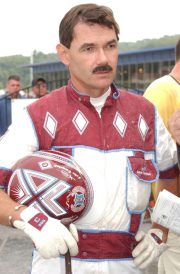
The humility harness racing icon and driver John Campbell carries led to a simple answer to the question of why he has such great success in The Adios.
“The success in it was just a lucky coincidence,” Campbell said. “I mean, I can like the race, and I did like the race. I also liked how the whole backstretch community just came together to celebrate Adios day each year. That was something that I really enjoyed being a part of it.
“I liked seeing because you don’t get that from your backstretch community anymore because there are hardly any more backstretch communities anymore. It’s unique.”
Campbell is the winningest driver in Adios history — by a mile.
He would expect nothing less than a party on the hill by the backstretch Saturday as the Grade 1 Delvin Miller 60th Adios Pace will be held at The Meadows. Post time is 11:30 a.m.
Campbell owns a record eight Adios final victories. His 76 Adios starts, which includes elimination and heat races, is tied for second with David Miller behind Dave Palone’s 99 starts.
Campbell notched 25 wins, 12 seconds and nine thirds. His $2,034,491 Adios earnings are tops as well.
Campbell’s eight Adios victories include 1984 (Andrel), 1987 (Run The Table), 1992 (Direct Flight), 1993 (Miles McCool), 1994 (Cam’s Card Shark), 1995 (David’s Pass), 2002 (Million Dollar Cam) and 2003 (Armbro Animate). The four straight wins from 1993-1995 is a record.
Clearly, that is not “a lucky coincidence.”
“I don’t think there’s ever been a question that he is the number one driver in all of harness racing over the years,” said Roger Huston, former track announcer at The Meadows. “John had tremendous success at The Meadows but also had tremendous success just about any place he drove. It was in his blood.
“His father was a great horseman as well, and he learned from him, his brother, Jimmy, who was a great trainer.”
Added Palone, the winningest driver of all time: “The Meadows is a very tricky racetrack and there’s been plenty of examples where people would come here and overdrive their horse or just not be in the right spot. But John just knew. John is John. He’s the greatest whoever lived in my book and that’s a big statement with these young guys now.
“I grew up idolizing John and still do to this day. I have John stories when I was in my accidents and it was never publicized. He was calling me, checking up on me, explaining to me what to do to get well and get back. He’s still my hero. Everybody has a hero. He’s mine and there will never be another one like him.”
Campbell, his father Duncan, and his brother Jim were prominent Standardbred horsemen. The Campbells were raised near London, Ontario.
John Campbell is widely regarded as the greatest driver in harness racing history, having amassed 11,058 career wins and nearly $304 million in purse earnings. His earnings surpass those of any active driver or jockey.
That is not a surprise to anyone who has paid attention to Campbell and his Adios success. Adios Day was one of his favorites.
“The Meadows just all came together and celebrated Adios day, and that was something that I found really interesting and it just made me happy inside to be part of it,” Campbell said.
The 5/8-mile track offers more turns than a mile track and it has been a tough adjustment to some of the greatest horses – Nihilator and Blissful Hall, among others.
“You had to be aware of the track bias at the Meadows,” Campbell explained. “That one thing that you had to be aware of, you couldn’t count on front-end speed holding up the same at the Meadows as it did at other tracks. That was something you had to be aware of as a driver.
“You had to account for that because if you use them too much that first half it could have a tiring effect on horses and it still does. You see horses race there and if they get over there, just a length or two too hard, they can’t hold on.”
Campbell became the youngest driver elected to the U.S. Harness Racing Hall of Fame in 1990, at age 35. He also joined the Canadian Horse Racing Hall of Fame and the London, Ontario, Sports Hall of Fame in its inaugural class of 2002.
Campbell won the Hambletonian Stakes a record six times. He retired from driving in 2017.
Before retiring, the Hambletonian Society, a nonprofit organization that administers major harness racing events and promotes Standardbred breeding, unanimously elected him president and Chief Executive Officer.
“John never panicked,” Palone said. “If a horse needed to be driven aggressive, he always seemed to do that and have them in the right spot. If they had to be patient and race from behind or close, he could do that. He’s just the all-around greatest, arguably who ever lived.”