

The countdown is on: Local coaches react to PIAA approving shot clock
 AP
AP
A shot clock in high school basketball has been a hot button topic for a long time, but that debate is over.
It’s coming.
Last week, the PIAA approved a shot clock starting in the 2028-29 high school basketball season.
That’ll give schools three years to purchase a shot clock and train somebody to be in charge of running it at home games.
For some local coaches, the shot clock can’t come fast enough, while others could do without it all together.
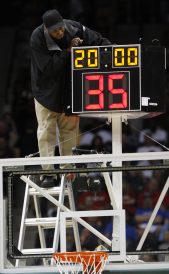
The NFHS rule for a shot clock is 35 seconds. Some states use a 30-second shot clock for girls basketball, but it is not mandated.
According to the NFHS, of the 50 states and the District of Columbia, 32 have a shot clock of some form for the 2025-26 season.
Peters Township girls basketball coach Steve Limberiou is glad that Pennsylvania is joining the list.
Limberiou has been an advocate for a shot clock. Last year during the state playoffs his Indians had to deal with a stall offense on two occasions.
First was Cathedral Prep in the quarterfinals, a game in which Peters Township won, 35-25. But after falling behind by a dozen points in the state semifinals, the Indians saw South Fayette successfully run a stall offense to close out the game.
“I was really happy to see the shot clock finally be approved,” Limberiou said. “I think it’s going to help the game for a number of reasons. Way too many games have resulted in fourth quarters featuring the team with the lead holding the ball and stalling to run out the clock and this will fix that. This will also help prepare our players to play college basketball.
“In general, I don’t think fans or players will miss seeing teams holding the ball and slowing down the game.”
Burgettstown girls coach Megan Zitner agrees that a shot clock is a good idea, but worries about the practical application for it at small schools.
Last week the Blue Devils went to Bishop Canevin for a game and the scoreboard was not operating. So, time was kept at the scorer’s table.
“They had a gym class flip scoreboard and someone at the scorer’s table yelled the time remaining every so often,” Zitner said. “If they had to run a shot clock that game wouldn’t have happened.”
Despite the challenges overall, Zitner is in favor of the idea.
“I would love a shot clock, but I just think resources differ from school to school,” Zitner said. “Ideally it would be better for high school basketball, but I just don’t know if it is realistically possible for some schools. Hopefully it will be. I guess we’ll find out.”
One coach who is not in favor of the shot clock is Eugene Briggs.
Briggs, who coaches the Fort Cherry boys, does not see very many benefits to instituting a shot clock. He pointed out that it will be another thing referees have to pay attention to adding to the difficulty of their jobs.
“I always hoped that they would not do it,” Briggs said. “When you think about the time and money that it’s going to take to operate that and the number of times it comes into play, it’s not worth it. Officials have enough to do without watching that clock and making sure it’s reset and working.
“Coaching-wise it’s not something that will affect us, because of the way we play, but a lot of times when you’re overwhelmed by someone else you need that opportunity to slow the game down and reset. The shot clock will probably help in getting games to mercy rule faster.”
Chartiers-Houston girls coach Laura Montecalvo played college basketball at California, so she knows that a shot clock could provide benefits to high school players hoping to play at the next level.
She cautioned that it could come with challenges.
“Instituting the shot clock may help players be better prepared for college basketball and force offensive fundamental teaching, however, it also may cause players to take bad shots and turn the ball over more often,” Montecalvo said. “That creates bad habits that are hard to break.”
Montecalvo believes it will no doubt change the way the game is played at the high school level.
“There will certainly be a shift in coaching strategy and a greater focus on offensive efficiency and defensive strategy,” Montecalvo said. “It will be an adjustment that likely will take time for players and coaches.”
Of the states surrounding Pennsylvania, Ohio and West Virginia do not use a shot clock, but New York, Maryland and Delaware currently have one.
Kentucky, Florida and Missouri have an optional shot clock for schools. Wyoming, Alabama and South Carolina only use a shot clock in the regular season.