

No shortage of runs in Frontier League games
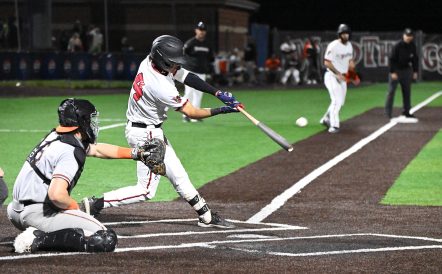
If you have checked the scores of Frontier League games this year, either on its website or in the Scoreboard section of this newspaper, then you likely had a few questions come to mind:
Are these football scores or baseball scores?
Are the hitters in this league really that good?
Are the pitchers that bad?
Through the first five weeks of the season, Frontier League scores have looked more like the old Ten Mile Valley Softball League – where 20 runs often were not enough to win – than professional baseball finals.
Here is a sampling of some final scores:
Windy City 19, Joliet 18
Evansville 14, Mississippi 13
Florence 20, Windy City 19
Lake Erie 17, Trois-Rivieres 5
Down East 22, Brockton 16
And those were only scores from last week.
“We’re the new United Football League,” joked Florence manager Toby Hall.
During the Frontier League’s infancy, back in the 1990s, it was a league filled with undrafted small college players and known for high-scoring games played in city parks and on small municipal fields. As the league grew and made its niche, players with experience in the affiliated minor leagues or at the Division I college level flocked to the Frontier League as a way to keep their careers going. And with the transformation came a change in the league’s reputation. By 2019, it had become a league known for low-scoring games and its young pitchers. That year, Frontier League games averaged 8.36 runs per contest.
This season, its sixth since merging with what was left of the Can-Am League, which had older and more experienced players, the Frontier League is again a hitter’s league. Gone are the 3-2 pitchers’ duels. They’ve been replaced by high-scoring games that blow up scoreboards because of overuse.
So far this year, the average runs scored in a Frontier League game has soared to 12.9. Last year, the average was 11.1 per game.
So why is run production on the rise?
Everybody seems to have a theory, whether it’s too many teams for too few quality pitchers, hitters being older because of a change in roster rules after the Can-Am merger or simply the way pitchers are training these days.
“We’ve been pitching-challenged the last four or five years,” said Hall, who spent nine years in the major leagues as a catcher. “I think it’s how they are training. I call them indoor facility guys. All they do is throw indoors, trying to throw harder. The ones with good metrics, we lose ’em.”
Added Florence hitting coach Harrison DiNicola, “(Major league organizations) funnel the good pitchers out of this league quicker than they do hitters.”
Hall says he can’t blame pitchers who attempt to throw harder and gain more velocity at the expense of command and pitchability. They know major league scouts aren’t looking for pitchers with fastballs in the mid-80s.
“It all goes back to analytics. The kids are being told to do what the organizations are asking for,” Hall said. “I don’t blame them. Being able to get picked up is the goal for every one of these guys. It’s frustrating on the coaching side. It makes my hair grayer when I see those guys just trying to throw hard.”
One place where the runs surge has not hit is in Washington. The Wild Things, who are off to an 18-9 start and lead the league in team ERA at 3.43, more than a run per game better than the second-place pitching staff. Down East is last in the league with a 7.16 team ERA, one of three clubs with an ERA over 7.00.
The average Wild Things game to date had only 9.52 runs.
Washington manager Tom Vaeth says much of his team’s pitching success comes from the way the staff is designed. The Wild Things don’t look for velocity as much as they look for pitchers who have a history of throwing strikes, getting outs and winning without issuing walks.
“That goes with our philosophy of what we want: pound the strike zone early, throw strike one. I purposely look for guys, particularly starters, who get guys out and who can pitch,” Vaeth explained.
“I don’t think we’ve ever led the league in strikeouts. … I like weak groundouts and flyouts. That’s why my guys can go seven innings. When you’re in the fourth inning and you’re throwing your 95th pitch, that doesn’t fly with me.”
“Pitchability seems to be on the decline,” Schaumburg manager Jamie Bennett, a former pitcher in the Frontier League and the Philadelphia Phillies’ farm system, told the Observer-Reporter last year. “Metrics now play such a big part of the game that guys want to see those numbers after a game. … I don’t know that the hitting has changed. It’s about the same as it has been in this league.”