

He’s a well-traveled coach
Wild Things’ Fleischaker has lived a baseball life in many countries
Ever wonder how you communicate a midgame pitching change to a German umpire?
Have you ever wondered how baseball teams are funded in European countries such as the Czech Republic, Switzerland or Italy?
Want to know a little about the Paderborn, Germany program that will be playing in Washington next week at the Pony League World Series?
Do you want to know which pitchers in the Frontier League have the best pickoff moves to first base?
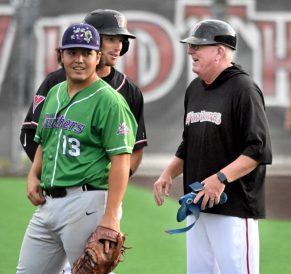
If you’re in need of such information, then Wild Things first-base coach Andy Fleischacker is your answer man.
Fleischacker is a well-traveled baseball guy. He can rattle off a list of all the countries he has played or coached in. It numbers 16.
Fleischacker, 56, is in his first season with the Wild Things and this is his first stop in professional baseball in the United States, but he has more than 20 years of experience coaching in Europe, where baseball is still a growing sport.
He started in 1995 as head coach of the Vienna Wanderers club team in Austria. He went to Germany as part of the MLB International program and ended up coaching there. He has coached at the club level in Switzerland and was a coach for the Swiss national team. He was the first American inducted into the Swiss Baseball Hall of Fame.
Fleischacker has seen baseball grow in Europe to the point that some players there are being signed by major league organizations.
“It’s still very much a niche sport but it has grown tremendously in the last 20 years,” he says. “There are different tiers to the hierarchy of baseball in Europe. You have Italy and Holland at the top of that list. Right below that, you have Germany and the Czech Republic. They made such good strides to close that gap. The gap used to be considerable, but now it’s really, really small, especially at the youth levels. Germany has been the European champion for 12U for several years.”
Fleischacker met his wife in Germany and spent enough time there to know the coaches of the Paderborn program, which won the European Zone championship to qualify for the Pony League World Series.
“The coach of the Paderborn team that is coming over here, he used to play on a team that was a division rival when I coached over there,” Fleischacker said.
Universal language
As an American in Europe, Fleischacker had to learn parts of several languages to help in everyday situations. One exception was on the baseball diamonds.
“English is the language of baseball,” he said. “No matter where we went, all of the instruction had to be done in English because the terminology, nothing translates.
“Almost everything on the field is done in English. When I first went to Germany, everything on the field had to be done in German because it wasn’t so widely accepted that this is an American game. Now that Germany is on the international stage, in World Baseball Classic qualifying, they are always going to the world championships in different age classes, that’s all done in English so now umpires speak English. Coaches speak to players in English and it’s widely accepted that instruction and the game is done in English.”
During Fleischacker’s travels he picked up enough of some languages to get by in everyday situations.
“I was pretty good conversationally in Italian because of my three years spent in Italy,” he said. “I’m pretty conversational in German. It gets a little bit tricky for me because there are three different kinds of German. I had to learn enough of that to communicate at home or on the streets when I was living there. Now I’m a little bit rusty because I don’t have the opportunity to speak it every day.”
Though he has extensive background in European baseball, Fleischacker lives in Tampa and has many coaching stops at various college levels in the United States.
Baseball’s future
Fleischacker says the key for baseball’s growth in Europe is for the sport to gain permanent status in the Olympic Games. It will be part of the 2028 Games in Los Angeles but was not included in the 2024 Paris Games.
“Baseball is not too far down on the pecking order of sports in Europe. And it has its moments when you really think it’s going to take off, and it has in some countries, like the Czech Republic, because they have made the main draw of the World Baseball Classic. For some countries, like Germany, that’s what it’s going to take. If they can eventually win a qualifier and make the main field of the WBC it will take off.
“The biggest problem most European countries have is funding. Italy and Holland, they are supported governmentally through the Olympic federation. With baseball not being a full-time Olympic sport, most national federations don’t give the baseball federations money. So that’s why Holland, the Czech Republic and Italy are the best three because they are supported governmentally by the Olympic federation. They get funds for infrastructure, they get funds to improve stadiums, they get funds for coaches, they get funds for the national teams to send them places. When I coached in Switzerland, those guys paid for all of their stuff.”
Fleischacker said MLB games are available in Europe, which has grown interest in the sport.
“It’s accessible now. It’s on TV,” he said. “And it depends on what area you’re in. In Germany, if you’re in an area that has a major club around it, you’re likely to know what baseball is, or if you’re around the Frankfurt area, where there are a lot of U.S. military bases, the Germans there know what baseball is.”
Stop in Washington
Fleischacker is aware that at his age it will soon be wise to put an end to a nomadic baseball lifestyle. Before that happens, he’s going to enjoy his time in Washington and the Frontier League.
“I have a wife and son and leaving them for five months is tough,” Fleischacker says. “But this experience in Washington has just been unbelievable and I have learned so much coaching-wise. It has been another fantastic baseball experience for me. I just don’t know. I’m always looking for the next adventure.”
Fleischacker’s role with the Wild Things will be expanded in upcoming games. The Frontier League handed down a three-game suspension for manager Tom Vaeth for his ejection from a game Sunday. The suspension starts with a doubleheader Thursday at Brockton and carries over to Friday at New Jersey. That means Fleischacker and pitching coach Josh Flowerman will run the team in Vaeth’s absence.