

Book tells history of the Penguins, from rough start to glory days
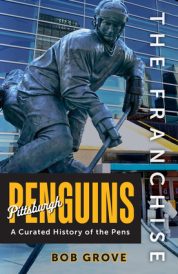
An entire generation of Penguins fans have grown up on playoff hockey, Stanley Cup championships, sold-out crowds at home games and some of the best players the NHL has produced calling Pittsburgh home.
It wasn’t always that way.
Before there was Mario Lemieux, and long before Sidney Crosby and five Stanley Cups, the Penguins struggled. Both on the ice and at the turnstiles.
The early days of the Penguins were rough and in sharp contrast to the more recent glory years. The Penguins franchise began in 1967 as one of six expansion teams in the growing NHL and the organization seemed to always be teetering on disaster.
Since those rough early decades, there have been two arenas, many Hall of Fame players and coaches and more memories and tales than one can easily pack into a book, yet Bob Grove has tried to do as much.
Grove, who spent 17 years covering the Penguins as a sportswriter for the Observer-Reporter, has written “The Franchise: Pittsburgh Penguins,” a book that covers the history of the team, from its inception through the more successful modern era.
“Trumph Books approached me a few years about doing this,” Grove said. “I told them I was absolutely interested but I was still working at that time.”
Grove has since retired and found he had more free time to research, interview and write a comprehensive book about a team that wasn’t always successful in its early days but was never boring.
“I wanted to contrast the early years to the current era, in which they have won more Stanley Cups than anyone,” Grove explained.
“The book covers the history. It’s not meant to be an A to Z until now. I was given a lot of freedom to tell the history of the franchise.
“They were one of six new franchises in 1967 and I wanted to look at how they did compared to the other five,” he continued. “One of those teams was the Oakland Seals, which became the California Golden Seals, then the Cleveland Barons, who merged with Minnesota. The Penguins were the worst among the other four by a lot of different metrics.”
The Penguins managed to put together some competitive teams in their early days but there were always financial obstacles to overcome that started almost from the first day of operation.
“The early years, they didn’t have the financial stability,” Grove said. “The results on the ice weren’t good and there was a lot of negativity around the franchise. There was always talk about possibly moving.”
These days, the Penguins are among the NHL’s highest-valued franchises. The Hoffmann Family of Companies recently purchased the team for a reported $1.7 billion.
“In 1967, twenty people put money up from the start, and they were wealthy people from the community, but they were working toward the $2 million franchise fee,” Grove explained. “By the first season they were looking for investors. The Penguins didn’t have any financial stability until Edward Debartolo became the owner in the late 1970s.
“There was no glue holding things together for more than a decade. In 1975, they put together a nice team with Pierre Larouche, Rick Kehoe, a rookie goaltender in Gary Inness, ‘Battleship’ Kelly, Jean Pronovost. They beat the Blues in the first round of the playoffs and won the first three games of the next series against the New York Islanders. They lost the next four games, including Game 7 by a 1-0 score on a goal with about five minutes left in the game.
“They were one win away from playing the Flyers in the semifinals and five wins from the Stanley Cup. A few months after that, the IRS comes in and padlocks the doors at the Civic Arena,” he continued. “Even when they had a good, competitive team they still didn’t have the financial wherewithal.”
Then everything changed in 1984, while Grove was a young reporter covering the team. The Penguins drafted a junior player from Canada with the first overall pick. It was a guy named Lemieux, and it changed the outlook of the franchise. Penguins hockey became successful and a hot ticket in Pittsburgh.
“The Penguins bet everything on an 18-year-old kid from Montreal,” Grove said, “and it worked out better than even the most optimistic person could have expected.
“The Penguins are really a story of two parts: PM and AM. That’s Pre-Mario and After-Mario. They were not very good before 1984 and tremendous after 1984.”
Grove keeps much of the focus of the book on the five Stanley Cup-winning teams and many of the key players in franchise history. As a respected Penguins historian, writing such a book was a labor of love.
“I was following the team since I was 11 years old,” Grove said. “I grew up with the Penguins of the 1970s. Those were my heroes. I was at Game 7 against the Islanders in 1975. I kept the ticket stub from that game in my wallet for years until it just basically disintegrated. … It was my way of saying what could have been. I got into journalism to cover the Penguins. Then I got the job in Washington and it was incredible.”
Grove said the book took more than a year to research and write.
“There was a lot of talking to the legends of the team and around the five Cup-winning teams. The book is focused on the hockey and the players and teams that made memories for the fans. I tried to keep in mind the fans,” he said.
The book can be purchased online from Amazon and in person at most Barnes and Noble stores in Western Pennsylvania and some independent book stores.